
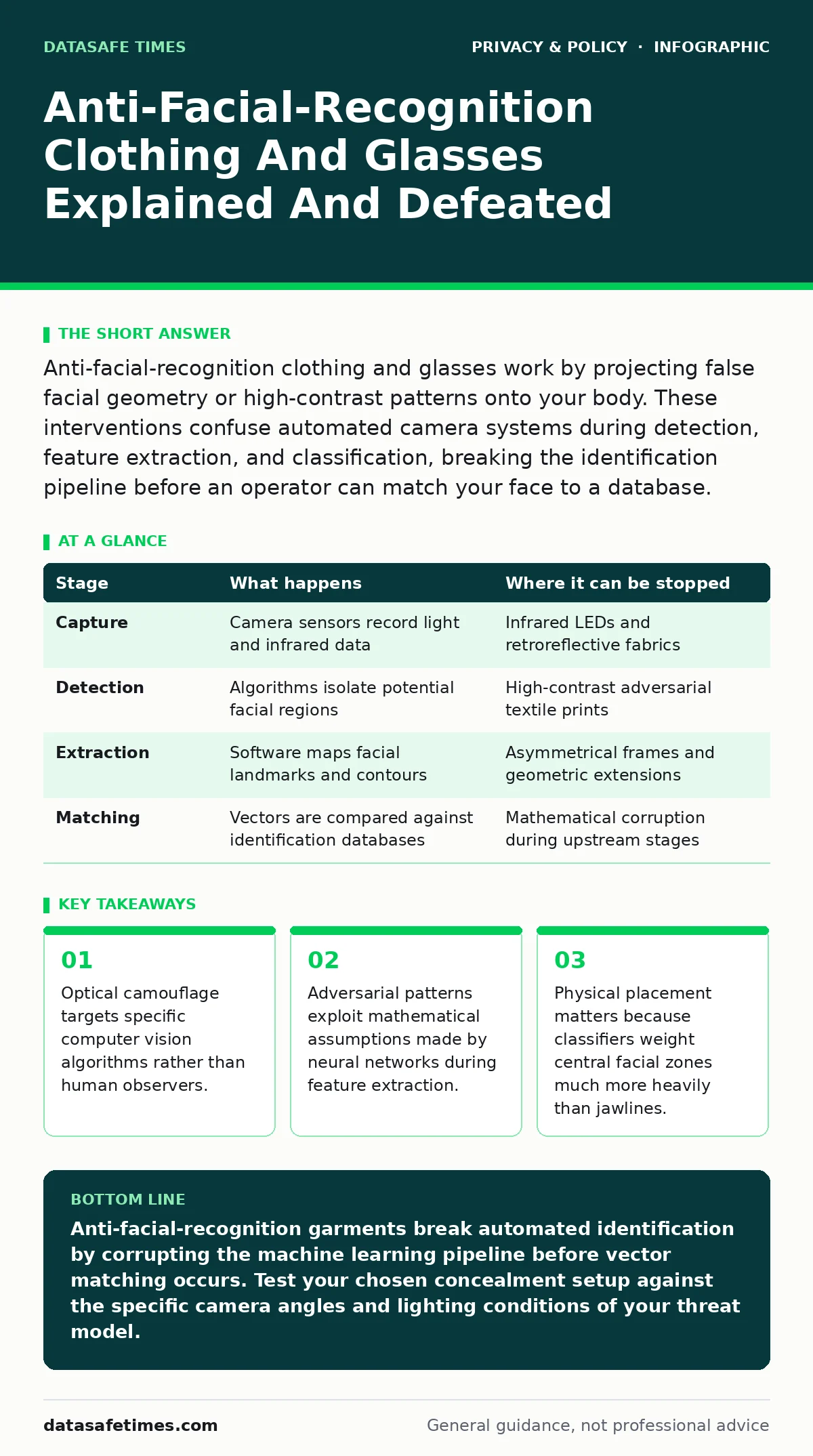
Anti-facial-recognition clothing and glasses work by projecting false facial geometry or high-contrast patterns onto your body. These interventions confuse automated camera systems during detection, feature extraction, and classification, breaking the identification pipeline before an operator can match your face to a database.
How Automated Systems Process Visual Input
Computer vision systems process human subjects through a rigid pipeline that transforms raw pixels into structured identity data. Automated identification relies on rapid image capture, face detection, feature extraction, and vector matching against known templates. Software developers building these systems often overlook how easily physical distortions break the mathematical assumptions embedded in neural network weights. Ad blockers clear digital trackers from your browser, but physical privacy requires manipulating the light and geometry entering a camera lens.
Stage 1: Image Capture and Sensor Exposure
Digital cameras convert photons into electrical signals using an array of light-sensitive elements behind a lens. Automated surveillance hardware triggers capture routines based on motion thresholds, infrared illumination, or continuous frame-rate sampling. Anti-facial-recognition clothing interrupts this initial stage by reflecting, absorbing, or scattering the specific wavelengths used by the camera sensor. Infrared LEDs embedded in frames or caps flood the sensor with localized overexposure, blinding the automatic gain control and rendering the surrounding facial features completely invisible in the captured frame.
Stage 2: Face Detection and Bounding Box Generation
Face detection algorithms scan the captured frame to locate regions containing human facial structures. Haarcascade classifiers and deep learning models search for specific spatial relationships, such as the darker regions of eye sockets compared to the bridge of the nose. Adversarial patches printed on fabric disrupt this stage by placing high-contrast geometric shapes across the cheekbones and forehead. These printed patterns create false positive gradients that trick the detector into drawing a bounding box around inanimate clothing rather than your actual skin.
Stage 3: Feature Extraction and Landmark Mapping
Feature extraction isolates distinct anatomical markers, measuring distances between the pupils, the width of the nose, and the contour of the jawline. Neural networks convert these anatomical measurements into a high-dimensional vector representing facial geometry. Specially designed frames with asymmetrical physical extensions alter the perceived contours of your face to the camera. This geometric deception feeds the feature extractor corrupted spatial coordinates, resulting in a mathematical vector that bears no resemblance to your actual facial profile.
Stage 4: Classification and Database Matching
Classification compares the extracted vector against a repository of enrolled identities using distance metrics in vector space. Automated identification fails at this final hurdle because the preceding stages already corrupted the input data beyond recognition. If the system cannot reliably map landmarks or isolate a clean bounding box, the resulting vector falls outside the matching threshold. Workplace monitoring systems often rely on similar classification logic to track employee movement, making physical optical disruptions a versatile countermeasure across different environments.
| Stage | What happens | Where it can be stopped |
|---|---|---|
| Capture | Camera sensors record light and infrared data | Infrared LEDs and retroreflective fabrics |
| Detection | Algorithms isolate potential facial regions | High-contrast adversarial textile prints |
| Extraction | Software maps facial landmarks and contours | Asymmetrical frames and geometric extensions |
| Matching | Vectors are compared against identification databases | Mathematical corruption during upstream stages |
The Mechanics of Infrared Saturation
Infrared illumination relies on invisible light sources that illuminate subjects in dark environments without alerting human targets. Custom frames equipped with near-infrared emitters project invisible beams directly into the aperture of a surveillance lens. This targeted blinding technique creates a wash-out effect that conceals facial features while remaining imperceptible to the naked eye. Police officers and security guards cannot spot the interference because humans lack sensitivity to the specific near-infrared spectrum utilized by these concealment frames.
Hidden Flaws and Environmental Limits
Physical privacy gear introduces distinct operational trade-offs that limit practical utility in everyday settings. Infrared dazzlers require power sources, adding weight, bulk, and battery maintenance overhead to your daily wardrobe. Ambient lighting conditions drastically alter effectiveness, as direct sunlight can wash out infrared signals while heavy rain scatters projected patterns. Furthermore, advanced classifiers trained on multi-spectral imagery can bypass simple optical disruptions by falling back on thermal signatures or gait analysis.
Key takeaways
- Optical camouflage targets specific computer vision algorithms rather than human observers.
- Adversarial patterns exploit mathematical assumptions made by neural networks during feature extraction.
- Physical placement matters because classifiers weight central facial zones much more heavily than jawlines.
Anti-facial-recognition garments break automated identification by corrupting the machine learning pipeline before vector matching occurs. Test your chosen concealment setup against the specific camera angles and lighting conditions of your threat model.
Frequently asked questions
Do anti-facial-recognition glasses stop human security guards?
No, these tools only confuse automated computer vision systems and software classifiers, leaving you completely visible to human observers.
Can normal clothing hide you from facial recognition?
Standard clothing does not disrupt facial recognition unless it features specific adversarial patterns or infrared emitters engineered to trick neural networks.
Are anti-facial-recognition items legal to wear in public?
Legality varies significantly by jurisdiction, with some municipalities explicitly banning face concealment devices during public gatherings and protests.
Does wearing a printed pattern protect your entire body?
Adversarial patterns only protect the specific areas where the geometry is placed, meaning classifiers can still identify unmasked body parts or gaits.
How this guide was produced: written by the DataSafe Times editorial team with AI assistance, checked against the public references listed below, and reviewed when the facts change. See our editorial policy or report an error.