
Cookie consent management involves matching user preference signals with client-side execution logic, but many developers confuse storing a choice with actively preventing storage mechanisms from running until explicit permission arrives.
Misreading: Saving a preference automatically halts network requests
Correct reading: Storing a boolean value in local storage changes nothing about network calls unless custom event listeners intercept every subsequent fetch operation. Consent frameworks record user intent inside a browser database, yet application code must actively read that flag before dispatching telemetry. Building robust gating requires wrapping native networking methods to inspect permission states before packets leave the device.
Applications treating consent as a passive database entry leave users vulnerable to unauthorized data flows. Developers frequently overlook how online tracking persists when asynchronous scripts execute independently of preference storage routines.
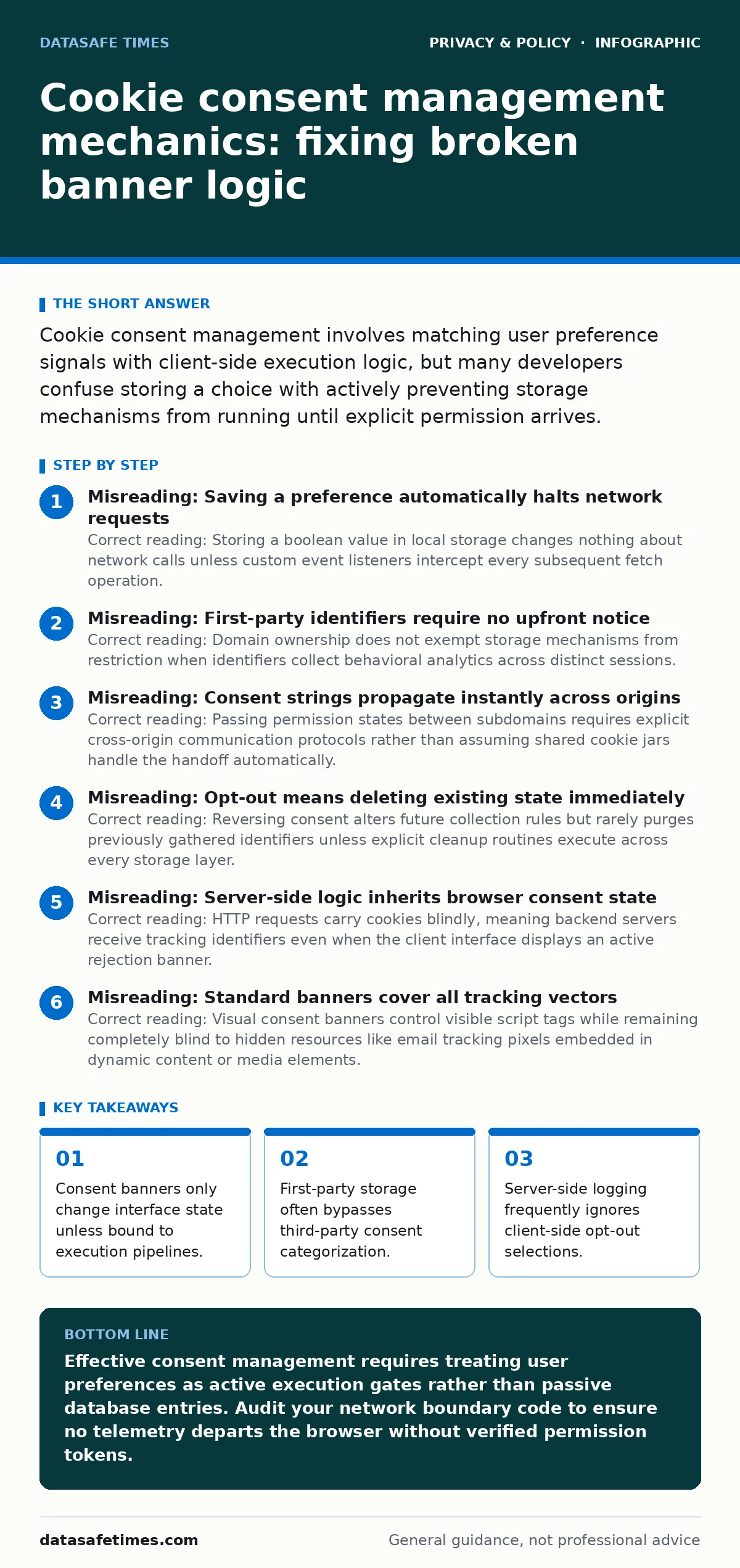
Misreading: First-party identifiers require no upfront notice
Correct reading: Domain ownership does not exempt storage mechanisms from restriction when identifiers collect behavioral analytics across distinct sessions. Regulators scrutinize any persistent string used for profiling, regardless of whether the domain matches the address bar. Developers often group session tokens with authentication cookies, failing to separate functional requirements from optional analytics.
Processing personal data demands strict purpose limitation, meaning a token gathered for login security cannot legally feed recommendation engines without distinct authorization. Treating all first-party storage as inherently exempt creates massive compliance gaps that standard auditing tools catch instantly.
Misreading: Consent strings propagate instantly across origins
Correct reading: Passing permission states between subdomains requires explicit cross-origin communication protocols rather than assuming shared cookie jars handle the handoff automatically. Modern browser privacy partitions isolate storage by top-level site, breaking traditional iframe-based sync methods. Engineers must explicitly construct post-message bridges to synchronize user choices across separate web properties.
Imagine a user opting out on a marketing landing page, only to find tracking active on a subdomain blog because the distinct origin never received the preference payload. Multi-site architectures demand centralized authorization endpoints that issue cryptographic tokens confirming user choices across every managed domain.
Misreading: Opt-out means deleting existing state immediately
Correct reading: Reversing consent alters future collection rules but rarely purges previously gathered identifiers unless explicit cleanup routines execute across every storage layer. Browser storage includes multiple persistence tiers, including relational databases and cache caches, which retain data long after a user clicks reject. Codebases must actively iterate through storage APIs to purge residual identifiers upon revocation.
Failing to clear historical records turns an opt-out into a simple pause button, leaving past metrics accessible to analytics pipelines. Developers must implement cascading deletion functions that target local databases, session caches, andIndexedDB records simultaneously when users withdraw permission.
Misreading: Server-side logic inherits browser consent state
Correct reading: HTTP requests carry cookies blindly, meaning backend servers receive tracking identifiers even when the client interface displays an active rejection banner. Client-side preferences live in the browser DOM, entirely invisible to upstream servers unless explicitly forwarded via request headers. Architects must design API gateways to inspect custom consent headers before processing incoming telemetry.
Suppose an application routes tracking beacons directly to backend ingestion endpoints without checking client-side preference stores. The server ingests the payload dutifully, completely unaware that the user clicked reject on the browser screen moments prior.
Misreading: Standard banners cover all tracking vectors
Correct reading: Visual consent banners control visible script tags while remaining completely blind to hidden resources like email tracking pixels embedded in dynamic content or media elements. Modern web applications load assets from multiple third-party CDNs that operate outside the DOM manipulation scope of standard consent management platforms. Comprehensive governance requires auditing every asset inclusion vector across the entire codebase.
Key takeaways
- Consent banners only change interface state unless bound to execution pipelines.
- First-party storage often bypasses third-party consent categorization.
- Server-side logging frequently ignores client-side opt-out selections.
Effective consent management requires treating user preferences as active execution gates rather than passive database entries. Audit your network boundary code to ensure no telemetry departs the browser without verified permission tokens.
Frequently asked questions
What is a cookie consent banner?
A cookie consent banner is a user interface element that requests permission from visitors before deploying tracking technologies and storing identifiers in their browsers.
Why do consent banners fail to block trackers?
Consent banners fail when developers treat preference storage as the final step rather than building explicit code execution gates that halt network requests until permission arrives.
How do browsers isolate storage across domains?
Browsers isolate storage by top-level site to prevent cross-site tracking, which means preference choices on one domain do not automatically apply to subdomains or external origins.
What happens to old data when a user opts out?
Old data remains intact in browser storage layers unless the application actively triggers deletion routines across local databases and caches upon receiving the opt-out signal.
How this guide was produced: written by the DataSafe Times editorial team with AI assistance, checked against the public references listed below, and reviewed when the facts change. See our editorial policy or report an error.