
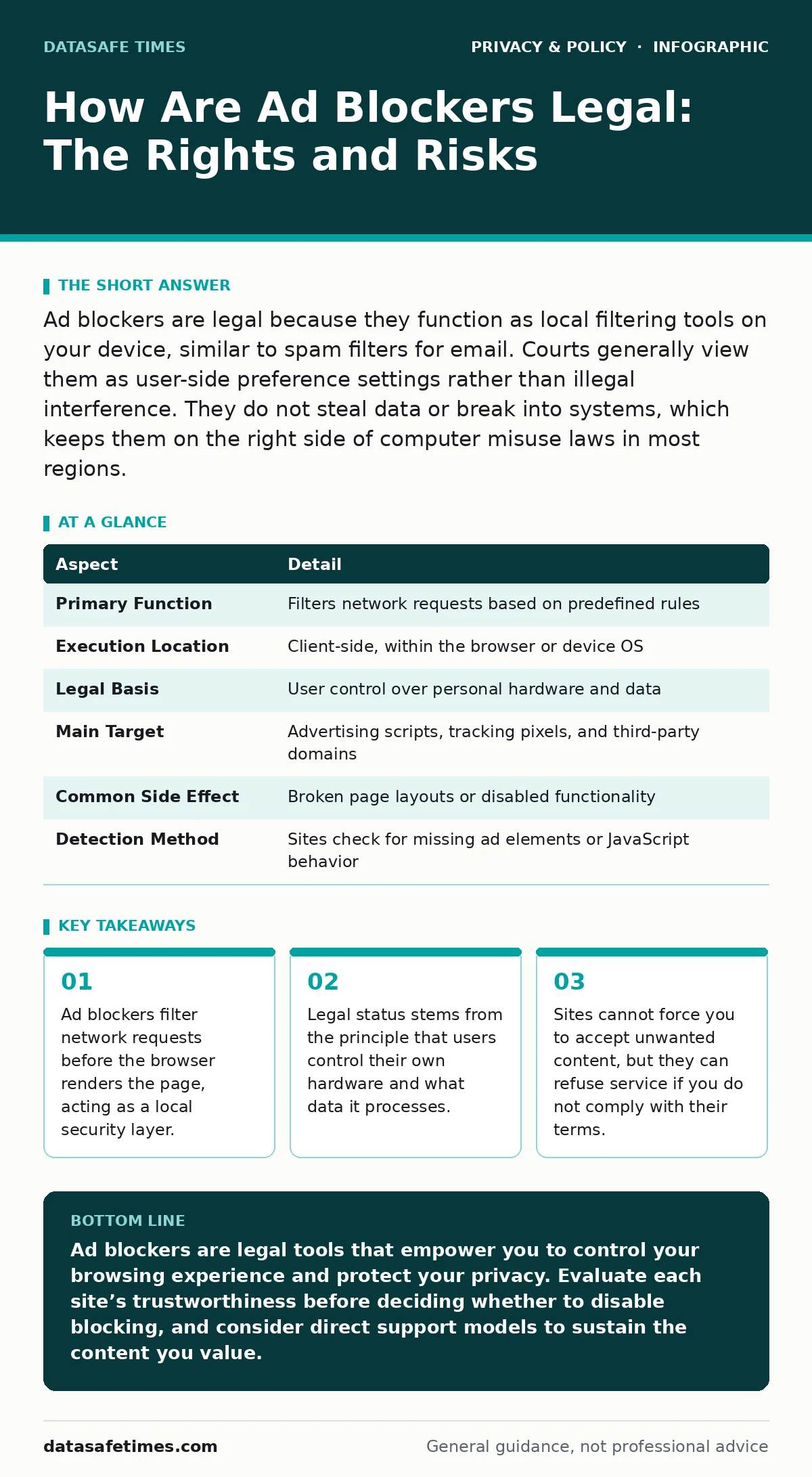
Ad blockers are legal because they function as local filtering tools on your device, similar to spam filters for email. Courts generally view them as user-side preference settings rather than illegal interference. They do not steal data or break into systems, which keeps them on the right side of computer misuse laws in most regions.
How Ad Blockers Work Technically
An ad blocker is a software extension or application that intercepts network requests made by your web browser. It compares these requests against a list of known advertising domains and content patterns. When a match occurs, the blocker prevents the browser from downloading the resource. This happens locally on your machine, not on the remote server. The server does not know you blocked the ad until it notices the missing revenue or analytics ping.
The mechanism relies on pattern matching and domain blacklists. Most blockers use public lists maintained by community volunteers. These lists identify scripts, images, and iframes associated with advertising networks. When your browser attempts to load a page, the blocker checks every single resource. If a resource matches a blocked pattern, the request is dropped. This reduces bandwidth usage and prevents tracking scripts from executing.
Imagine you are reading a news article. The page contains 50 images, 10 scripts, and 3 iframes. An ad blocker might block 15 of those requests. The remaining 48 resources load normally. You see the article, but you do not see the banner ads or the tracking pixels. The website server still sent the HTML code for the ads, but your browser never asked for the actual ad content. This distinction is critical for understanding why the practice is generally lawful.
At a Glance: Ad Blocker Mechanics
| Aspect | Detail |
|---|---|
| Primary Function | Filters network requests based on predefined rules |
| Execution Location | Client-side, within the browser or device OS |
| Legal Basis | User control over personal hardware and data |
| Main Target | Advertising scripts, tracking pixels, and third-party domains |
| Common Side Effect | Broken page layouts or disabled functionality |
| Detection Method | Sites check for missing ad elements or JavaScript behavior |
How Are Ad Blockers Legal
The question of how are ad blockers legal centers on the nature of the interaction between user and server. Your computer is your property. You have the right to decide what software runs on it and what data it processes. An ad blocker is a tool that exercises this right. It does not alter the website’s code on the server. It does not steal intellectual property. It simply declines to render certain content.
Courts in multiple jurisdictions have upheld this view. The legal argument rests on the distinction between active interference and passive refusal. Active interference would involve injecting malicious code or disrupting the server’s operation. Passive refusal is simply not requesting specific resources. Since the website voluntarily serves ads to anyone who asks, and you choose not to ask, no contract is broken. The website’s terms of service may prohibit ad blocking, but violating terms of service is a breach of contract, not a criminal act in most cases.
This legal standing protects users who wish to maintain digital privacy rights. By blocking ads, you also block the trackers that often accompany them. This aligns with the broader legal principle that individuals have a right to control their personal information. While websites may dislike the loss of revenue, the law does not currently mandate that users must accept all content served to them.
Who Is Affected by Blocking
The primary impact falls on website publishers and advertising networks. Publishers lose revenue when ads are not displayed. This can lead to reduced content quality or increased paywalls. Advertising networks lose data on user behavior. They cannot track where you go or what you click. This disrupts their ability to target ads effectively.
Users benefit from faster page loads and reduced exposure to malware. Many ads contain malicious scripts or lead to deceptive sites. Blocking them reduces the attack surface of your browser. However, users may also experience broken functionality. Some websites rely on ad scripts to load other features. Blocking these scripts can prevent videos from playing or forms from submitting. This is a technical trade-off, not a legal one.
The ecosystem shifts when large numbers of users block ads. Publishers may implement anti-adblock measures. These measures detect the absence of ad elements and display a message asking you to disable the blocker. This creates a cat-and-mouse game. The legal boundary here is clear: the site can refuse service, but it cannot force you to disable the blocker. You can choose to leave the site rather than comply.
What to Do About Detection and Restrictions
Websites use various methods to detect ad blockers. They may check if an ad container exists in the page code. They may monitor for JavaScript errors that occur when ad scripts are blocked. Some sites use complex heuristics to identify unusual network behavior. When detection occurs, the site may overlay a warning message. It may also prevent you from viewing the content.
You have several options. You can disable the ad blocker for that specific site. This restores functionality but exposes you to ads and trackers. You can use a more sophisticated blocker that tries to mimic normal behavior. Some blockers allow you to whitelist specific domains. This lets you support sites you trust while blocking ads elsewhere. Another option is to use a browser that has built-in tracking protection. This reduces the need for separate extensions.
Consider the trade-offs carefully. Disabling protection on a news site may seem minor, but it exposes you to the same trackers across the web. These trackers can build a profile of your interests and habits. This is why understanding online tracking is necessary. You are not just blocking an image; you are preventing a data collection point from activating. The choice is between convenience and privacy.
What People Usually Get Wrong
Many users believe ad blockers are illegal because they "steal" content. This is incorrect. The content is not stolen; it is simply not requested. Another common misconception is that ad blockers are only for privacy. While they do enhance privacy, their primary function is to remove unwanted content. Speed and security are also major benefits.
Users often think that disabling an ad blocker is the only way to support a site. This is not true. Many sites offer subscription models or one-time donations. These methods support creators without requiring you to accept ads. Some sites even offer ad-free experiences for subscribers. This is a sustainable model that respects user choice.
Another error is assuming all ad blockers are the same. Different tools use different lists and methods. Some are more aggressive than others. Some may break more sites than others. Choosing the right tool requires understanding your priorities. If speed is key, a lightweight blocker may suffice. If privacy is key, a blocker with strict tracking protection is better.
The Future of Web Blocking
The legal landscape for ad blockers remains stable, but technical challenges grow. Websites are becoming more sophisticated in their detection methods. They are also moving towards more intrusive forms of monetization. This may push users toward more aggressive blocking tools. Some browsers are now integrating ad blocking by default. This shifts the burden from extensions to the browser itself.
This trend reinforces the legal standing of ad blocking. If browser manufacturers include it, it signals that the practice is normal and acceptable. It also reduces the friction for users. They do not need to install separate software. The protection is built into the tool they already use. This may lead to wider adoption and further changes in how websites monetize content.
As technology evolves, the balance between user control and publisher revenue will continue to shift. New models may emerge that do not rely on intrusive ads. Subscription services, sponsored content, and direct donations are already growing. These models respect user choice while providing revenue. The legal framework will likely adapt to support these new interactions, but the core principle remains: you control your device.
Key takeaways
- Ad blockers filter network requests before the browser renders the page, acting as a local security layer.
- Legal status stems from the principle that users control their own hardware and what data it processes.
- Sites cannot force you to accept unwanted content, but they can refuse service if you do not comply with their terms.
Ad blockers are legal tools that empower you to control your browsing experience and protect your privacy. Evaluate each site’s trustworthiness before deciding whether to disable blocking, and consider direct support models to sustain the content you value.
Frequently asked questions
Can a website sue me for using an ad blocker?
No, individual users are generally protected by consumer rights and the principle of user control over personal hardware.
Do ad blockers violate the DMCA?
No, ad blockers do not circumvent copyright protection; they simply prevent the loading of specific content resources.
Are ad blockers legal in Europe?
Yes, European courts have upheld the legality of ad blockers, viewing them as a legitimate exercise of user rights.
Can my employer monitor my ad blocker usage?
Employers can monitor network traffic on company devices, but they cannot legally force you to disable personal tools on private devices.
How this guide was produced: written by the DataSafe Times editorial team with AI assistance, checked against the public references listed below, and reviewed when the facts change. See our editorial policy or report an error.