
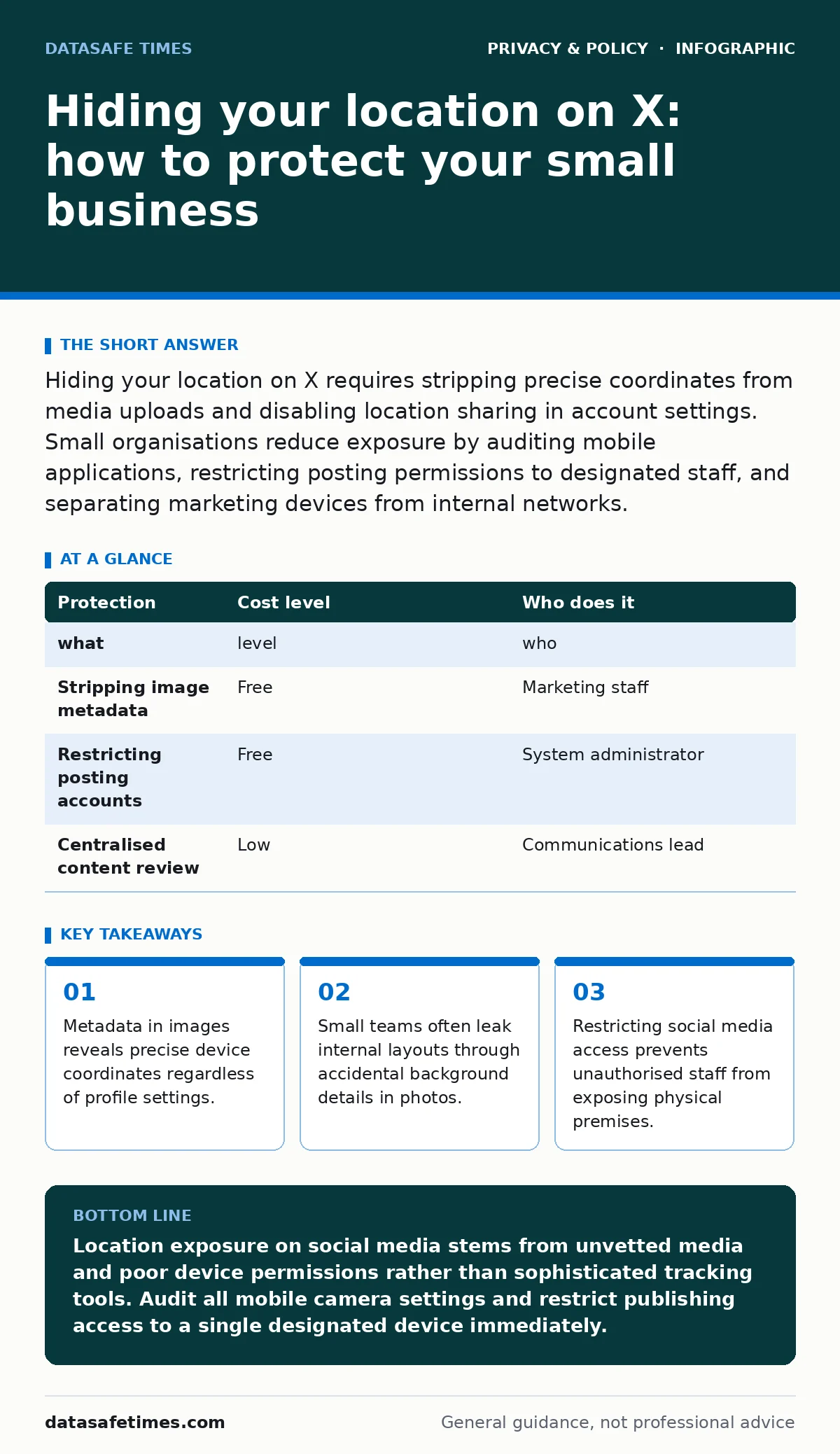
Hiding your location on X requires stripping precise coordinates from media uploads and disabling location sharing in account settings. Small organisations reduce exposure by auditing mobile applications, restricting posting permissions to designated staff, and separating marketing devices from internal networks.
Why Small Organisations Face Unique Exposure
Small businesses face high exposure on social media because marketing duties often fall to multiple staff members using personal devices. Personal phones automatically embed precise GPS coordinates into every captured image unless explicitly disabled at the operating system level.
Larger corporations typically route all public communications through dedicated marketing departments enforcing strict asset management policies. Small teams lack these layers, meaning a single casual snapshot can broadcast operational layouts, equipment types, and exact street locations to anyone parsing the raw file.
External observers can correlate this visual data with public registries to map physical entry points and internal network perimeters. Attackers rarely need sophisticated signals intelligence when employees willingly publish high-resolution images containing building security badges, server room doors, and unredacted whiteboards.
Understanding Location Leaks Beyond Geotags
Geotags represent only one vector for physical exposure on public platforms. Visual background leakage often reveals sensitive infrastructure details that automated tools cannot scrub.
Window reflections in office photos frequently display street signs, neighbouring structures, or internal desk arrangements. Acoustic signatures in short video clips can identify specific HVAC units or proximity to busy transit hubs.
Metadata scrubbing removes digital coordinates, but visual analysis requires human attention before publication. Staff members must inspect every frame for identifying markers before uploading media to public timelines.
Low-Cost Protections for Lean Teams
Protecting a small organisation from location tracking relies on procedural discipline rather than expensive software licenses. Simple operational changes eliminate the vast majority of accidental disclosures without slowing down daily publishing workflows.
| Protection | Cost level | Who does it |
|---|---|---|
| what | level | who |
| Stripping image metadata | Free | Marketing staff |
| Restricting posting accounts | Free | System administrator |
| Centralised content review | Low | Communications lead |
Stripping metadata requires disabling location services for the camera application on all devices used for company social media accounts. Alternatively, staff can run images through dedicated file metadata removal tools before transfer, ensuring no hidden data travels alongside the visual asset.
Restricting account access limits the blast radius of a compromised or careless credential. Only designated individuals should possess the ability to publish from the official organisational profile, reducing the number of people who might accidentally share sensitive workplace views.
Hidden Costs of Location Sharing
Enabling location features on social media profiles creates persistent tracking vectors that outlive individual posts. Platforms frequently log historical position data to build behavioral profiles, which creates secondary repositories of organisational movement over time.
Third-party analytics tools often scrape public timelines to aggregate corporate travel patterns and office hours. This aggregated intelligence helps malicious actors determine when buildings remain empty, creating physical security risks that standard cybersecurity tools cannot mitigate.
Furthermore, mixing personal accounts with professional duties blurs operational boundaries. If an employee logs into the corporate profile from a personal device that broadcasts real-time positioning, the corporate presence inherits that vulnerability.
What to Ask Your IT Provider
Small organisations relying on outsourced technical support must ask precise questions regarding social media infrastructure and device management. Generic cybersecurity contracts rarely cover social media hygiene unless explicitly requested by management.
- How do you manage camera permissions and metadata generation on mobile devices assigned to marketing staff?
- What mechanisms prevent employees from installing unauthorised social media applications on hardware connected to internal networks?
- How do you handle file metadata removal when staff members submit promotional imagery for publishing?
- What protocols exist for monitoring unauthorized organisational accounts created by rogue employees?
Clear answers to these questions establish baseline accountability for physical and digital security alike. Technical providers should offer concrete procedures for enforcing least-privilege access across all public-facing communication channels.
Balancing Marketing Reach with Operational Security
Balancing visibility with safety demands deliberate choices about what the organisation shares with the public. Marketing strategies often demand authenticity, but authenticity should never compromise physical security boundaries.
Public communications should rely on pre-approved image libraries rather than spontaneous snapshots taken inside operational workspaces. This separation ensures that every published asset undergoes proper review for accidental disclosures before reaching the public domain.
Reviewing historical posts periodically helps identify past leaks that might still provide useful intelligence to observers. Removing outdated content limits the window of exposure and reduces the accumulation of searchable operational history.
Key takeaways
- Metadata in images reveals precise device coordinates regardless of profile settings.
- Small teams often leak internal layouts through accidental background details in photos.
- Restricting social media access prevents unauthorised staff from exposing physical premises.
Location exposure on social media stems from unvetted media and poor device permissions rather than sophisticated tracking tools. Audit all mobile camera settings and restrict publishing access to a single designated device immediately.
Frequently asked questions
Does turning off location services in the X application completely hide my coordinates?
No, because modern smartphones embed GPS coordinates directly into image files at the moment of capture, meaning the platform receives location data regardless of app-specific permissions if the camera app itself retains access.
Can a virtual private network hide my physical location while posting on social media?
A virtual private network routes your internet traffic through a remote server to mask your IP address, but it does nothing to prevent image metadata or manual check-ins from revealing your exact whereabouts.
How do I remove metadata from images before publishing them online?
You can strip metadata by using built-in operating system property windows to clear personal information, or by using dedicated utility software designed to scrub EXIF data prior to upload.
Are location disclosures a risk for companies without physical offices?
Distributed teams still face exposure risks when remote workers post photos from home offices, as background details can reveal residential streets and personal routines.
How this guide was produced: written by the DataSafe Times editorial team with AI assistance, checked against the public references listed below, and reviewed when the facts change. See our editorial policy or report an error.