
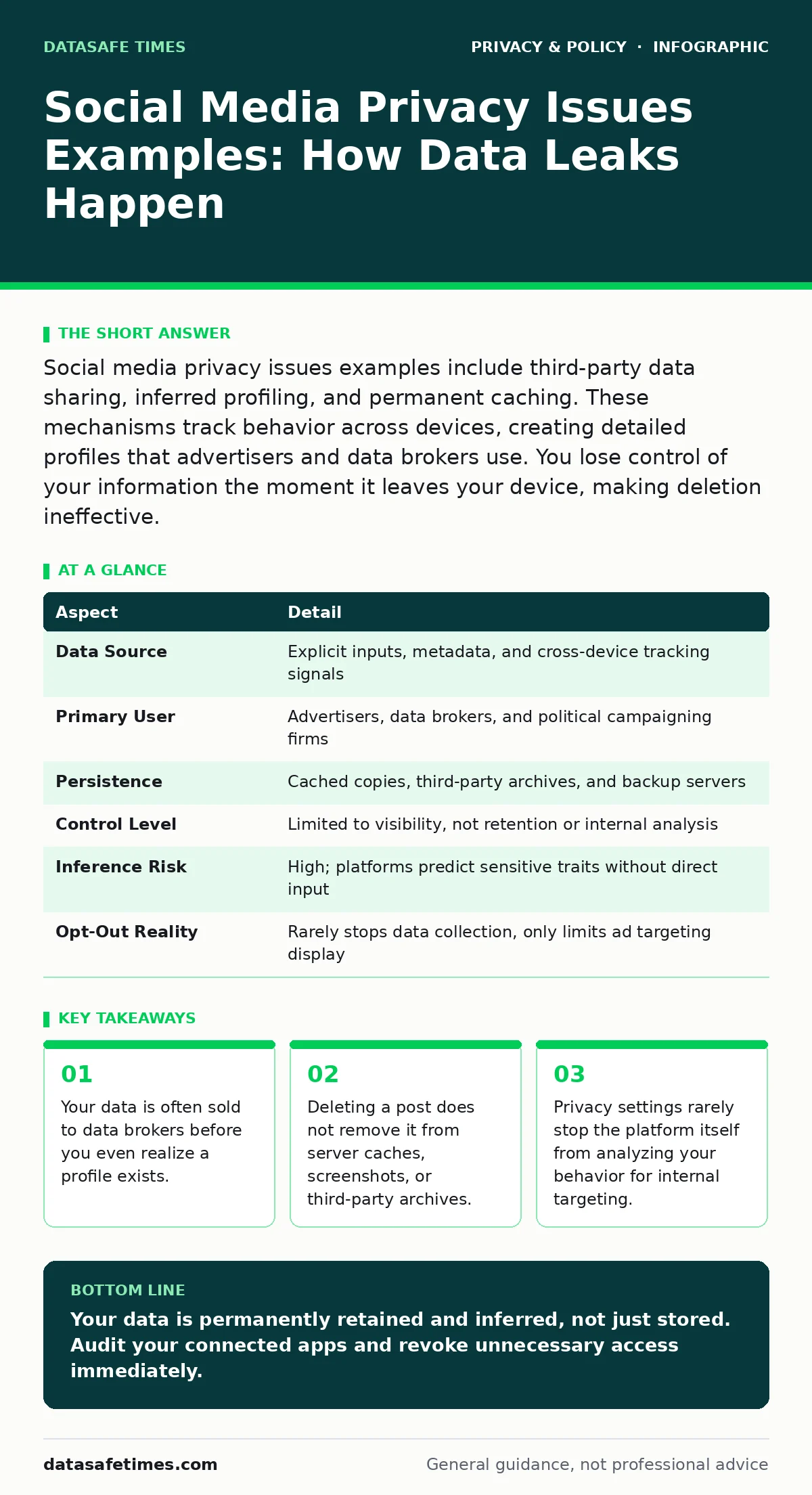
Social media privacy issues examples include third-party data sharing, inferred profiling, and permanent caching. These mechanisms track behavior across devices, creating detailed profiles that advertisers and data brokers use. You lose control of your information the moment it leaves your device, making deletion ineffective.
Understanding the Mechanism of Social Media Privacy Issues Examples
Social media privacy issues examples reveal a system designed to capture attention and sell access to that attention. The core mechanism is not simple data collection; it is behavioral inference. Platforms do not just store what you type. They analyze how long you hover over an image, which links you ignore, and the time of day you are most active. This metadata creates a psychological profile that is often more valuable than your explicit content.
Imagine a library that does not just record which books you check out. It records how long you stare at a book before putting it back, which sections you walk past quickly, and which friends you discuss those books with. That library then sells a report on your potential future purchases to publishers. This is the basic economic model of most social networks. The product is not the service; the product is the prediction of your behavior.
| Aspect | Detail |
|---|---|
| Data Source | Explicit inputs, metadata, and cross-device tracking signals |
| Primary User | Advertisers, data brokers, and political campaigning firms |
| Persistence | Cached copies, third-party archives, and backup servers |
| Control Level | Limited to visibility, not retention or internal analysis |
| Inference Risk | High; platforms predict sensitive traits without direct input |
| Opt-Out Reality | Rarely stops data collection, only limits ad targeting display |
How Inferred Profiling Works Beyond Posts
The most significant risk is not that someone reads your posts. The risk is that algorithms infer private facts you never stated. Machine learning models correlate seemingly harmless actions to predict sensitive attributes. If you view articles about pregnancy, join a local community group, and change your profile picture style, the system may infer a pregnancy before you announce it. This inference happens on the server side, often in real time.
This process relies on cross-referencing data points from multiple sources. Your location history, your purchase history linked via email, and your social graph are combined. The result is a shadow profile. A shadow profile exists even if you never created an account on the platform. If your friends upload photos containing you, or if you visit the platform via a third-party app, data is collected. This means abstinence from the platform does not guarantee privacy.
The Illusion of Deletion and Data Persistence
Users often assume that deleting a post removes it from existence. This assumption is incorrect. When you delete content, the platform may keep a cached copy for server efficiency, legal compliance, or machine learning training. These caches are not always accessible to users but remain part of the dataset. Furthermore, other users may have taken screenshots, archived links, or used third-party tools to save the content.
Third-party data brokers aggregate information from public sources and sell it. Once your data enters this ecosystem, you cannot delete it. You can request removal from some brokers, but the data often reappears from other sources. This creates a permanent digital footprint. The concept of "right to be forgotten" is legally complex and technically difficult to enforce across global servers. Your past behavior remains a factor in future profiling, regardless of your current activity.
Who Is Most Affected by These Risks
The impact is not evenly distributed. Public figures, journalists, and activists face direct surveillance risks. However, the average user faces economic and manipulative risks. The algorithm is designed to maximize engagement, often by promoting content that triggers emotional responses. This can lead to radicalization, anxiety, or financial loss through targeted scams.
Developers and technical users are not immune. They often interact with platforms via APIs or third-party integrations. These integrations can expose session tokens, user IDs, and connection graphs. A single compromised application can reveal the entire social graph of a user. This means that technical sophistication does not guarantee safety. The attack surface is the platform itself, which holds the keys to your identity.
Common Misconceptions About Privacy Controls
Many users believe that private browsing mode protects their social media activity. Private browsing mode only prevents the local device from saving history and cookies. It does not hide your activity from the website you are visiting. The platform still sees your IP address, your device fingerprint, and your actions. For true anonymity, different tools are required, but these are rarely integrated into standard social media usage.
Another misconception is that strong passwords prevent data leaks. Passwords protect access, not data retention. If the platform has already collected and analyzed your data, a strong password does not retroactively delete that analysis. Similarly, disabling location services on your phone does not stop the platform from inferring your location through IP address or check-in data from friends.
Practical Steps to Limit Exposure
You cannot stop all data collection, but you can increase the cost and reduce the accuracy of profiling. Start by auditing connected applications. Revoke access for apps you no longer use. Each connected app is a potential leak point for your social graph and personal details. Check the privacy settings of each platform regularly, as defaults often change to collect more data.
Use separate email addresses for social media accounts. This prevents the platform from linking your social identity to your primary professional or personal email. Consider using encrypted messaging apps for sensitive conversations instead of social media direct messages. Social media DMs are often stored on the provider’s servers without end-to-end encryption, meaning the provider can access them.
The Role of External Standards and Tools
Regulations like GDPR provide a framework for data rights, but enforcement is uneven. These laws give you the right to request data deletion and portability. However, the process is often bureaucratic and slow. While these rights are valuable, they are reactive. You must actively exercise them. Proactive measures are more effective than relying on legal recourse after a breach or unwanted exposure.
Technical tools can help mitigate some risks. DNS over HTTPS encrypts your domain lookups, preventing local network observers from seeing which sites you visit. However, this does not hide your activity from the destination server. For storing sensitive files, encrypted cloud storage ensures that even the provider cannot read your content. Social media platforms do not offer this level of encryption for user posts.
Navigating the Trade-Offs of Connectivity
The fundamental trade-off is convenience versus privacy. Social media offers connection, discovery, and professional networking. Privacy measures add friction. You must choose which data you are willing to share. There is no perfect solution. Every action on a social platform generates data. The goal is to minimize the sensitivity of that data and limit the duration of its retention.
Understanding these social media privacy issues examples allows you to make informed choices. You can participate while limiting your footprint. You can use platforms for specific purposes while avoiding others. The key is awareness. Recognize that the platform is a data harvester. Treat every interaction as a transaction where you pay with information.
Key takeaways
- Your data is often sold to data brokers before you even realize a profile exists.
- Deleting a post does not remove it from server caches, screenshots, or third-party archives.
- Privacy settings rarely stop the platform itself from analyzing your behavior for internal targeting.
Your data is permanently retained and inferred, not just stored. Audit your connected apps and revoke unnecessary access immediately.
Frequently asked questions
Does deleting my social media account erase all my data?
No. Platforms often retain data for legal reasons, and third parties may have already copied or aggregated your information.
Can I stop a platform from tracking me if I have an account?
You can limit ad tracking, but the platform will still collect usage data to improve its service and algorithms.
Are private messages on social media secure?
Generally, no. Most social media platforms do not use end-to-end encryption by default for direct messages.
How do data brokers get my social media information?
They scrape public profiles, purchase data from partners, and aggregate information from various online sources.
How this guide was produced: written by the DataSafe Times editorial team with AI assistance, checked against the public references listed below, and reviewed when the facts change. See our editorial policy or report an error.