Location tracking captures physical coordinates through a continuous loop of radio signal emissions, ambient network association, and cloud-based triangulation. You can disrupt this cycle by denying background sensor access, severing persistent network links, and auditing application permissions regularly.
The Mechanics of Spatial Data Collection
Location data emerges from the constant negotiation between a mobile device and the surrounding electronic infrastructure. Hardware components continuously scan for nearby radio frequencies to maintain network connectivity. 3 distinct actors participate in this silent exchange: the device broadcasting identifiers, the access points capturing signals, and the background software logging proximity. Understanding this tripartite relationship reveals why turning off mapping software fails to stop spatial surveillance entirely.
Background software often bypasses explicit user interfaces by requesting continuous sensor telemetry under the guise of performance optimization. Software developers frequently underestimate how many ambient APIs request coordinates for telemetry unrelated to user features. Reviewing digital privacy rights helps clarify the legal boundaries of this data collection, though technical mitigation remains your primary defense against persistent logging.
Stage Analysis of the Tracking Pipeline
Stage 1: Signal Emission
Device radios constantly broadcast hardware addresses and temporary association tokens to announce presence to cellular towers and routers. This broadcast happens at the link layer before any application logic executes. 3 separate radio bands typically emit identifiers simultaneously: cellular, Wi-Fi, and Bluetooth. Each protocol exposes unique hardware signatures that remain stable over long periods unless randomized at the driver level.
Stage 2: Network Interception
Nearby infrastructure captures these broadcast packets and logs the received signal strength indicator alongside the device identifier. Routers operated by commercial entities routinely harvest these probes even when the device fails to complete a full network association handshake. Suppose a pedestrian walks past a storefront equipped with specialized sensor nodes; their device MAC address enters a local database instantly. This interception requires zero user interaction and ignores standard application permission dialogs.
Stage 3: Aggregation and Inference
Interceted probe logs travel from local infrastructure to cloud servers via continuous background data synchronization channels. Centralized aggregators cross-reference signal strengths against known geographic databases of fixed access points to calculate physical coordinates. 4 distinct triangulation data points resolve a precise location within meters. Machine learning models then process these spatial coordinates to infer sensitive personal routines, such as medical visits or political gatherings, entirely from raw radio metadata.
Stage 4: Storage and Monetization
Aggregated movement trajectories land in proprietary databases where automated broker networks package them for commercial syndication. Advertisers and analytics firms purchase these feeds to profile consumer habits across disparate physical environments. 2 primary monetization vectors drive this industry: real-time bidding for targeted physical advertising and historical movement analysis for macroeconomic forecasting. Once data enters these broker networks, exercising control becomes practically impossible without upstream prevention.
Interception Points in the Data Pipeline
Disrupting location telemetry requires targeted interventions at specific architectural boundaries within the operating system.
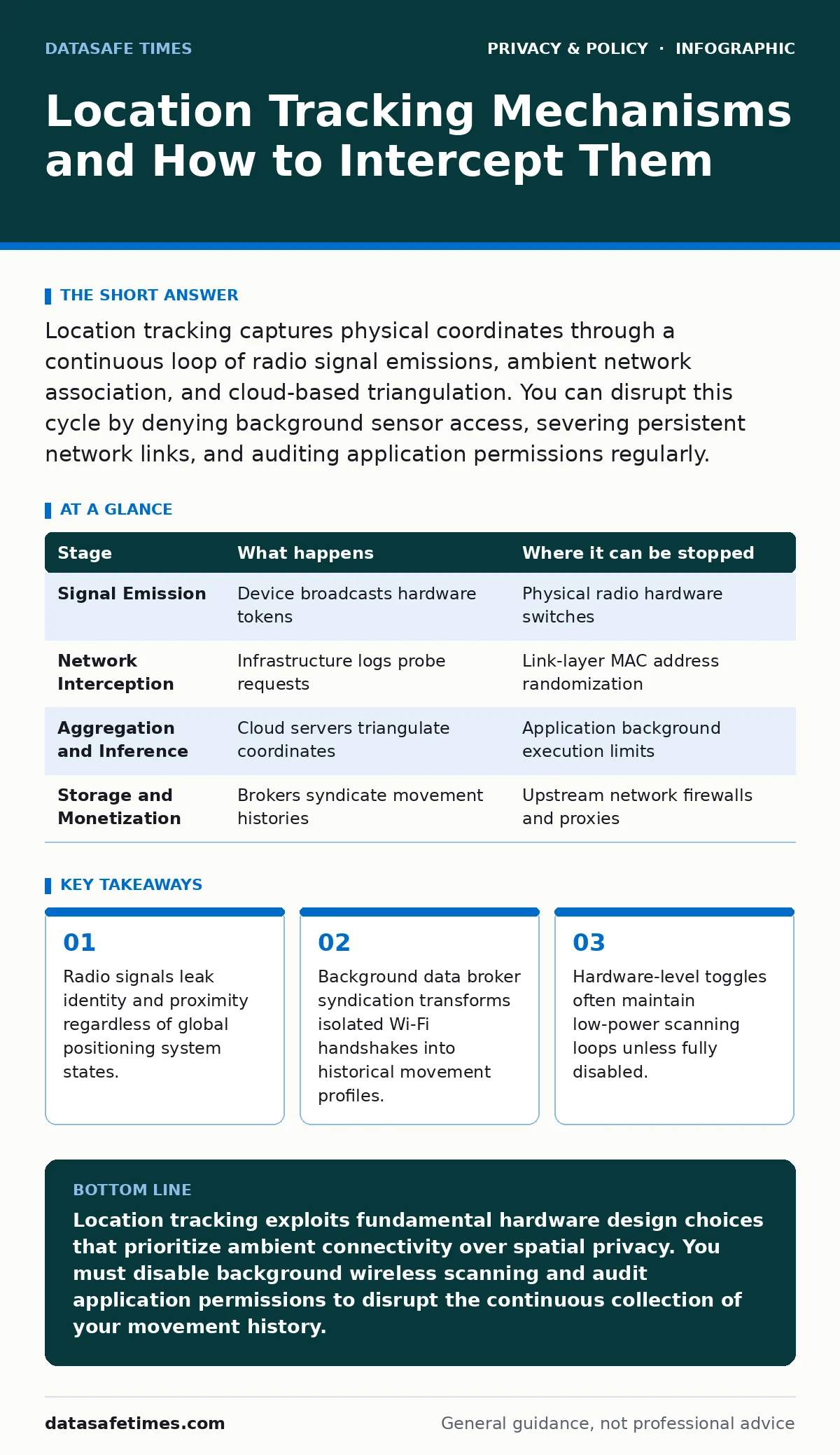
| Stage | What happens | Where it can be stopped |
|---|---|---|
| Signal Emission | Device broadcasts hardware tokens | Physical radio hardware switches |
| Network Interception | Infrastructure logs probe requests | Link-layer MAC address randomization |
| Aggregation and Inference | Cloud servers triangulate coordinates | Application background execution limits |
| Storage and Monetization | Brokers syndicate movement histories | Upstream network firewalls and proxies |
Hidden Costs of Ambient Sensor Sweeps
Continuous background scanning introduces severe thermal and battery penalties that device manufacturers rarely attribute to telemetry software. Operating system kernels expend noticeable energy waking baseband processors to listen for beacons, which shortens overall hardware lifespan. Furthermore, leaking ambient network lists creates a distinct correlation risk where an adversary maps your historical trajectory simply by observing which routers your device probes in public spaces.
Applications that route traffic through encrypted messaging apps sometimes leak location metadata if the underlying operating system permits unconstrained sensor access to auxiliary libraries. Developers must isolate location-handling modules inside strict permission sandboxes to prevent secondary software development kits from siphoning spatial data without authorization. Ignoring this architectural separation turns seemingly secure applications into silent location beacons.
Why Standard Permission Prompts Fail
Operating system permission dialogs present a false dichotomy by asking users to grant or deny location access permanently. Most people select temporary permission models, assuming applications stop harvesting coordinates once closed, but background services frequently respawn via push notification triggers. 2 separate permission states rarely convey whether an application caches historical coordinates locally before batch-uploading them during subsequent network handshakes.
Auditing system behavior requires inspecting outbound network connections with local packet inspection tools rather than relying on graphical permission toggles. People often assume private browsing mode prevents location leakage during web searches, but browser engines still query nearby Wi-Fi access points to accelerate geolocation fixes. Technical rigor demands disabling wireless scanning entirely rather than trusting software-level permission flags.
Key takeaways
- Radio signals leak identity and proximity regardless of global positioning system states.
- Background data broker syndication transforms isolated Wi-Fi handshakes into historical movement profiles.
- Hardware-level toggles often maintain low-power scanning loops unless fully disabled.
Location tracking exploits fundamental hardware design choices that prioritize ambient connectivity over spatial privacy. You must disable background wireless scanning and audit application permissions to disrupt the continuous collection of your movement history.
Frequently asked questions
Can turning off the global positioning system stop location tracking completely?
Disabling satellite positioning stops high-precision coordinate generation, but cellular tower triangulation and Wi-Fi probe logging continue to track device movement with regional accuracy.
How do applications access location data without explicit user prompts?
Software libraries often inherit ambient telemetry permissions from the host operating system or harvest approximate coordinates through IP address lookups during routine network requests.
Why do mobile devices broadcast hardware identifiers to unknown routers?
Mobile operating systems transmit probe requests continuously to check for known networks, allowing ambient infrastructure to log unique hardware tokens regardless of connection status.
What is the most effective way to prevent passive location harvesting?
Disabling background Wi-Fi and Bluetooth scanning in the operating system settings prevents devices from broadcasting probe requests to unknown infrastructure.
How this guide was produced: written by the DataSafe Times editorial team with AI assistance, checked against the public references listed below, and reviewed when the facts change. See our editorial policy or report an error.