
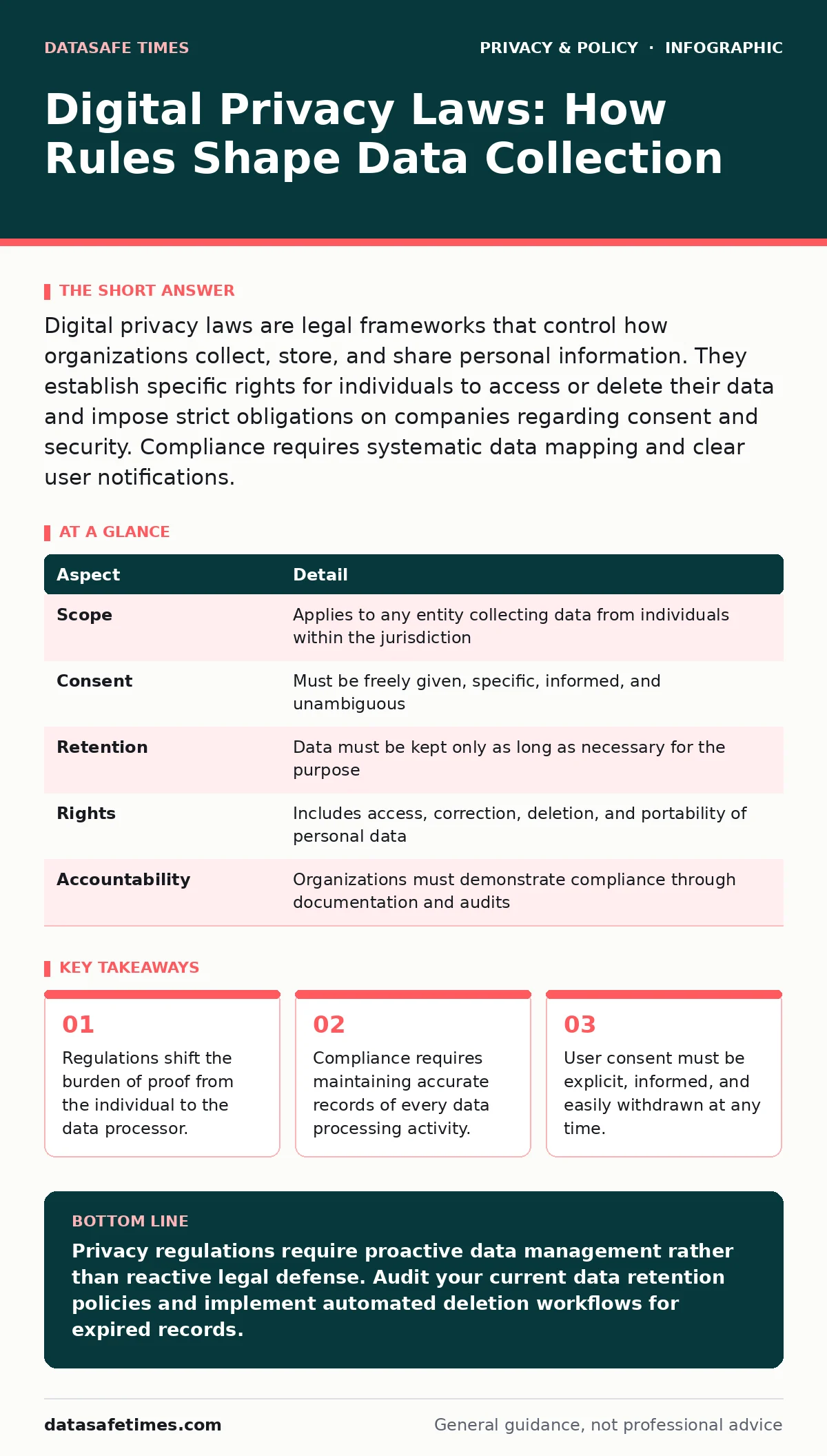
Digital privacy laws are legal frameworks that control how organizations collect, store, and share personal information. They establish specific rights for individuals to access or delete their data and impose strict obligations on companies regarding consent and security. Compliance requires systematic data mapping and clear user notifications.
The Foundation of Data Control
Imagine a library that keeps a record of every book you touch, even if you do not borrow it. Now imagine a rule that forces the library to delete that record if you ask, and to explain why they kept it in the first place. This analogy captures the core mechanism of digital privacy laws. These legal frameworks regulate how entities handle personal information, shifting power from data collectors to data subjects.
Digital privacy laws define personal data as any information that can identify a living person. This includes obvious identifiers like names and addresses, but also technical identifiers like IP addresses and device fingerprints. The laws mandate that organizations process this data only for specified, explicit, and legitimate purposes. They prohibit further processing that is incompatible with those original purposes.
| Aspect | Detail |
|---|---|
| Scope | Applies to any entity collecting data from individuals within the jurisdiction |
| Consent | Must be freely given, specific, informed, and unambiguous |
| Retention | Data must be kept only as long as necessary for the purpose |
| Rights | Includes access, correction, deletion, and portability of personal data |
| Accountability | Organizations must demonstrate compliance through documentation and audits |
How Digital Privacy Laws Work
The operational model of these regulations relies on accountability and transparency. Organizations cannot simply claim they have privacy policies; they must implement technical and organizational measures to enforce them. This means building systems that can locate, isolate, and delete specific user records upon request. It also means designing systems that minimize data collection from the start, a principle known as data minimization.
Data protection impact assessments are required for high-risk processing activities. These assessments evaluate the necessity and proportionality of processing, as well as the risks to the rights and freedoms of individuals. If the risks are significant, the organization must implement safeguards to mitigate them. This process forces engineering teams to consider privacy implications during the design phase, not as an afterthought.
The burden of proof rests on the data controller. If a regulator questions a practice, the organization must demonstrate why it was lawful. This reverses the traditional legal dynamic where the victim must prove harm. In the digital context, harm is often potential or statistical, making individual litigation difficult. These laws solve that by creating administrative enforcement mechanisms.
Who Is Affected by the Rules
The rules apply to any organization that processes personal data of individuals within the relevant jurisdiction. This includes technology companies, healthcare providers, financial institutions, and even small businesses with online presences. The definition of "processing" is broad, covering collection, storage, use, disclosure, and deletion. If your software interacts with user data, you are likely a data processor or controller.
Individuals are affected as data subjects. They gain specific rights regarding their information. They can request copies of their data, correct inaccuracies, and demand deletion. They can also object to certain types of processing, such as direct marketing or automated decision-making. These rights are not optional features; they are legal entitlements that organizations must facilitate.
Third-party vendors are also implicated. If you use a service provider to host your data or analyze it, you remain responsible for ensuring they comply with the same standards. Contracts must include specific clauses regarding data protection. This creates a chain of accountability that extends throughout the entire technology stack. Understanding your role in this chain is necessary for compliance.
Common Misconceptions About Compliance
Many organizations believe that a privacy policy satisfies legal requirements. This is incorrect. A policy is a disclosure document, not a compliance mechanism. The law requires actual practices that align with the policy. If your policy says you delete data after 30 days, but your database retains it for 3 years, you are in violation. The discrepancy between stated intent and technical reality is where most failures occur.
Another common error is assuming that anonymized data is always safe. True anonymization is difficult. If you can re-identify individuals by combining anonymized datasets, the data is still considered personal. Techniques like k-anonymity or differential privacy help, but they are complex to implement correctly. Relying on simple masking or hashing is often insufficient if the hash can be reversed or the mask removed.
Some believe that user consent is the only valid legal basis for processing. This is a misunderstanding of the framework. Legitimate interest under the GDPR, for instance, allows processing without explicit consent if it is necessary for the organization's legitimate interests and does not override the user's rights. This balance requires careful documentation and regular review. Misusing legitimate interest can lead to severe penalties.
Technical Implementation Strategies
Engineering privacy into systems requires specific architectural choices. Data classification is the first step. You must identify what constitutes personal data within your systems. This often involves scanning logs, databases, and backups for identifiable information. Automated tools can help, but manual review is necessary to catch edge cases.
Access controls must be granular. Not every employee needs access to all data. Role-based access control ensures that users only see what they need to do their jobs. Audit logs should record who accessed what data and when. These logs are critical for demonstrating accountability during audits or investigations.
Encryption is a standard safeguard. Data should be encrypted at rest and in transit. However, encryption alone does not solve privacy issues. If an attacker gains access to the decryption keys, the data is exposed. Key management is therefore a critical component of your security strategy. Regular key rotation reduces the window of exposure if a key is compromised.
See also: Encrypted Cloud Storage: How Zero-Knowledge Architecture Protects Files
Navigating Global Regulatory Differences
Organizations operating internationally face a complex web of regulations. Different jurisdictions have different requirements for consent, data transfer, and user rights. A practice that is legal in one country may be prohibited in another. This creates significant operational overhead for global technology companies.
Data transfer mechanisms are particularly challenging. Moving data across borders may require specific legal safeguards, such as standard contractual clauses. These clauses ensure that the receiving country provides an adequate level of protection. Changes in international law can invalidate previous transfer mechanisms, requiring rapid legal and technical adjustments.
Harmonization efforts exist, but they are incomplete. Organizations often adopt the strictest standard as their baseline to simplify compliance. This approach, known as the "gold standard," ensures that practices are acceptable in most jurisdictions. However, it may impose unnecessary costs on operations in regions with lighter regulations. Balancing compliance with efficiency is an ongoing challenge.
Maintaining Ongoing Compliance
Compliance is not a one-time project. It is a continuous process that requires regular review and updating. Data processing activities change as products evolve. New features often introduce new data collection points. Each change must be evaluated for its privacy impact.
Training employees is essential. Technical staff must understand the legal requirements to implement them correctly. Legal teams must understand the technical realities to draft enforceable policies. Collaboration between these groups prevents gaps in compliance. Regular audits help identify weaknesses before regulators do.
Documentation is your primary defense. Keep detailed records of data flows, consent mechanisms, and security measures. If a regulator asks for proof, you must be able to provide it quickly. Poor documentation can lead to penalties even if your practices were mostly compliant. Treat your compliance records with the same rigor as your source code.
Key takeaways
- Regulations shift the burden of proof from the individual to the data processor.
- Compliance requires maintaining accurate records of every data processing activity.
- User consent must be explicit, informed, and easily withdrawn at any time.
Privacy regulations require proactive data management rather than reactive legal defense. Audit your current data retention policies and implement automated deletion workflows for expired records.
Frequently asked questions
Do small businesses need to comply with digital privacy laws?
Yes, most regulations apply regardless of company size if they process personal data of individuals within the jurisdiction. Exemptions are rare and usually limited to purely personal or household activities.
What is the difference between data privacy and data security?
Data privacy concerns the proper handling, use, and disclosure of information, while data security focuses on protecting that information from unauthorized access or attacks. You can have secure data that is not private if it is used improperly.
Can I use legitimate interest for marketing emails?
It depends on the jurisdiction and the context. In many regions, explicit consent is required for direct marketing, especially via email. Legitimate interest is often insufficient for this specific use case.
How long should I keep user data?
You should keep data only as long as necessary to fulfill the purpose for which it was collected. Define specific retention periods for each data type and delete records automatically when they expire.
How this guide was produced: written by the DataSafe Times editorial team with AI assistance, checked against the public references listed below, and reviewed when the facts change. See our editorial policy or report an error.