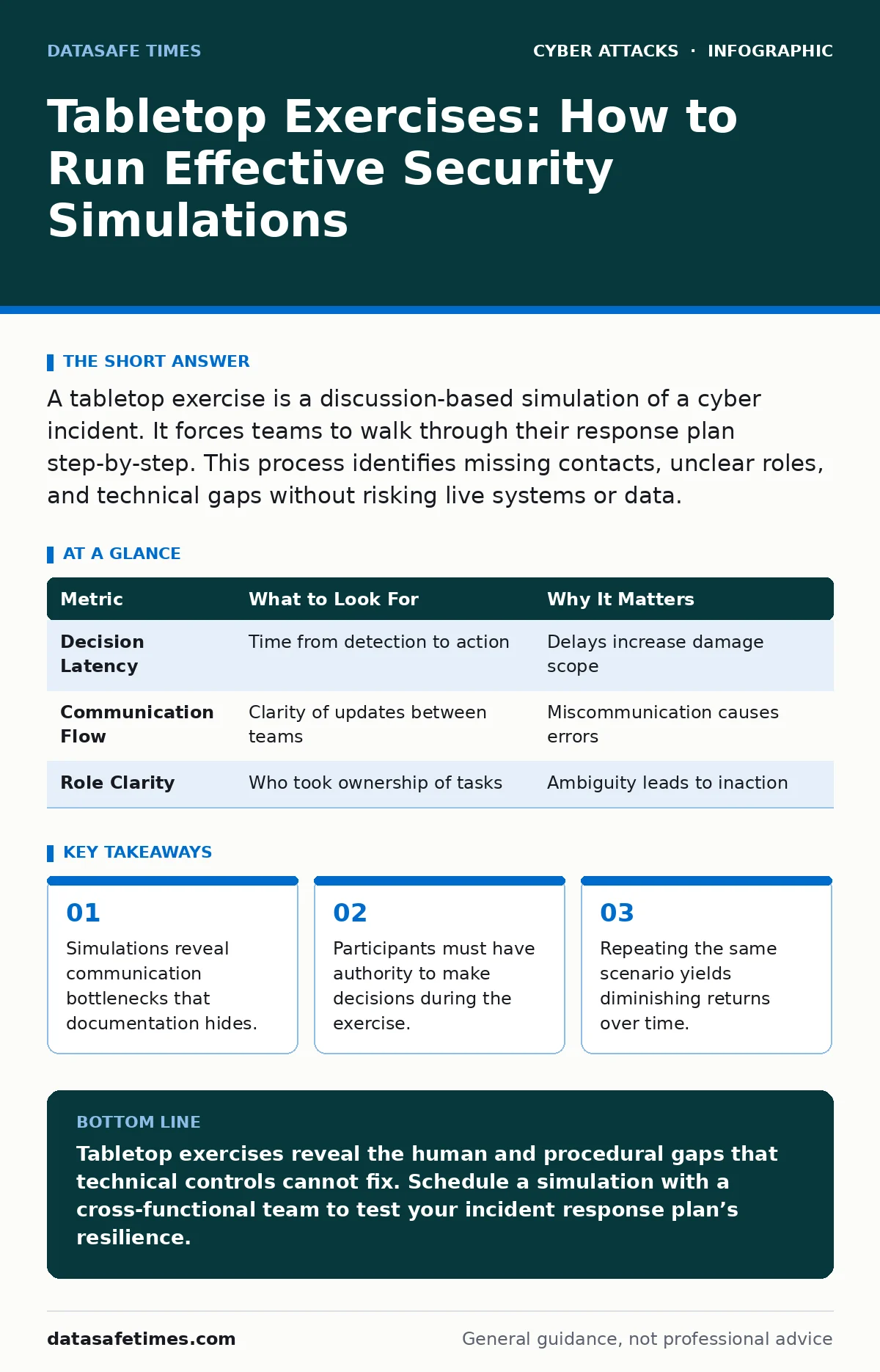
A tabletop exercise is a discussion-based simulation of a cyber incident. It forces teams to walk through their response plan step-by-step. This process identifies missing contacts, unclear roles, and technical gaps without risking live systems or data.
What exactly is a tabletop exercise?
A tabletop exercise is a structured discussion where team members talk through a hypothetical security incident. It is not a technical drill where you click buttons or run scripts. Instead, you focus on decision-making, communication, and role clarity.
The goal is to test the logic of your incident response plan. You identify who needs to know what, when, and how. This method works because human error in coordination is often more damaging than the technical vulnerability itself.
Who should participate in the simulation?
You need a cross-functional group that includes technical staff, legal counsel, public relations, and executive leadership. IT staff alone cannot handle the broader implications of a breach. Legal teams define liability, while communications teams manage external narratives.
Exclude junior staff who lack decision-making authority. Their presence can slow down the discussion with excessive questions that derail the flow. You want people who can commit to actions or escalate issues immediately.
How do you choose a realistic scenario?
Select a scenario that challenges your specific infrastructure and business model. Do not pick a generic ransomware attack if your primary risk is data leakage through misconfigured cloud storage. The scenario must force difficult trade-offs, such as shutting down critical services to contain a threat.
Consider the attack vector carefully. If your organization relies heavily on third-party integrations, simulate a supply chain compromise. This tests your vendor management protocols, which are often weaker than your internal defenses.
How much preparation is required before starting?
Minimal preparation is best to test your actual readiness. Send the scenario outline to participants a few days in advance, but withhold specific details. This prevents them from rehearsing perfect answers and forces them to think on their feet.
Ensure all participants have access to their incident response plans. They should know their roles but not the exact sequence of events. This mirrors the confusion and urgency of a real incident.
What happens if the team argues during the exercise?
Conflict is a positive sign. It means participants are engaging with the material and identifying genuine ambiguities in their roles. If everyone agrees instantly, the exercise has likely failed to stress-test the plan.
Document the disagreements. These points of contention highlight areas where your policies are unclear or contradictory. Resolving these conflicts during the simulation is more valuable than achieving a smooth, fictional resolution.
See also: XML External Entity Attacks: Response, Recovery and Prevention Steps
How do you measure success without technical metrics?
Success is measured by the clarity of decisions and the speed of communication. Did the team identify the correct containment strategy? Did legal counsel provide timely advice on notification requirements? These qualitative outcomes matter more than technical accuracy.
Track the time it takes to reach critical decisions. Delays in authorization can exacerbate the impact of an incident. Note any moments where information was lost or misunderstood between departments.
| Metric | What to Look For | Why It Matters |
|---|---|---|
| Decision Latency | Time from detection to action | Delays increase damage scope |
| Communication Flow | Clarity of updates between teams | Miscommunication causes errors |
| Role Clarity | Who took ownership of tasks | Ambiguity leads to inaction |
How often should you run these exercises?
Run tabletop exercises at least twice a year, or whenever significant changes occur to your infrastructure or personnel. Annual reviews are insufficient because technology and threats evolve rapidly. New hires also need to understand their responsibilities.
Vary the scenarios each time. Repeating the same exercise creates a false sense of security. Participants may memorize the "right" answers rather than thinking critically about new variations of the threat.
What if you cannot get executive buy-in?
Frame the exercise as a business continuity test, not just a security drill. Executives care about revenue protection, reputation, and regulatory compliance. Show how a poorly handled incident can disrupt operations and incur legal costs.
Start with a small, low-stakes scenario. Demonstrate the value by identifying a simple, fixable gap in your current process. Use this success to build trust and request broader participation for future exercises.
How do you handle sensitive information during the simulation?
Use fictional data and generic company names. Never use real customer data, proprietary code, or actual system credentials. This prevents accidental exposure and keeps the focus on process rather than specific technical details.
If discussing real vulnerabilities, refer to them by abstract identifiers. This allows the team to practice handling sensitive issues without creating a new security risk. Treat the exercise documentation as confidential.
How do you integrate lessons learned into your plan?
Update your incident response plan immediately after the exercise. Assign owners to each identified gap and set deadlines for remediation. Follow up on these actions in your next review cycle.
Share the findings with the broader organization, but anonymize individual performance. The goal is to improve the system, not to blame individuals. This encourages honest participation in future exercises.
How do you simulate advanced persistent threats?
Advanced persistent threats require a longer, multi-session exercise. Spread the simulation over several weeks, introducing new indicators of compromise gradually. This tests your ability to detect slow-moving, stealthy attacks.
Focus on detection and attribution challenges. These threats often bypass initial defenses, so your response must rely on behavioral analysis and forensic investigation. Ensure your team knows how to preserve evidence for later analysis.
What is the role of external partners in these exercises?
Include key vendors and partners if your incident response plan involves them. Test your communication channels with cloud providers, law firms, and insurance companies. Real-world incidents often require coordinated action with third parties.
Verify that your contracts with these partners align with your response timelines. Discrepancies can lead to delays in containment or recovery. Ensure all parties understand their obligations and contact procedures.
Key takeaways
- Simulations reveal communication bottlenecks that documentation hides.
- Participants must have authority to make decisions during the exercise.
- Repeating the same scenario yields diminishing returns over time.
Tabletop exercises reveal the human and procedural gaps that technical controls cannot fix. Schedule a simulation with a cross-functional team to test your incident response plan’s resilience.
Frequently asked questions
Can tabletop exercises replace technical penetration testing?
No, they serve different purposes. Penetration testing validates technical controls, while tabletop exercises validate human processes and decision-making. Both are necessary for a complete security posture.
How long should a tabletop exercise last?
Two to four hours is typical for a single scenario. Longer sessions can lead to fatigue and diminishing returns. Keep the discussion focused and energetic.
Do I need a facilitator for a small team?
Yes, even for small teams. A facilitator ensures that all voices are heard and that the discussion stays on track. Without one, dominant personalities can steer the conversation away from critical issues.
How do I handle a participant who refuses to engage?
Address the issue privately after the exercise. Explain the value of their input and the potential consequences of their absence. If they continue to disengage, consider excluding them from future sessions.
How this guide was produced: written by the DataSafe Times editorial team with AI assistance, checked against the public references listed below, and reviewed when the facts change. See our editorial policy or report an error.