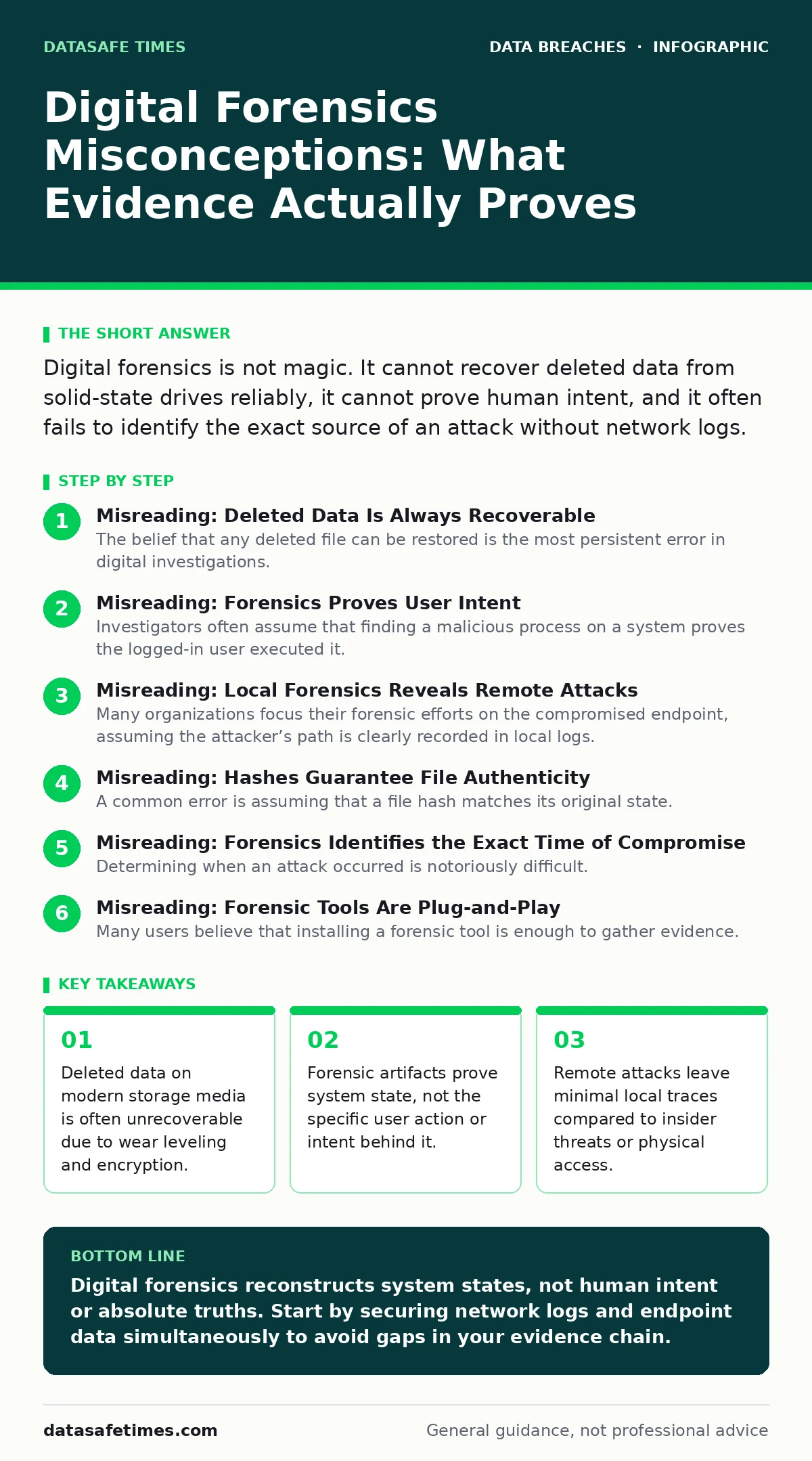
Digital forensics is not magic. It cannot recover deleted data from solid-state drives reliably, it cannot prove human intent, and it often fails to identify the exact source of an attack without network logs.
Misreading: Deleted Data Is Always Recoverable
The belief that any deleted file can be restored is the most persistent error in digital investigations. This view assumes storage devices work like simple scratchpads where erasing leaves a ghost image. Modern storage architecture makes this assumption dangerous. Solid-state drives use wear leveling to distribute writes across memory cells. When you delete a file, the drive marks the space as free and may immediately overwrite the physical blocks with new data or garbage-collect them to maintain performance.
Encrypted drives add another layer of obscurity. If the encryption key is destroyed, the remaining magnetic or electronic states are mathematically indistinguishable from random noise. You cannot decrypt data without the key, even if you have physical possession of the drive. This reality contrasts sharply with older mechanical hard drives, where deleted files often remained in place until overwritten. Relying on recovery tools for sensitive data disposal is insufficient. You must use methods that address the storage medium’s specific behavior. See secure data disposal for techniques that match the hardware type.
Correct reading: Data recovery depends entirely on the storage technology, the encryption status, and the time elapsed since deletion. Assume deleted data on SSDs or encrypted volumes is permanently lost. Do not plan an investigation around recovering files that were never persisted to disk.
Misreading: Forensics Proves User Intent
Investigators often assume that finding a malicious process on a system proves the logged-in user executed it. This logic fails because malware can run with elevated privileges, use scheduled tasks, or exploit kernel vulnerabilities. A process owner field in a system monitor shows which account context the code is running in, not who launched it. An attacker who compromises a service account will see their processes running under that service identity.
Attribution requires correlating multiple data sources. You need network logs to see where the connection originated. You need authentication logs to see who logged in and when. You need endpoint telemetry to see what actions preceded the malware execution. Without this chain, you only know that something bad happened on the machine. You do not know why it happened or who wanted it to happen. This gap is why insider data theft investigations are so difficult. The insider has legitimate access, making their actions look like normal operations.
Correct reading: Forensic artifacts establish what the system did, not why a human did it. Intent must be inferred from context, not derived from binary execution logs alone. Always look for the human trail in authentication and network records, not just in process lists.
Misreading: Local Forensics Reveals Remote Attacks
Many organizations focus their forensic efforts on the compromised endpoint, assuming the attacker’s path is clearly recorded in local logs. This approach misses the majority of modern threats. Remote attackers often use short-lived connections, encrypted tunnels, and living-off-the-land binaries. These tools leave few traces on the victim machine. The attacker may execute commands via PowerShell or Windows Management Instrumentation, which are standard system tools. Local logs often record these actions as routine maintenance.
The true evidence of a remote attack lives in the network. You need to analyze traffic flows, DNS queries, and connection attempts. Without network visibility, you are looking at the aftermath without the cause. The endpoint shows the result, but the network shows the method. This is why third-party data breaches are so hard to trace. The attacker may have entered through a vendor’s system, bypassing your perimeter entirely. Your local logs will show the exfiltration, but not the entry point. See data exfiltration for how to detect data leaving your network.
Correct reading: Endpoint forensics is insufficient for identifying remote attack vectors. You must combine host-based data with network-level analysis to reconstruct the full attack chain. Local logs show the impact; network logs show the access.
Misreading: Hashes Guarantee File Authenticity
A common error is assuming that a file hash matches its original state. Cryptographic hashes like SHA-256 are unique fingerprints for data. If the hash matches, the data is identical. However, this only proves the file has not changed since the hash was calculated. It does not prove the file was clean when the hash was first created. An attacker can modify a file and recalculate the hash. If you only check the hash against a known good value, you assume the known good value was correct.
This creates a trust problem. You must verify the integrity of the hash source, not just the file. If the reference hash came from a compromised repository, your validation is useless. This is why file integrity monitoring is critical. It tracks changes over time, alerting you when a file deviates from its baseline. Without continuous monitoring, a single hash check is a snapshot in time that may already be poisoned. See file integrity monitoring for how to establish and maintain trust in your file systems.
Correct reading: Hashes verify data consistency, not data safety. A matching hash only confirms the file is unchanged since the last check. You must trust the source of the reference hash and monitor for changes continuously.
Misreading: Forensics Identifies the Exact Time of Compromise
Determining when an attack occurred is notoriously difficult. System clocks can be manipulated, and attackers often clean logs to hide their presence. File modification times can be altered by simple commands. An attacker can change the timestamp of a malicious file to match a legitimate system file, making it appear as if it was created during normal installation. This technique, known as timestamp manipulation, defeats basic timeline analysis.
You must cross-reference multiple independent time sources. Event logs, file system metadata, and network connection timestamps often disagree. The most reliable indicator is usually the network connection time, as it is harder for an attacker to control remote server logs. However, if the attacker uses a proxy or a compromised internal machine, even network times can be misleading. This uncertainty means you often cannot pinpoint the exact minute of compromise. You can only establish a window of possibility.
Correct reading: Timestamps are easily falsified and often inconsistent across system components. Use multiple independent data sources to establish a probable time window, not an exact moment. Assume the attacker has tampered with local time records.
See also: Tabletop Exercises: How to Run Effective Security Simulations · XML External Entity Attacks: Response, Recovery and Prevention Steps
Misreading: Forensic Tools Are Plug-and-Play
Many users believe that installing a forensic tool is enough to gather evidence. This view ignores the complexity of data interpretation. Tools can collect data, but they cannot interpret context. A tool might flag a process as suspicious, but it cannot determine if that process was part of a legitimate software update or a malicious injection. The tool provides raw data; the investigator provides the meaning.
Misusing these tools can destroy evidence. Improperly imaging a drive can overwrite sectors. Running analysis software on a live system can change memory states. You must follow strict chain-of-custody procedures and use validated methods. The tool is only as good as the operator’s understanding of the underlying technology. Without this knowledge, you risk missing critical details or creating false positives. This is why identity theft investigations often fail. The forensic data is there, but the investigator lacks the context to link it to a specific individual.
Correct reading: Forensic tools collect data; humans interpret it. Proper training and methodology are required to avoid destroying evidence or misinterpreting results. Never trust a tool’s automated conclusion without manual verification.
Key takeaways
- Deleted data on modern storage media is often unrecoverable due to wear leveling and encryption.
- Forensic artifacts prove system state, not the specific user action or intent behind it.
- Remote attacks leave minimal local traces compared to insider threats or physical access.
Digital forensics reconstructs system states, not human intent or absolute truths. Start by securing network logs and endpoint data simultaneously to avoid gaps in your evidence chain.
Frequently asked questions
Can I recover deleted emails from my server?
Only if the server retains backups or if the data has not been overwritten by new storage operations. Most modern email systems purge deleted items immediately from active storage.
Does a malware detection prove a breach?
Detection proves malicious code is present. It does not prove data was stolen or that an attacker accessed your systems. You must verify execution and data movement.
How do I preserve evidence on a live system?
Capture volatile data first, such as memory and network connections. Then create a bit-for-bit image of the storage drive before running any analysis tools.
Can forensics identify an anonymous attacker?
Forensics can identify technical indicators like IP addresses or malware signatures. It cannot identify a person without correlating this data with external records like ISP logs.
How this guide was produced: written by the DataSafe Times editorial team with AI assistance, checked against the public references listed below, and reviewed when the facts change. See our editorial policy or report an error.