
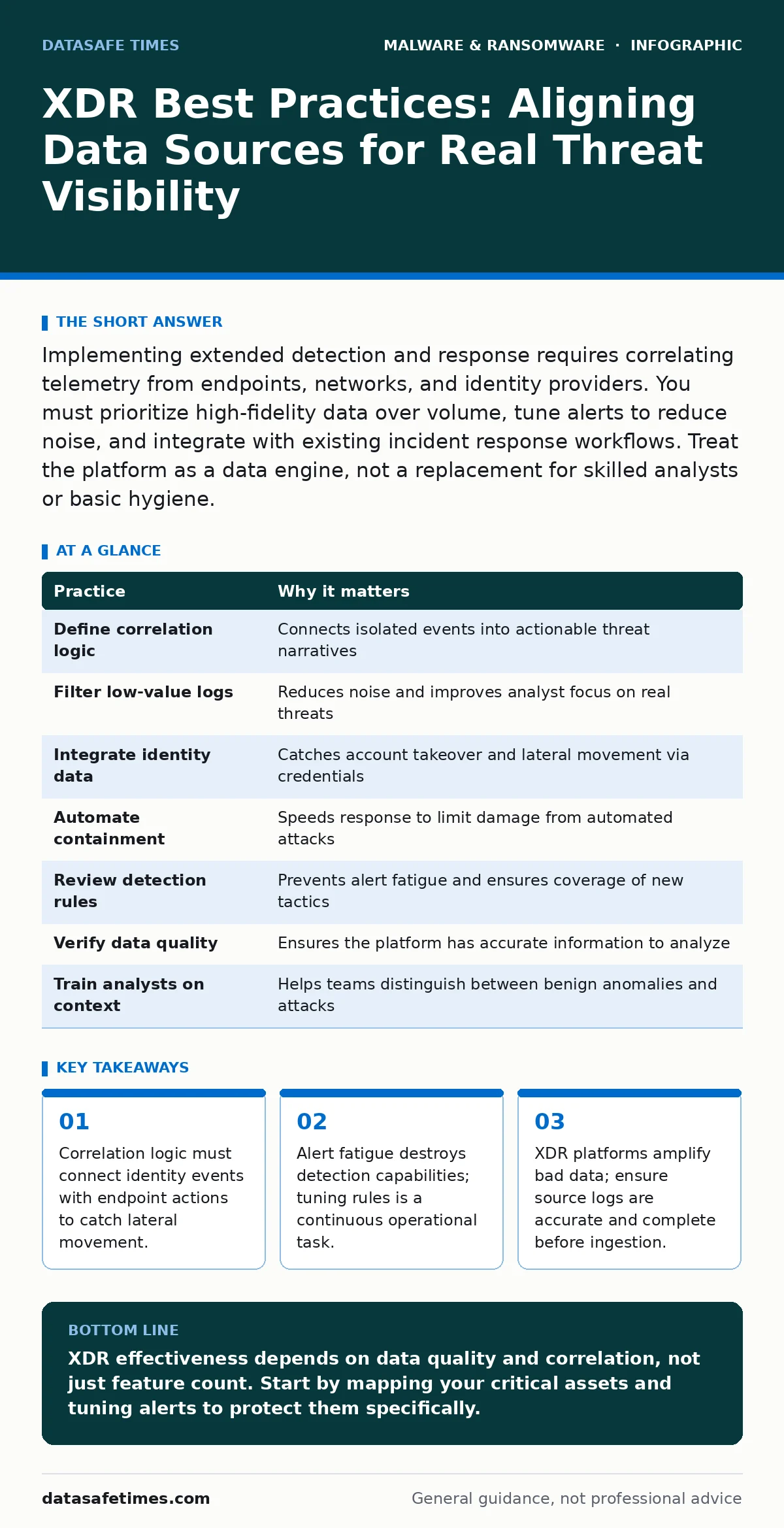
Implementing extended detection and response requires correlating telemetry from endpoints, networks, and identity providers. You must prioritize high-fidelity data over volume, tune alerts to reduce noise, and integrate with existing incident response workflows. Treat the platform as a data engine, not a replacement for skilled analysts or basic hygiene.
Data Correlation Defines Detection Capability
Extended detection and response (XDR) aggregates telemetry from multiple sources to identify threats that single-point tools miss. The value lies in connecting disparate events. A failed login from a suspicious IP combined with a process execution on a high-value host reveals lateral movement. Without this linkage, each event appears benign.
You must define what constitutes a threat sequence. Standard correlation rules often trigger on common administrative actions. Custom rules that map your specific attack surface reduce false positives. Imagine a script executing on a server. Alone, it is routine. Paired with an anomalous DNS query, it suggests command and control communication.
Prioritize High-Fidelity Telemetry Over Volume
Collecting every log entry creates noise that obscures real threats. XDR platforms struggle when ingesting low-value data such as routine application logs or benign network chatter. High-fidelity telemetry includes detailed process creation, DNS queries, and authentication events. These data points provide the context needed for accurate detection.
Filter data at the source where possible. Send only security-relevant logs to the XDR platform. This reduces storage costs and improves query performance. If your endpoint detection and response agents send verbose debug logs, disable them. Focus on events that indicate state changes or privilege escalation.
| Practice | Why it matters |
|---|---|
| Define correlation logic | Connects isolated events into actionable threat narratives |
| Filter low-value logs | Reduces noise and improves analyst focus on real threats |
| Integrate identity data | Catches account takeover and lateral movement via credentials |
| Automate containment | Speeds response to limit damage from automated attacks |
| Review detection rules | Prevents alert fatigue and ensures coverage of new tactics |
| Verify data quality | Ensures the platform has accurate information to analyze |
| Train analysts on context | Helps teams distinguish between benign anomalies and attacks |
Integrate Identity and Access Management
Threat actors increasingly target credentials rather than exploiting software vulnerabilities. Remote access trojans often use stolen tokens to move laterally. XDR systems that ignore identity telemetry miss a critical attack vector. You must ingest signals from identity providers, such as Azure Active Directory or Okta.
Monitor for impossible travel, unusual login times, and privilege escalation. When an XDR platform correlates a successful login with a subsequent file exfiltration attempt, the risk context changes dramatically. Without identity data, the file transfer looks like normal business activity. With it, the sequence indicates compromised credentials.
See our guide on remote access trojans for details on how attackers maintain persistence through stolen sessions.
Tune Alerts to Combat Fatigue
Alert fatigue causes analysts to ignore genuine threats. XDR platforms generate thousands of events daily. If you do not tune detection rules, your team will drown in noise. Start by disabling low-severity alerts that lack context. Focus on high-fidelity indicators that require immediate action.
Review dismissed alerts weekly. Identify patterns that cause false positives. Adjust thresholds or add exclusion criteria for known benign activities. For example, a backup service running PowerShell scripts may trigger malicious script detection. Exclude the service account from that specific rule. This refinement improves signal-to-noise ratio.
Automate Containment for Speed
Human response times are too slow for automated malware. XDR platforms can trigger containment actions automatically. When a high-confidence threat is detected, the system can isolate the host, disable the user account, or block the malicious IP. This limits the blast radius before an analyst reviews the incident.
Define clear playbooks for automation. Not every alert warrants isolation. Automate responses for critical threats only, such as known ransomware hashes or command-and-control connections. Keep lower-severity alerts for manual review. This balance prevents operational disruption while stopping severe attacks quickly.
See also: XML External Entity Attacks: Response, Recovery and Prevention Steps · How Sandboxing Works: The Mechanics of Isolated Execution
Validate Data Quality at the Source
XDR platforms are only as good as their input data. If endpoint agents are outdated or network sensors are misconfigured, the XDR dashboard displays gaps. These gaps create blind spots where threats hide. Regularly verify that all data sources are sending complete and accurate telemetry.
Check for timestamp synchronization across devices. Misaligned clocks break correlation logic. An event appearing before it actually occurred can invalidate a threat timeline. Ensure all agents use Network Time Protocol to maintain consistent timestamps. This precision allows the XDR engine to reconstruct attack chains accurately.
Align with Incident Response Workflows
XDR is not a standalone solution. It must integrate with your existing incident response processes. Define how alerts flow from the XDR platform to your ticketing system or communication channels. Ensure analysts know who to contact and what actions to take for each alert type.
Create runbooks for common scenarios. Document the steps for investigating a compromised endpoint or a phishing campaign. Integrate these runbooks into the XDR interface if possible. This reduces decision latency during an incident. Analysts spend less time figuring out what to do and more time executing the response.
Leverage Sandboxing for Unknown Payloads
Static analysis cannot catch all malware. Some threats use packing or obfuscation to hide their behavior. XDR platforms often include sandboxing capabilities to execute suspicious files in a safe environment. This reveals the true intent of the payload.
Enable dynamic analysis for files that trigger heuristic alerts. The sandbox observes system changes, network calls, and registry modifications. This provides context that static signatures lack. Imagine a document that appears benign until opened. The sandbox executes it and detects the drop of a malicious executable.
Refer to our guide on sandboxing for best practices on isolating untrusted code.
Review and Update Detection Logic Regularly
Threat tactics evolve continuously. Static detection rules become obsolete. You must regularly review and update your XDR detection logic. Subscribe to threat intelligence feeds and monitor community discussions for new techniques. Incorporate these insights into your correlation rules.
Conduct red team exercises to test your XDR coverage. Simulate attacks using known tactics. Identify gaps in detection. Adjust rules to catch these simulated threats. This proactive approach ensures your platform remains effective against emerging threats. It also validates that your automation and workflows function as expected.
Key takeaways
- Correlation logic must connect identity events with endpoint actions to catch lateral movement.
- Alert fatigue destroys detection capabilities; tuning rules is a continuous operational task.
- XDR platforms amplify bad data; ensure source logs are accurate and complete before ingestion.
XDR effectiveness depends on data quality and correlation, not just feature count. Start by mapping your critical assets and tuning alerts to protect them specifically.
Frequently asked questions
Does XDR replace next-generation antivirus?
No, XDR complements next-generation antivirus by correlating endpoint data with network and identity signals. It provides broader context but relies on the underlying agents for initial detection.
Can XDR detect Mac malware effectively?
Yes, if the XDR platform supports macOS telemetry. Many modern platforms offer agents for Mac operating systems, allowing correlation of Mac-specific events with the broader environment.
How does XDR handle potentially unwanted programs?
XDR can detect potentially unwanted programs by analyzing behavior and installation patterns. However, it often requires specific rules to distinguish them from legitimate software, as they may not exhibit malicious behavior.
Is XDR suitable for small organizations?
XDR can be complex for small teams. It requires skilled analysts to tune and manage. Small organizations may benefit more from managed detection and response services that handle the operational overhead.
How this guide was produced: written by the DataSafe Times editorial team with AI assistance, checked against the public references listed below, and reviewed when the facts change. See our editorial policy or report an error.