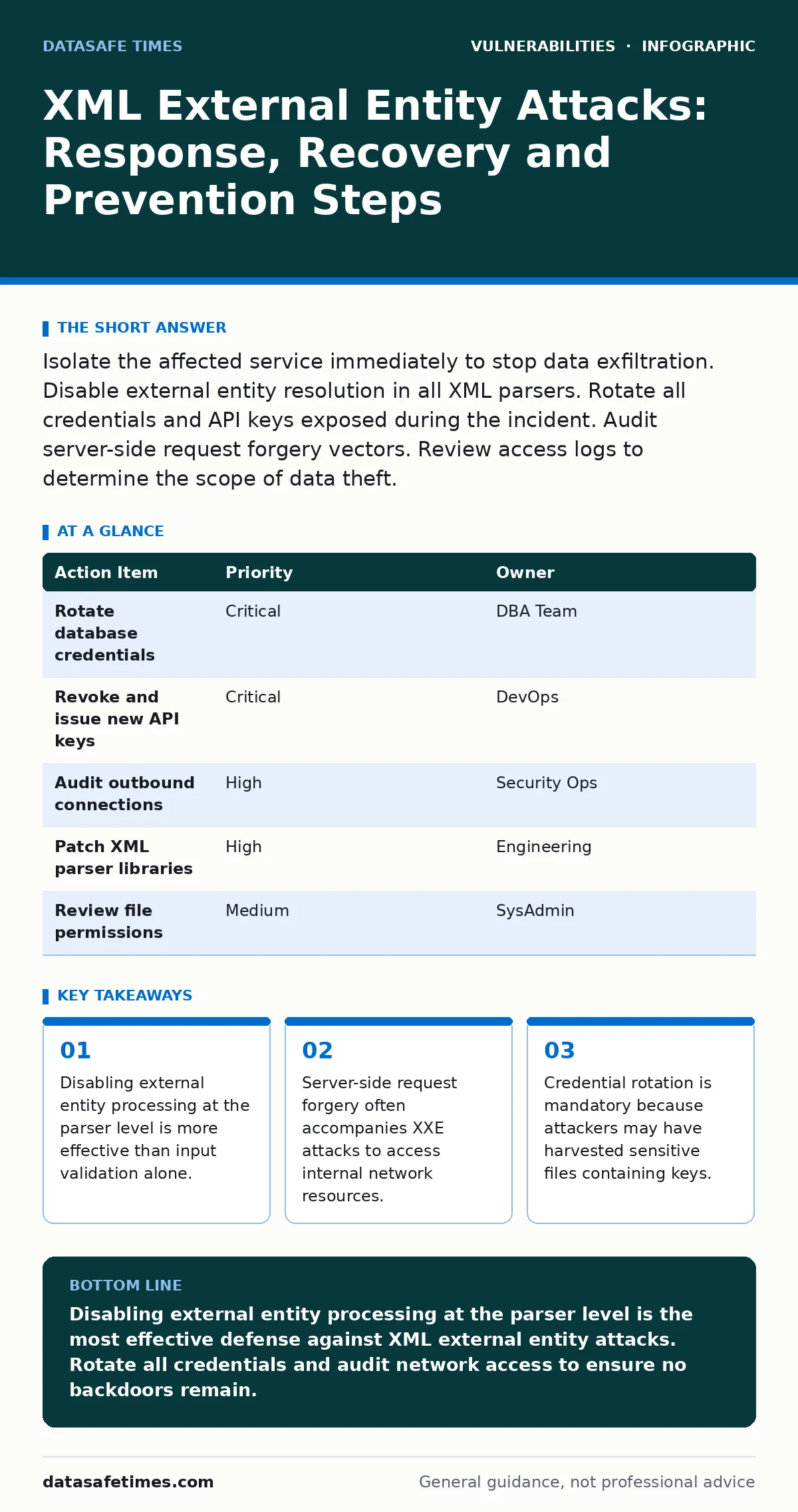
Isolate the affected service immediately to stop data exfiltration. Disable external entity resolution in all XML parsers. Rotate all credentials and API keys exposed during the incident. Audit server-side request forgery vectors. Review access logs to determine the scope of data theft.
The First Hour: Containment and Triage
An XML external entity attack exploits a parser’s ability to resolve external references. When you suspect a breach, time is the only resource that matters. The attacker is likely still pulling data from your servers. Do not attempt to analyze the full scope before stopping the bleeding.
- Isolate the affected application from the public internet or internal network.
- Disable the specific endpoint or service processing the malicious XML.
- Preserve server logs and memory dumps for forensic analysis.
- Disable external entity resolution in the XML parser configuration.
- Notify the security incident response team immediately.
The most damaging action is ignoring the server-side request forgery component. XXE is rarely just about reading files. Attackers use the parser to make requests to internal services. If you only block file reads, they can still pivot deeper into your network. Check for outbound connections to unusual internal IPs during the attack window.
The First Day: Assessment and Credential Rotation
Once the immediate threat is contained, you must determine what was taken. XML parsers often have access to the same filesystem permissions as the application process. This means an attacker could read configuration files, environment variables, and even source code.
Start by reviewing the application logs for unusual XML payloads. Look for DOCTYPE declarations that reference external entities. These declarations are the hallmark of an XXE attempt. Note the timestamps and source IP addresses. Cross-reference these with your firewall logs to see what internal resources were accessed.
If the attacker accessed configuration files, assume all secrets are compromised. This includes database passwords, API keys, and encryption keys. You must rotate every credential that the application process could read. Do not guess which keys were exposed. Assume the worst case scenario.
| Action Item | Priority | Owner |
|---|---|---|
| Rotate database credentials | Critical | DBA Team |
| Revoke and issue new API keys | Critical | DevOps |
| Audit outbound connections | High | Security Ops |
| Patch XML parser libraries | High | Engineering |
| Review file permissions | Medium | SysAdmin |
Rotation is not just about changing passwords. It involves updating every system that holds the old credentials. This includes backup systems, monitoring tools, and developer laptops. Use a secrets management system to track these changes. Failure to rotate a single key can leave a backdoor open.
The First Week: Recovery and Hardening
With the immediate threats neutralized and credentials rotated, focus on hardening the system. The goal is to make XXE attacks impossible, not just difficult. Input validation is a defense-in-depth measure, but it is not a complete solution. Attackers can often bypass validation with obfuscation or encoding tricks.
The most effective defense is disabling external entity processing at the parser level. Most modern XML parsers allow you to disable this feature entirely. If your application does not need to resolve external entities, turn it off. This single change eliminates the attack surface.
Check your dependency chain for vulnerable libraries. Older versions of XML parsers often have XXE enabled by default. Update these libraries to the latest secure version. Consider using a parser that does not support external entities at all. This reduces the complexity of your security posture.
Imagine you use a third-party library that processes XML for data import. You cannot control the library’s source code. In this case, you must wrap the parser with a security layer. This layer should strip out DOCTYPE declarations before the parser sees them. This adds overhead, but it prevents the attack.
Review your network architecture. Did the attacker use the XXE vector to access internal services? If so, you have a server-side request forgery vulnerability. Segment your network to limit what the application can reach. Use firewalls to block unnecessary outbound connections from the application tier.
Who to Tell: Internal and External Communication
Communication is a critical part of recovery. You must inform internal teams about the incident. Developers need to know which components were affected. Operations teams need to know about the network changes. Management needs to know about the potential business impact.
If customer data was exposed, you must notify them. Check your local laws for data breach notification requirements. These laws often have strict timelines for notification. Provide clear information about what happened and what steps you took to protect their data. Transparency builds trust, even in difficult situations.
Do not blame individuals. Focus on the technical failure and the remediation steps. This encourages a culture of security rather than fear. Developers are more likely to report potential vulnerabilities if they know they will not be punished for making mistakes.
How to Stop a Repeat: Long-Term Prevention
Prevention requires a shift in how you handle XML data. Treat all XML input as untrusted. Validate it against a strict schema before processing. Use a parser that disables external entities by default. Monitor for unusual XML payloads in real-time.
Integrate security checks into your CI/CD pipeline. Automated tests should detect attempts to process external entities. This catches vulnerabilities before they reach production. Regular penetration testing can also identify XXE weaknesses that automated tools miss.
Consider using a more secure data format. JSON does not support external entities. If your application can switch to JSON, you eliminate this risk entirely. This is not always possible, but it is worth evaluating for new services.
Review your access controls. Limit the permissions of the application process. If the process cannot read sensitive files, an XXE attack is less damaging. Use least privilege principles for all system accounts. This reduces the impact of any successful attack.
See also: Tabletop Exercises: How to Run Effective Security Simulations · Prevent PHP Application Vulnerabilities: The Priority Order That Works
Related Security Considerations
XXE attacks often overlap with other vulnerabilities. Server-side request forgery is a common companion. If an attacker can make your server request internal resources, they can access sensitive data. Address SSRF alongside XXE.
Dependency confusion attacks can also compromise your supply chain. Attackers may upload malicious packages to your private repository. Ensure your package manager is configured to prefer internal repositories over public ones. This prevents attackers from injecting malicious code.
Regular penetration testing helps identify these weaknesses. Testers can simulate XXE attacks to verify your defenses. This proactive approach finds issues before attackers do. Combine testing with automated scanning for continuous protection.
Final Checklist for Resilience
Use this checklist to ensure your recovery is complete. Review each item with your security team. Sign off on the completion of each step. This documentation provides accountability and a record of your response.
- All XML parsers configured to disable external entities.
- All compromised credentials rotated and verified.
- Network segmentation reviewed and updated.
- Incident report completed and lessons learned documented.
- Team training on XML security best practices completed.
Key takeaways
- Disabling external entity processing at the parser level is more effective than input validation alone.
- Server-side request forgery often accompanies XXE attacks to access internal network resources.
- Credential rotation is mandatory because attackers may have harvested sensitive files containing keys.
Disabling external entity processing at the parser level is the most effective defense against XML external entity attacks. Rotate all credentials and audit network access to ensure no backdoors remain.
Frequently asked questions
Can input validation prevent XXE attacks?
Input validation can reduce the risk, but it is not foolproof. Attackers can bypass validation with encoding tricks. Disabling external entities at the parser level is more reliable.
Do I need to worry about XXE if I use JSON?
No, JSON does not support external entities. However, other injection risks may exist. Validate all input regardless of format.
How do I know if my parser supports external entities?
Check the documentation for your XML parser. Most parsers have a configuration option to disable external entities. If unsure, assume they are enabled and disable them.
Is XXE still a common attack vector?
Yes, many legacy systems still use vulnerable XML parsers. Even modern systems can be affected if parsers are misconfigured. Regular testing is necessary.
How this guide was produced: written by the DataSafe Times editorial team with AI assistance, checked against the public references listed below, and reviewed when the facts change. See our editorial policy or report an error.