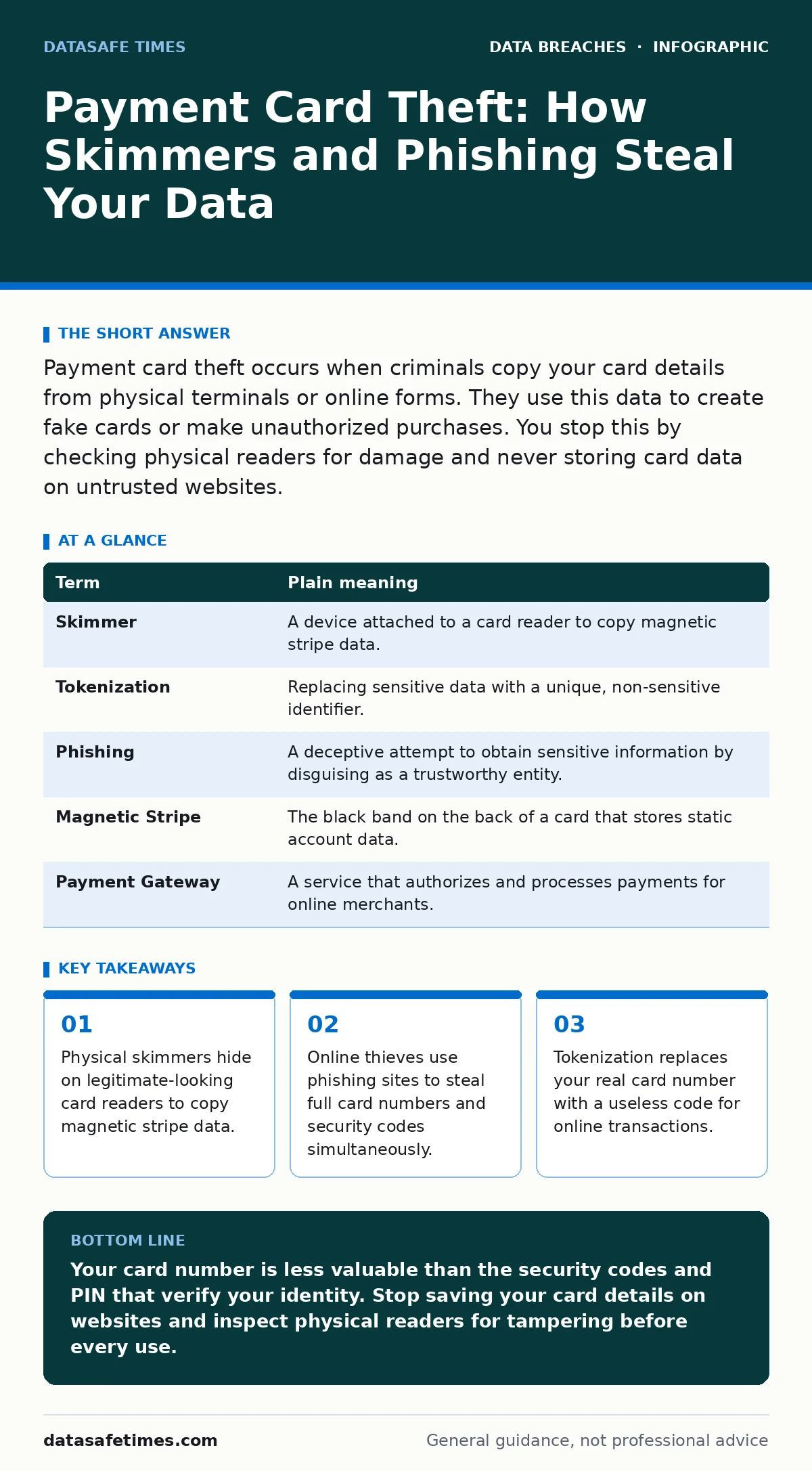
Payment card theft occurs when criminals copy your card details from physical terminals or online forms. They use this data to create fake cards or make unauthorized purchases. You stop this by checking physical readers for damage and never storing card data on untrusted websites.
The Library Book Analogy
Imagine your payment card is a library book. The barcode on the spine is your card number. It identifies the book, but it does not let anyone check it out. The checkout process requires a librarian to verify your identity. In the digital world, that verification is the security code and the expiration date. Stealing the barcode alone does not give a thief access to the shelf. They need the librarian’s permission.
Most people focus on hiding the barcode. They worry about someone seeing the number on their card. This is the wrong focus. The number is public information in many contexts. The real value lies in the transient data that proves you are holding the card right now. That transient data is what criminals actually want.
How Physical Theft Works
Suppose you are at a gas station. You insert your card into the pump. The machine reads the magnetic stripe. This stripe contains your account number and expiration date. It does not contain the three-digit security code on the back. A thief can copy this data using a device called a skimmer.
A skimmer is a thin piece of hardware attached to the legitimate card reader. It looks like part of the machine. When you slide your card, the skimmer copies the magnetic data. The real reader still processes the transaction, so you do not notice. The thief retrieves the skimmer later and downloads the copied data. They can then print a counterfeit card with your details.
The Online Trap
Online theft is different because the environment is invisible. Imagine a website that looks exactly like your bank. It has the same logo, the same colors, and the same layout. This is a phishing site. It is not a copy; it is a mirror held up to the real site.
When you type your card number into this mirror, the data goes to the thief, not the bank. The thief now has your card number, expiration date, and the security code. With all three, they do not need to print a fake card. They can buy digital goods or services instantly. They can also make purchases at stores that do not require a physical card present.
This is where third-party data breaches become relevant. If a merchant you trust gets hacked, your data might be stolen from their database. You did not go to a fake site. You went to the real one. The security failure happened behind the scenes.
Why Numbers Alone Are Not Enough
You might think that if your card number is stolen, you are doomed. This is not true. Most online merchants use a payment gateway. This is a service that handles the transaction between the merchant and the bank. Modern gateways use tokenization.
Tokenization replaces your real card number with a random string of characters called a token. This token works for that specific merchant but is useless to anyone else. If a thief steals the token, they cannot use it to buy shoes at a different store. They cannot use it to withdraw cash. The token is like a single-use ticket. It works once, at one place, and then it expires.
The Hidden Cost of Convenience
Convenience is the enemy of security. Imagine you save your card details on a shopping app. The app promises one-click checkout. This is fast. It is also dangerous. If the app’s servers are compromised, your card data is exposed. You traded speed for privacy.
This is similar to the risks in leaked source code. If developers leave sensitive data in their code, hackers can find it. When you save your card, you are trusting the app developer to protect that data. You have no way to verify they do. The easier you make it for the merchant to charge you, the easier you make it for a thief to do the same.
Simple Safety Habits
You do not need complex software to stay safe. You need to change how you interact with payment terminals. Start with physical cards. Always cover the keypad with your hand when entering your PIN. This prevents hidden cameras from recording it. Check the card reader for loose parts. If it wobbles, do not use it.
For online purchases, use a browser extension that blocks known phishing sites. Do not save your card details on any website, even ones you trust. Type them in every time. It takes ten seconds more. It saves you from a massive headache later.
- Inspect card readers at gas stations and ATMs for signs of tampering.
- Use virtual card numbers if your bank offers them. These are temporary numbers that expire after one use.
- Monitor your bank statements daily. Look for small, odd charges. These are often test transactions to see if your card works.
What To Do If It Happens
If you notice unauthorized charges, do not wait. Contact your bank immediately. They will freeze your account and issue a new card. This stops further theft. You are not responsible for unauthorized charges in most cases, but you must report them quickly.
This process is similar to identity theft. The thief has your data. They are using it to impersonate you. The bank needs to know this impersonation is happening. Do not just cancel the card. Report the fraud. This creates a record. It helps the bank track the thief. It also protects you from future liability.
| Term | Plain meaning |
|---|---|
| Skimmer | A device attached to a card reader to copy magnetic stripe data. |
| Tokenization | Replacing sensitive data with a unique, non-sensitive identifier. |
| Phishing | A deceptive attempt to obtain sensitive information by disguising as a trustworthy entity. |
| Magnetic Stripe | The black band on the back of a card that stores static account data. |
| Payment Gateway | A service that authorizes and processes payments for online merchants. |
Key takeaways
- Physical skimmers hide on legitimate-looking card readers to copy magnetic stripe data.
- Online thieves use phishing sites to steal full card numbers and security codes simultaneously.
- Tokenization replaces your real card number with a useless code for online transactions.
Your card number is less valuable than the security codes and PIN that verify your identity. Stop saving your card details on websites and inspect physical readers for tampering before every use.
Frequently asked questions
Can thieves steal my data through NFC contactless payments?
No. Contactless payments use encrypted tokens. The data transmitted is useless to a thief without the physical card and your PIN for large amounts.
Is it safe to use my card at a gas station pump?
It is safer to go inside and pay at the register. The pumps are more vulnerable to skimmers because they are outdoors and less monitored.
What if I already saved my card on a website?
Remove it immediately. Go to the account settings of that website and delete your payment methods. Consider changing your password for that site as well.
Do virtual cards work for subscriptions?
Some do. Many banks allow you to create a virtual card with a spending limit or an expiration date. This limits the damage if the merchant’s data is leaked.
How this guide was produced: written by the DataSafe Times editorial team with AI assistance, checked against the public references listed below, and reviewed when the facts change. See our editorial policy or report an error.