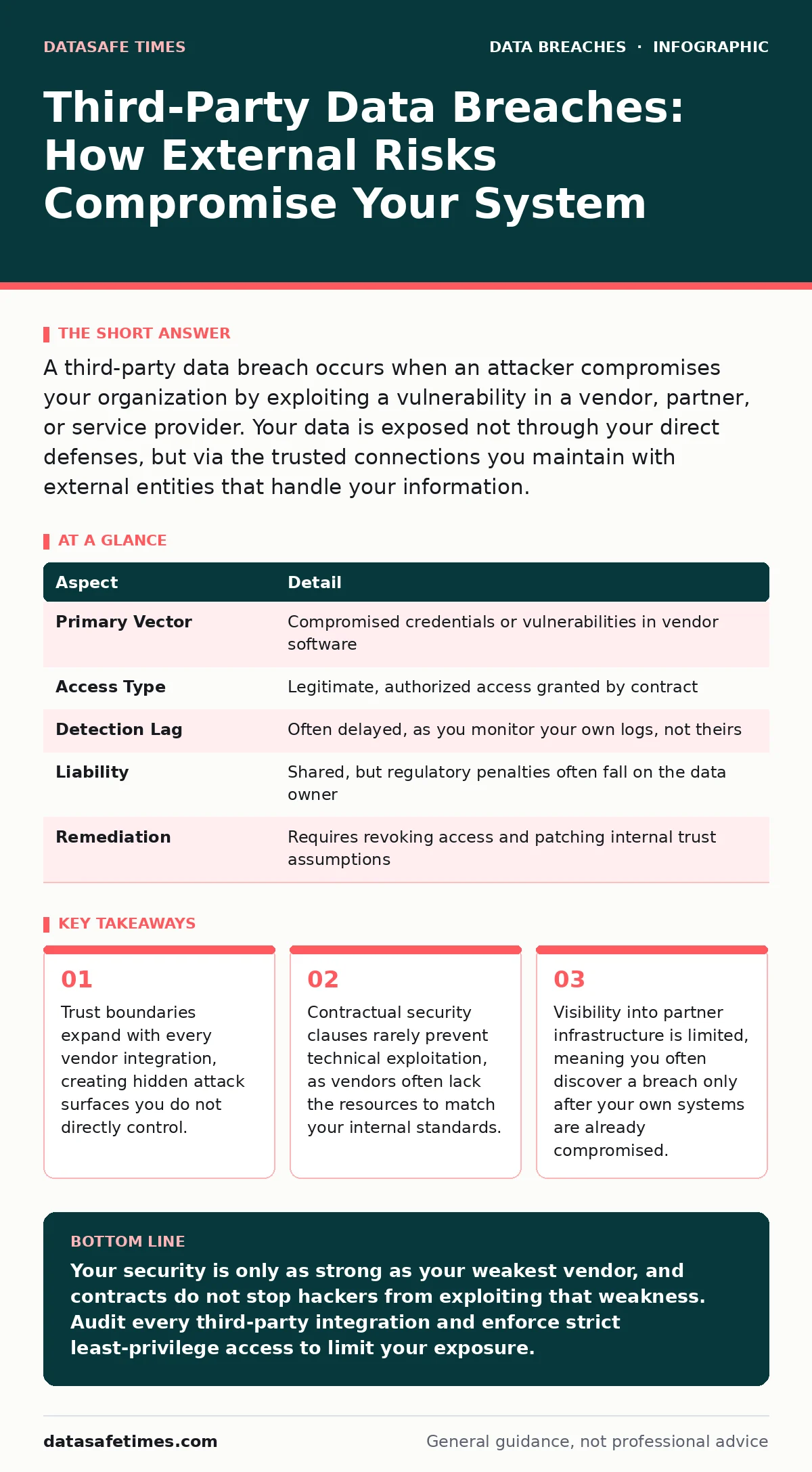
A third-party data breach occurs when an attacker compromises your organization by exploiting a vulnerability in a vendor, partner, or service provider. Your data is exposed not through your direct defenses, but via the trusted connections you maintain with external entities that handle your information.
The Supply Chain Analogy
Imagine you build a fortress with impenetrable stone walls and a deep moat. You guard the main gate with armed sentinels. Yet, you hire an outside catering company to bring meals through a small service entrance. If the caterer hires a thief as a driver, the food arrives with a spy inside. Your walls did not fail. Your gatekeepers did not sleep. The breach occurred because you extended trust to an entity that operated outside your direct supervision.
This is the core mechanism of a third-party data breach. You are not attacked directly. The attacker targets the weakest link in your network of dependencies. That link is often a software vendor, a cloud provider, or a payment processor. They hold your data or access your systems. When they fall, you fall with them.
Defining the Scope
A third-party data breach is a security incident where unauthorized access to your data occurs via an external partner. This partner has legitimate access to your environment. They are not an intruder in the traditional sense. They are a trusted actor who has been compromised.
The definition hinges on access, not ownership. The data may sit on your servers, but the partner has a key. The data may sit on their servers, but it belongs to you. In both cases, the partner’s failure to protect that access point becomes your liability. You must treat every integration as a potential breach vector.
| Aspect | Detail |
|---|---|
| Primary Vector | Compromised credentials or vulnerabilities in vendor software |
| Access Type | Legitimate, authorized access granted by contract |
| Detection Lag | Often delayed, as you monitor your own logs, not theirs |
| Liability | Shared, but regulatory penalties often fall on the data owner |
| Remediation | Requires revoking access and patching internal trust assumptions |
How the Attack Unfolds
The attacker rarely starts by scanning your firewall. They scan the web for popular software vendors. They look for companies that serve many clients. A single breach at the vendor level yields thousands of potential targets. This is an efficiency play for the criminal.
Once the vendor is compromised, the attacker uses the vendor’s legitimate credentials. They log in as if they were the vendor’s support team. Your firewall sees a trusted IP address. Your intrusion detection system sees valid authentication tokens. Nothing triggers an alarm. The attacker moves laterally from the vendor’s account into your shared database or API endpoint. They exfiltrate data under the guise of normal business operations.
Common Forms of Exposure
The most common form is the shared database. You store customer records in a cloud environment managed by a provider. If the provider misconfigures a bucket or fails to encrypt data at rest, your records are exposed. You did not misconfigure anything. The provider did. But the data is yours.
Another form is the software supply chain. You install a library or component from an open-source repository. That component contains a hidden vulnerability. When attackers exploit that vulnerability, they gain code execution rights on your server. You updated your system. You patched your OS. You did not patch the third-party code embedded in your application. This relates directly to the risks found in leaked source code, where internal logic is exposed to reverse engineering.
A third form is the managed service provider. You outsource IT support or email hosting. The provider’s employees have access to your systems. If an employee is phished or coerced, they hand over the keys. You have no visibility into their internal security practices. You rely on their word that they are secure.
Who Bears the Cost
You bear the cost. Even if the breach originated at a vendor, regulators and customers look to you. You collected the data. You promised to protect it. The fact that you entrusted it to a third party is your decision. It is not a legal shield.
The financial impact includes notification costs, credit monitoring services, and legal fees. But the reputational damage is harder to quantify. Trust is fragile. If users believe you cannot manage your vendors, they will leave. This dynamic mirrors the fallout seen in identity theft cases, where the victim’s reputation and financial standing are eroded by the actions of others.
Your partners also suffer. If your breach is traced back to a shared infrastructure flaw, your partners may face lawsuits from their own clients. The ecosystem collapses together. This is why database security is a shared responsibility model, not a siloed one.
What People Usually Get Wrong
Many organizations believe that a signed contract transfers risk. It does not. A contract defines liability after the fact. It does not prevent the exploit. An attacker does not care about your indemnification clause. They care about the open port.
Another mistake is assuming that vendors follow the same standards as you. They often do not. A small software firm may not have a dedicated security team. They may use default passwords on their admin panels. They may not perform regular penetration testing. You assume they are as careful as you are. They are not. This gap is where breaches happen.
Finally, organizations often focus on onboarding and ignore offboarding. When a vendor relationship ends, access is often not revoked promptly. Former partners retain credentials. Those credentials are forgotten in a spreadsheet. Months later, they are used to enter your system. This is why employee offboarding security protocols must be extended to vendor access management.
Reducing the Risk
You cannot control your vendors. You can only control your exposure to them. Start by mapping your data flow. Know exactly where your data lives. Know which third parties have access. If you cannot answer these questions, you are already blind.
Implement least privilege access. Do not give vendors administrative rights unless absolutely necessary. Use API keys with limited scopes. Rotate credentials regularly. Assume that any credential shared with a third party will eventually be leaked. Design your system so that a leaked key causes minimal damage.
Monitor for anomalies in vendor behavior. If a vendor’s IP address suddenly accesses a large volume of data at 3 AM, something is wrong. Set up alerts for these patterns. This requires file integrity monitoring on the endpoints that vendors interact with, ensuring that changes are tracked and verified.
Conduct regular security assessments of critical vendors. Do not rely on their self-reported certifications. Ask for evidence. Review their incident response plans. If they cannot articulate how they would handle a breach, they are not ready to handle your data.
Secure data disposal is another critical layer. When a contract ends, ensure that the vendor deletes your data and provides proof. Do not accept a verbal assurance. Require cryptographic erasure or physical destruction certificates.
The Limits of Control
No measure guarantees safety. You can vet every vendor, lock every door, and monitor every log. An attacker may still find a zero-day vulnerability in a library you use. They may compromise a vendor’s employee through social engineering. You can reduce the probability. You cannot eliminate it.
The goal is resilience. When a breach occurs, how fast can you detect it? How fast can you isolate the affected systems? How fast can you revoke access? Speed matters more than perfection. Build systems that can fail safely. Assume the breach. Prepare for the inevitable.
Key takeaways
- Trust boundaries expand with every vendor integration, creating hidden attack surfaces you do not directly control.
- Contractual security clauses rarely prevent technical exploitation, as vendors often lack the resources to match your internal standards.
- Visibility into partner infrastructure is limited, meaning you often discover a breach only after your own systems are already compromised.
Your security is only as strong as your weakest vendor, and contracts do not stop hackers from exploiting that weakness. Audit every third-party integration and enforce strict least-privilege access to limit your exposure.
Frequently asked questions
How do I know if my vendor has been breached?
You usually won’t know until your own systems show anomalies. Monitor for unusual data access patterns, unexpected API calls, or alerts from security tools that indicate compromised credentials.
Does cyber insurance cover third-party breaches?
Coverage varies by policy. Most policies include third-party liability, but exclusions often apply if you failed to perform due diligence or if the breach resulted from known, unpatched vulnerabilities.
Should I stop using third-party vendors?
No. Modern software relies on integration. The risk is managed, not avoided. Focus on reducing the blast radius of any single vendor compromise through segmentation and strict access controls.
What is the difference between a second-party and third-party breach?
A second-party breach involves a direct partner in a transaction, like a merchant processor. A third-party breach involves a vendor supporting that partner, like the software the merchant uses. Both result in your data exposure.
How this guide was produced: written by the DataSafe Times editorial team with AI assistance, checked against the public references listed below, and reviewed when the facts change. See our editorial policy or report an error.