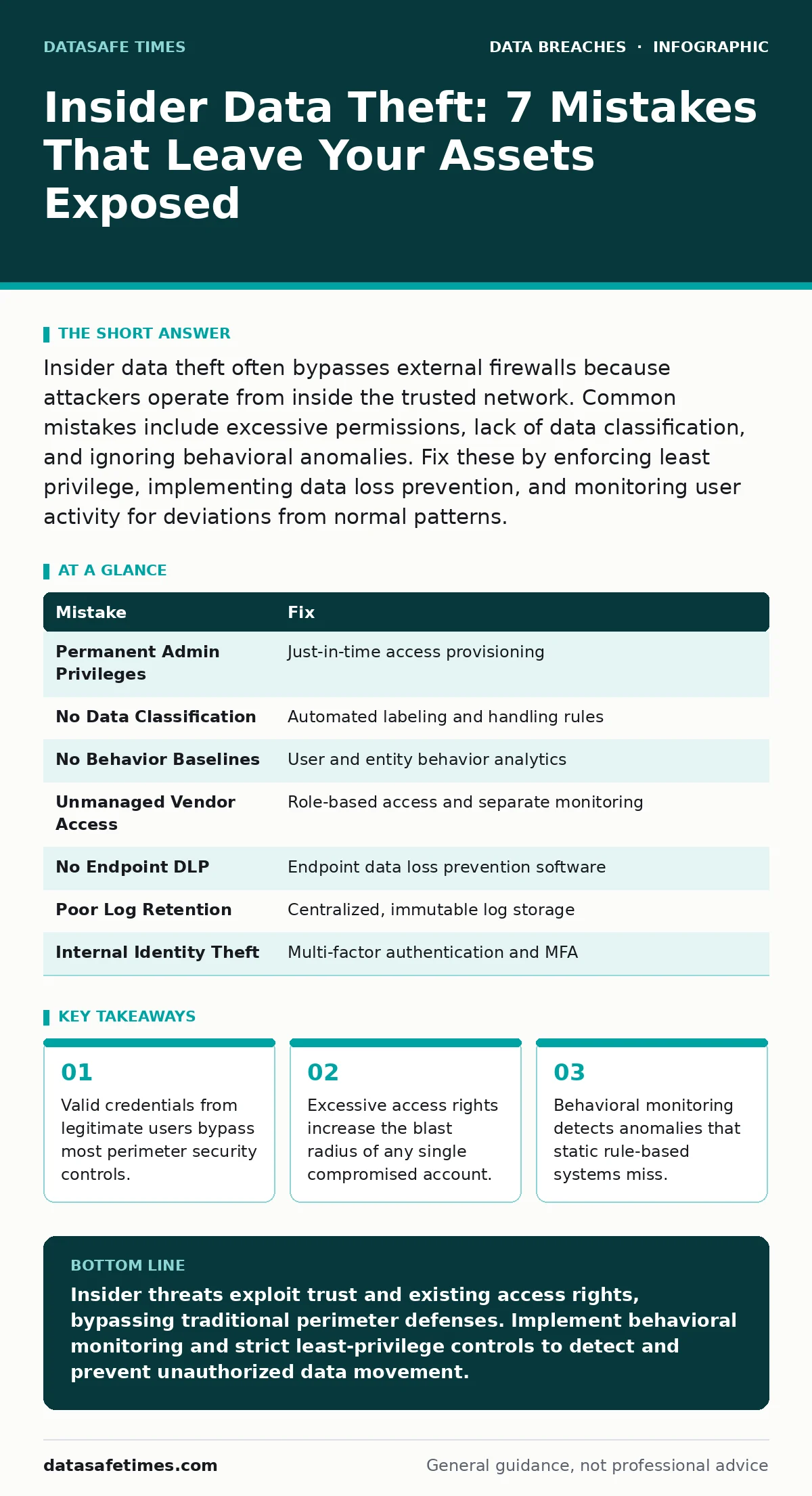
Insider data theft often bypasses external firewalls because attackers operate from inside the trusted network. Common mistakes include excessive permissions, lack of data classification, and ignoring behavioral anomalies. Fix these by enforcing least privilege, implementing data loss prevention, and monitoring user activity for deviations from normal patterns.
Mistake 1: Granting Permanent Administrative Privileges
Administrative privileges allow a user to modify system configurations, install software, and access sensitive data stores. When these rights are granted permanently to standard employees, the system assumes every action is authorized. This assumption creates a blind spot for malicious insiders who can escalate their own permissions or disable security logging.
Why it hurts:
Permanent admin rights eliminate the need for an attacker to exploit a vulnerability. The insider already has the keys to the kingdom. They can copy data, alter audit logs, or create backdoor accounts without triggering alerts that require elevated permission changes. This direct access makes detection nearly impossible using standard network monitoring tools.
The fix:
Implement just-in-time access provisioning. This mechanism grants elevated privileges only for a specific duration and task. The system revokes the rights automatically after the window closes. Combine this with multi-factor authentication for any privilege elevation request. This reduces the window of opportunity for an insider to act maliciously or for a stolen credential to be abused.
Mistake 2: Ignoring Data Classification and Labeling
Not all data carries the same risk or value. Treating internal documentation the same as customer financial records or proprietary source code creates noise in security monitoring. Without clear labels, security tools cannot distinguish between a routine file transfer and a potential data exfiltration event. This lack of granularity forces security teams to ignore large volumes of traffic to avoid alert fatigue.
Why it hurts:
Unlabeled data allows insiders to move sensitive information under the guise of normal business activity. If a database contains both public and private records without separation, an insider can extract the private records without triggering specific database security alerts. The volume of data movement appears normal because it is mixed with legitimate, non-sensitive transfers.
The fix:
Apply data classification labels at the point of creation. Use automated tools to scan for patterns that indicate sensitive information, such as credit card numbers or personal identifiers. Enforce different handling rules for each class. For example, block the upload of highly classified files to personal cloud storage services while allowing them on approved corporate drives.
Mistake 3: Failing to Monitor User Behavior Baselines
Standard security tools look for known bad signatures, such as malware hashes or known malicious IP addresses. They rarely look at how a specific user typically behaves. An insider who works nights, downloads large files, or accesses unusual systems may be acting normally for their role, or they may be preparing to steal data. Without a baseline, these actions appear identical.
Why it hurts:
Behavioral anomalies are often the first sign of insider threat, whether malicious or accidental. If you do not define what normal looks like for each user, you cannot detect deviations. An insider can slowly exfiltrate data over months, keeping each transfer small enough to avoid threshold-based alerts. This slow burn approach avoids detection by systems that only look for immediate, high-volume spikes.
The fix:
Deploy user and entity behavior analytics. These systems learn the typical patterns of each user, including login times, accessed resources, and data volumes. When behavior deviates significantly from the established baseline, the system generates an alert. Investigate these anomalies promptly to determine if they represent a security incident or a change in job responsibilities.
Mistake 4: Overlooking Third-Party and Vendor Access
Organizations often grant external vendors access to internal systems to provide maintenance or support. These accounts are frequently created with high privileges to ensure the vendor can perform their work. Once created, these accounts are rarely reviewed or revoked when the contract ends. This creates a persistent entry point for data theft.
Why it hurts:
Third-party accounts are often less secure than internal employee accounts. Vendors may share credentials among staff or fail to enforce strict access controls. An insider at the vendor organization, or an attacker who compromises the vendor, can use these credentials to access your data. The breach may not be attributed to your own employees, making the investigation more complex.
The fix:
Treat third-party access with the same scrutiny as internal employee access. Use role-based access control to limit vendor permissions to only what is strictly necessary. Implement separate monitoring for these accounts and revoke access immediately when services are no longer needed. Consider using a jump server or bastion host to mediate all vendor access, providing a single point of control and logging.
Mistake 5: Neglecting Endpoint Data Loss Prevention
Network firewalls and intrusion detection systems focus on traffic moving across the network perimeter. They often miss data that leaves the organization through endpoints, such as USB drives, email attachments, or direct uploads to personal accounts. If the endpoint itself is not monitored, data can bypass network controls entirely.
Why it hurts:
Insiders can copy sensitive data to removable media or upload it to personal cloud storage from their workstation. These actions do not traverse the network perimeter in a way that traditional tools detect. The data leaves the organization in small, fragmented pieces that look like normal user activity. By the time the theft is discovered, the data is already outside your control.
The fix:
Implement data loss prevention software on endpoints. This software monitors file access and blocks unauthorized transfers of sensitive data. It can prevent copying to USB drives, block uploads to unauthorized cloud services, and scan outgoing emails for sensitive content. Ensure the software is configured to enforce policies consistently across all devices, including laptops and mobile devices.
See also: Insider Threat Mistakes That Expose Your Data and How to Fix Them · Role Based Access Control vs ACL: The Structural Difference
Mistake 6: Inadequate Logging and Audit Trail Retention
Security logs provide the evidence needed to investigate incidents. However, many organizations fail to collect sufficient logs or retain them for a long enough period. Logs may be stored on local devices that can be wiped by an insider, or they may be deleted after a short retention period. Without complete logs, you cannot reconstruct the actions of an insider.
Why it hurts:
An insider with administrative privileges can delete local logs to cover their tracks. If logs are not sent to a centralized, immutable storage system, this action destroys the evidence. Even if logs are preserved, a short retention period may mean that evidence of slow, long-term data theft is lost before it is noticed. This makes forensic analysis difficult or impossible.
The fix:
Centralize log collection using a secure log management system. Ensure logs are forwarded in real-time to a remote server that insiders cannot access. Implement file integrity monitoring on critical systems to detect any unauthorized changes to log files. Retain logs for a period that matches your regulatory requirements and investigation needs, typically several years.
Mistake 7: Assuming Identity Theft Only Comes From Outside
Identity theft is often viewed as an external attack where criminals steal credentials to impersonate users. However, insiders can also steal identities. A malicious employee may compromise the credentials of a more privileged colleague or a service account to access data they are not authorized to see. This lateral movement allows them to bypass their own permission limits.
Why it hurts:
When an insider uses stolen credentials, the activity appears to come from a legitimate, high-privilege account. Security teams may trust the actions of a senior manager or a critical service account without verification. This trust allows the insider to access highly sensitive data stores, such as those containing leaked source code or customer records, without raising immediate suspicion.
The fix:
Enforce strong authentication for all accounts, especially privileged ones. Use multi-factor authentication to ensure that a stolen password alone is insufficient for access. Monitor for impossible travel, such as logins from two distant locations in a short time, which indicates credential compromise. Regularly review access logs for unusual activity from service accounts.
| Mistake | Fix |
|---|---|
| Permanent Admin Privileges | Just-in-time access provisioning |
| No Data Classification | Automated labeling and handling rules |
| No Behavior Baselines | User and entity behavior analytics |
| Unmanaged Vendor Access | Role-based access and separate monitoring |
| No Endpoint DLP | Endpoint data loss prevention software |
| Poor Log Retention | Centralized, immutable log storage |
| Internal Identity Theft | Multi-factor authentication and MFA |
Key takeaways
- Valid credentials from legitimate users bypass most perimeter security controls.
- Excessive access rights increase the blast radius of any single compromised account.
- Behavioral monitoring detects anomalies that static rule-based systems miss.
Insider threats exploit trust and existing access rights, bypassing traditional perimeter defenses. Implement behavioral monitoring and strict least-privilege controls to detect and prevent unauthorized data movement.
Frequently asked questions
How do I distinguish between a malicious insider and a careless employee?
Malicious insiders typically show deliberate patterns of evasion, such as accessing data outside their role or disabling logging. Careless employees usually make accidental errors that follow normal work patterns. Behavioral analytics helps separate these intents.
Does remote work increase the risk of insider data theft?
Remote work expands the attack surface by moving endpoints outside the physical office. It requires stricter endpoint security and remote access controls. The risk shifts from physical theft to digital exfiltration via personal devices or networks.
Can automated tools fully prevent insider data theft?
No tool can fully prevent insider theft, as humans can always find ways to bypass controls. Automation reduces the risk and speeds up detection. Human oversight and investigation remain necessary to confirm alerts and take appropriate action.
How often should I review user access permissions?
Review permissions quarterly or upon any change in role or employment status. Regular reviews ensure that access rights align with current job duties. This process, known as access certification, removes stale permissions that could be exploited.
How this guide was produced: written by the DataSafe Times editorial team with AI assistance, checked against the public references listed below, and reviewed when the facts change. See our editorial policy or report an error.