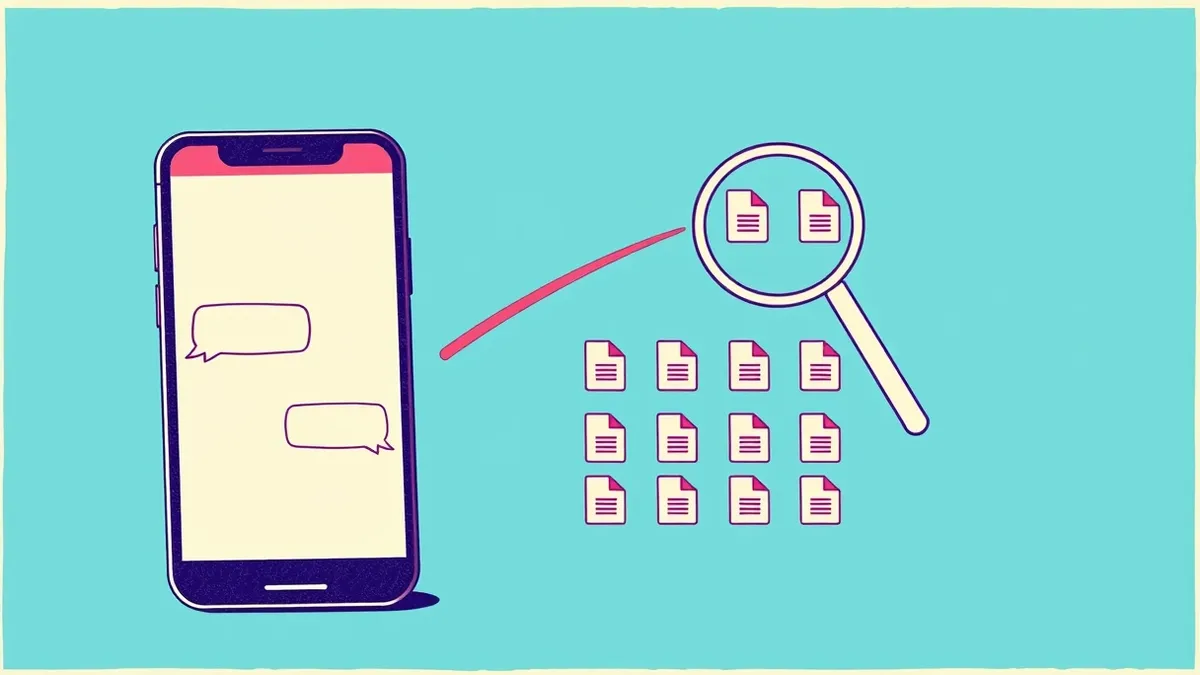
Artificial intelligence chat platforms often assign predictable, publicly accessible web addresses to shared conversation transcripts. When web crawlers discover these addresses, search engines index the transcripts, making private queries searchable by anyone on the internet.
Understanding the Indexation Mechanism
Modern software systems often create unique hyperlinks to let users share dynamic content without authentication barriers. Artificial intelligence interfaces adopt this pattern by publishing conversation transcripts to static web addresses. Indexation occurs when automated programs catalog these public addresses, turning private thoughts into searchable public records. Developers building these features frequently overlook how external discovery mechanisms interact with unauthenticated endpoints.
Anatomy of a Shared Conversation Link
Web applications construct these sharing endpoints using sequential integers, predictable hash functions, or randomized strings with low entropy. Entropy measures the randomness of data within a generated identifier, determining how difficult guessing that identifier becomes. Low entropy strings allow automated scanners to enumerate valid addresses rapidly. Generating secure links requires cryptographic pseudo-random number generators operating with sufficient bit length to prevent brute-force discovery.
The Role of Automated Web Crawlers
Autonomous software agents traverse the internet following hyperlinks to build indexes for search engines. These crawlers evaluate page content, parse document structures, and store text for rapid retrieval. When a crawler encounters an unauthenticated chat transcript, it indexes the text without verifying whether the human author intended public exposure. Web standards provide mechanisms like robot exclusion files to signal crawler intent, but these rules remain voluntary and frequently fail.
Stages of the Leak
Stage 1: Generation
Users click a share button inside the conversational interface, prompting the backend to serialize the chat history into a database. The system assigns a unique web address to this payload and returns the link to the client. This action often occurs without warning the user that the resulting endpoint lacks access controls or authentication requirements.
Stage 2: Discovery
Search engines or malicious actors discover the newly minted address through explicit sharing, embedded links, or systematic enumeration. Automated crawlers follow hyperlinks found on public forums, social media posts, or browser telemetry feeds. Once a crawler lands on the page, the unauthenticated nature of the endpoint allows immediate data ingestion.
Stage 3: Indexation
Systems parse the natural language text within the transcript and add the terms to a searchable database. Vector embeddings and inverted indexes map the words to the specific web address, associating sensitive queries with a publicly accessible Uniform Resource Locator. This stage solidifies the leak, transforming a transient web request into a persistent public artifact.
Stage 4: Retrieval
Internet users execute standard queries containing specific phrases or code snippets found inside the leaked transcript. Search engines match the query parameters against the indexed database and display the chat transcript in search engine result pages. Anyone clicking the result gains full visibility into the original conversation history.
Table of Stages and Interruption Points
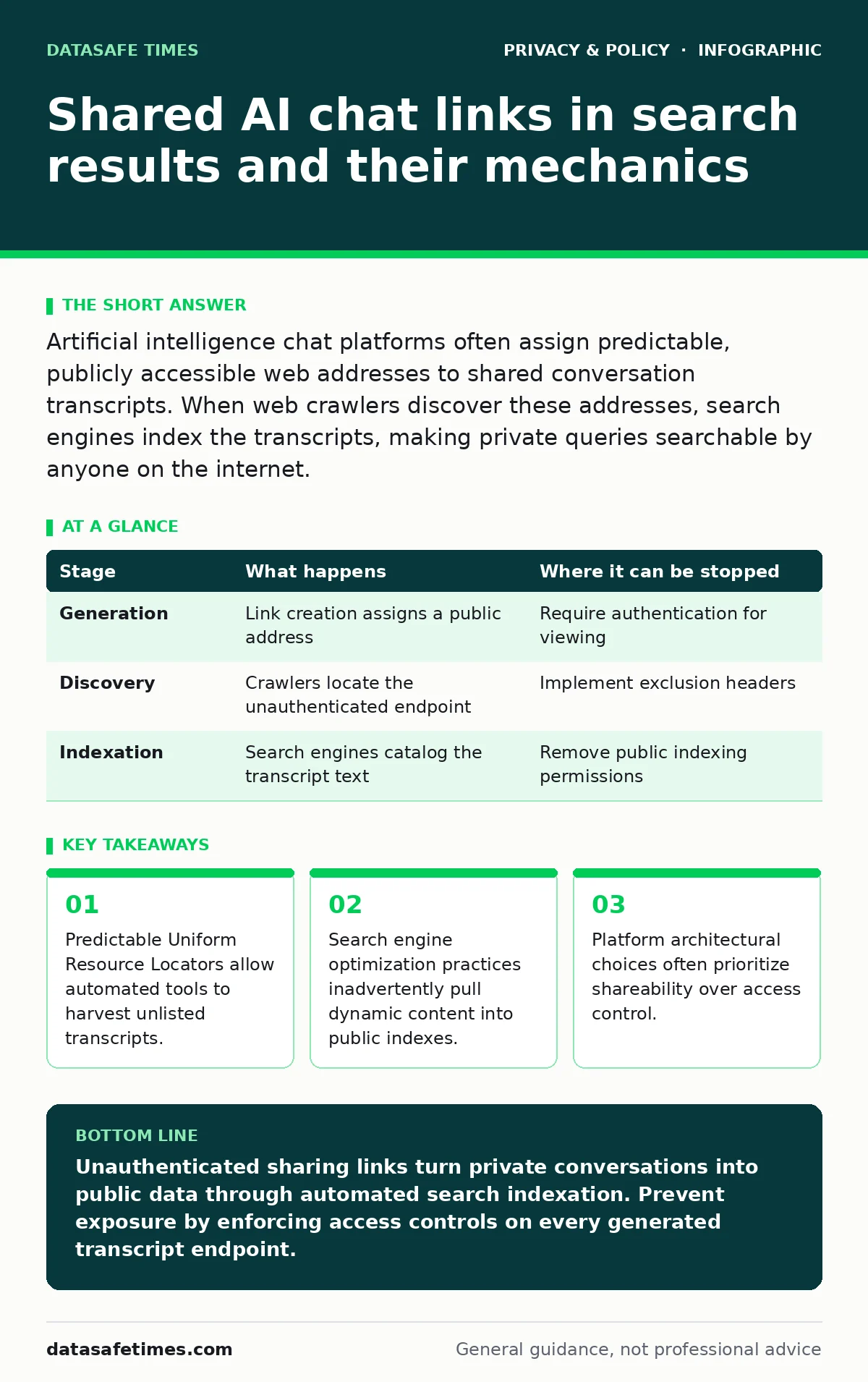
Intercepting this data pipeline requires targeted interventions at specific architectural boundaries. 3 distinct barriers exist to stop transcripts from reaching public search indexes.
| Stage | What happens | Where it can be stopped |
|---|---|---|
| Generation | Link creation assigns a public address | Require authentication for viewing |
| Discovery | Crawlers locate the unauthenticated endpoint | Implement exclusion headers |
| Indexation | Search engines catalog the transcript text | Remove public indexing permissions |
Hidden Costs and Non-Obvious Consequences
Deleting a shared chat transcript inside your account dashboard rarely purges existing search engine indexes immediately. Search engine caching behavior ensures that leaked data persists long after the original source vanishes from the application. Organizations facing regulatory compliance actions under statutes like the CCPA discover that third-party indexation complicates data deletion mandates, especially when individuals submit formal data subject access requests for complete record removal. Furthermore, relying on browser cookies for session security fails here because the shared link deliberately strips authentication requirements to allow anonymous viewing.
Key takeaways
- Predictable Uniform Resource Locators allow automated tools to harvest unlisted transcripts.
- Search engine optimization practices inadvertently pull dynamic content into public indexes.
- Platform architectural choices often prioritize shareability over access control.
Unauthenticated sharing links turn private conversations into public data through automated search indexation. Prevent exposure by enforcing access controls on every generated transcript endpoint.
Frequently asked questions
Why do artificial intelligence chat platforms make shared links public by default?
Platforms prioritize frictionless collaboration and easy sharing, assuming users understand that generated links function as public web pages rather than private messages.
Can search engines remove indexed transcripts if the original link is deleted?
Search engines typically require a specific removal request or timeout period to clear cached copies, meaning deleted transcripts often remain accessible in search results for weeks.
Do robots exclusion files guarantee that search crawlers will ignore shared chat transcripts?
Exclusion files rely entirely on crawler compliance and provide no cryptographic enforcement, meaning non-compliant scraping tools routinely ignore those instructions.
How does link entropy prevent unauthorized access to shared transcripts?
High entropy identifiers use cryptographic randomness to ensure that guessing valid link addresses through brute-force enumeration remains computationally impractical for attackers.
How this guide was produced: written by the DataSafe Times editorial team with AI assistance, checked against the public references listed below, and reviewed when the facts change. See our editorial policy or report an error.