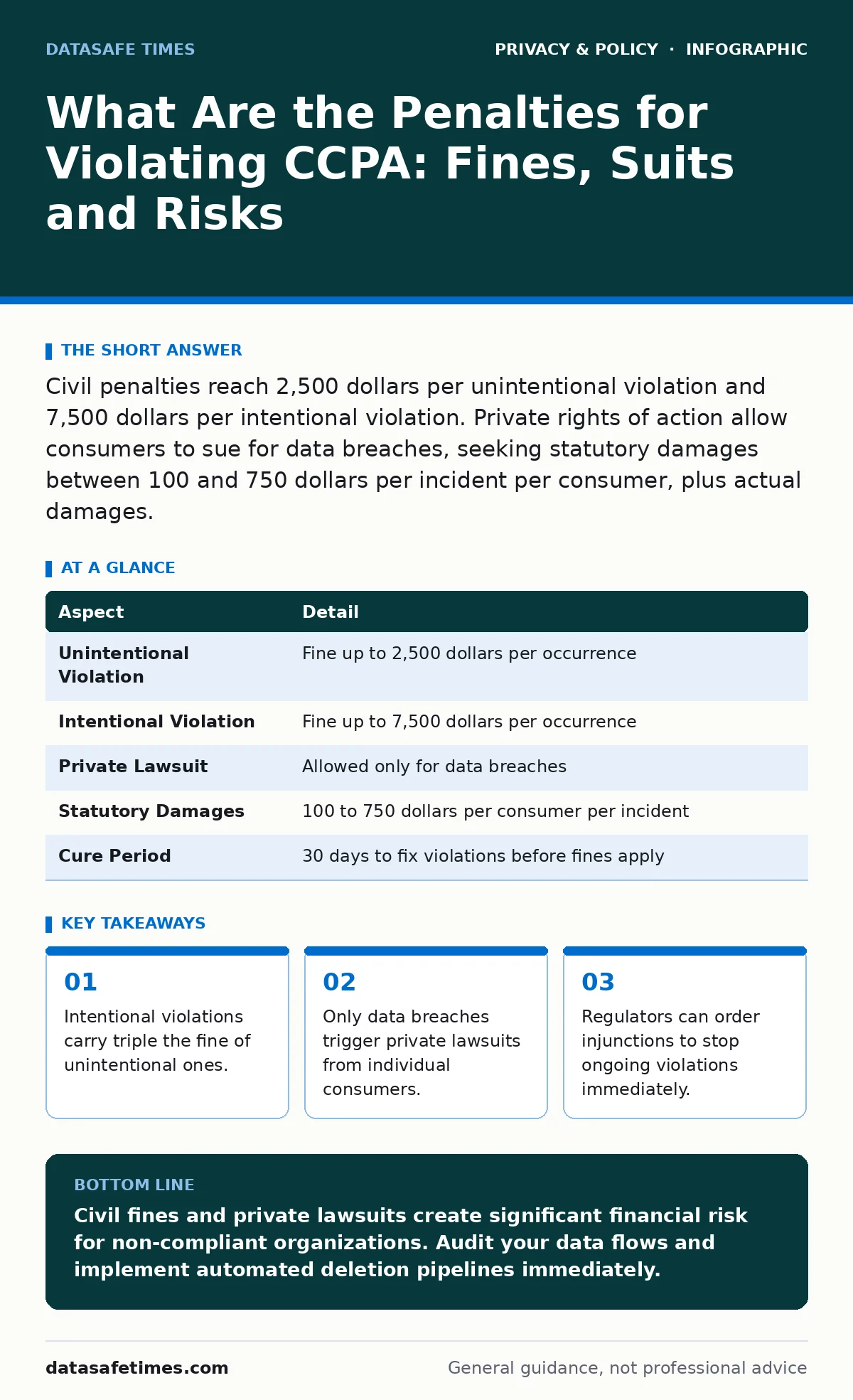
Civil penalties reach 2,500 dollars per unintentional violation and 7,500 dollars per intentional violation. Private rights of action allow consumers to sue for data breaches, seeking statutory damages between 100 and 750 dollars per incident per consumer, plus actual damages.
Everyday Data Collection Analogy
Imagine you run a small coffee shop that tracks every customer’s favorite drink. You record names, phone numbers, and payment details to send discount coupons. The California Consumer Privacy Act treats this data collection like a library check-out system. You must tell customers what you keep. You must let them request deletion. You must stop selling that information if they ask. Failure to maintain this transparency triggers legal consequences.
The law applies to for-profit entities that do business in California. It covers companies meeting specific revenue thresholds. It covers firms that process personal data of 100,000 or more consumers. It covers organizations that derive substantial revenue from selling personal information. Small businesses often misunderstand their status. They assume small size exempts them. This assumption is incorrect if they meet the consumer count threshold.
| Aspect | Detail |
|---|---|
| Unintentional Violation | Fine up to 2,500 dollars per occurrence |
| Intentional Violation | Fine up to 7,500 dollars per occurrence |
| Private Lawsuit | Allowed only for data breaches |
| Statutory Damages | 100 to 750 dollars per consumer per incident |
| Cure Period | 30 days to fix violations before fines apply |
How the Enforcement Mechanism Works
The California Attorney General enforces the statute directly. They investigate complaints from consumers or businesses. They send a notice of violation. The organization receives 30 days to cure the problem. If the organization fixes the issue within this window, the Attorney General may not pursue civil penalties. This cure period applies only to unintentional violations. It does not apply to intentional misuse of data.
The California Privacy Protection Agency also holds enforcement power. This agency issues regulations and investigates complaints. They can impose administrative fines. These fines are separate from Attorney General actions. The state can seek injunctive relief. This stops the organization from continuing the illegal activity. The state can also demand corrective actions. These actions often require system-wide changes to data handling processes.
What Are the Penalties for Violating CCPA
The civil penalties structure depends on intent. Unintentional violations face fines up to 2,500 dollars per violation. Each failure to provide required notices counts as a separate violation. Each failure to honor a deletion request counts as another violation. Intentional violations face fines up to 7,500 dollars per violation. Selling data after a consumer opts out is intentional. Ignoring a verified request for access is intentional.
Private rights of action exist only for data breaches. A consumer whose nonencrypted personal information is breached can sue. They can seek statutory damages between 100 and 750 dollars per consumer per incident. They can also seek actual damages. Actual damages must be proven with evidence. Statutory damages do not require proof of harm. Class action lawsuits multiply these damages significantly. Organizations must track incident response carefully.
Who Faces Regulatory Scrutiny
The law targets businesses that collect personal data. It defines personal data broadly. It includes identifiers like names and email addresses. It includes commercial information like transaction records. It includes internet activity like browsing history. It includes geolocation data. It includes sensitive personal information like social security numbers. It includes racial or ethnic origin.
Nonprofits are generally exempt. Government agencies are exempt. Credit reporting agencies follow federal law instead. However, vendors and service providers face indirect pressure. They must help businesses comply. They must delete data upon request. They must not retain data longer than necessary. This creates a chain of compliance. Small vendors often lack resources for this chain. They become weak points in larger organizations' compliance efforts.
Common Misinterpretations of the Law
Many organizations believe they are exempt because they are small. The consumer count threshold catches many small firms. Processing 100,000 consumers triggers coverage. Many startups reach this number quickly. They assume revenue thresholds protect them. This assumption fails if they sell data. Deriving substantial revenue from sales triggers coverage.
Another common error is ignoring sensitive data. The law grants extra protections for sensitive personal information. This includes health data. This includes precise geolocation. This includes religious beliefs. Organizations often treat this data like standard information. They fail to provide the required notice. They fail to allow limiting use. This creates liability distinct from general violations.
See also: Why Is Doxxing Not Illegal: The Legal Gaps and Technical Fixes
Technical Implementation for Developers
Developers must build compliance into the architecture. They cannot patch it later. The system must identify users across devices. It must link cookies to user accounts. It must track consent preferences. The system must honor opt-out signals globally. Global Privacy Control signals must be respected. These signals come from browser extensions. They indicate a user’s preference to stop selling data.
Data mapping is required. You must know where every piece of data resides. You must know how long you keep it. You must know who has access to it. Deletion requests require complete removal. This includes backups. This includes analytics databases. This includes third-party vendor copies. Partial deletion is not sufficient. It leaves residual liability.
Mitigation Strategies for Compliance
Start with a data inventory. Map all data flows. Identify collection points. Identify storage locations. Identify sharing partners. Update your privacy policy. It must list all categories of data collected. It must list purposes for collection. It must list sharing partners. It must describe consumer rights.
Implement a verification process. You must verify user identities before granting access. You must verify them before deleting data. Weak verification exposes you to fraud. Strong verification respects privacy. Use multi-factor authentication for sensitive requests. Balance security with usability.
Related Privacy Considerations
Understanding CCPA helps you manage other risks. You should review your use of encrypted messaging apps. These apps often store metadata. Metadata counts as personal data. You must disclose its collection. You should also consider children's online privacy risks. Minors require additional protections. Their data cannot be sold without consent.
VPNs affect data attribution. They mask IP addresses. IP addresses are personal data. Masking them complicates verification. It also complicates consent management. Social media privacy risks extend to embedded widgets. These widgets collect data on your site. You are responsible for their collection. Ad blockers interfere with tracking pixels. They may break consent mechanisms. You must design for these tools. Public Wi-Fi risks include data interception. Encrypt all data in transit. DNS over HTTPS prevents eavesdropping on domain requests. Personal data requires encryption at rest. This limits breach impact.
Key takeaways
- Intentional violations carry triple the fine of unintentional ones.
- Only data breaches trigger private lawsuits from individual consumers.
- Regulators can order injunctions to stop ongoing violations immediately.
Civil fines and private lawsuits create significant financial risk for non-compliant organizations. Audit your data flows and implement automated deletion pipelines immediately.
Frequently asked questions
Can small businesses be sued under CCPA?
Yes, if they process data of 100,000 or more consumers. Size alone does not exempt you from enforcement actions or private lawsuits for data breaches.
Does CCPA apply to websites with no sales?
It applies if you meet the consumer threshold or revenue threshold. Even without sales, you must honor access and deletion requests for covered entities.
How do I verify a consumer's identity?
Use reasonable verification methods. For sensitive data, use multi-factor authentication. For general data, match provided information against records you hold securely.
What happens if I ignore a deletion request?
You face civil penalties up to 7,500 dollars per violation. You also risk private lawsuits if the retained data is later breached and exposed to consumers.
How this guide was produced: written by the DataSafe Times editorial team with AI assistance, checked against the public references listed below, and reviewed when the facts change. See our editorial policy or report an error.