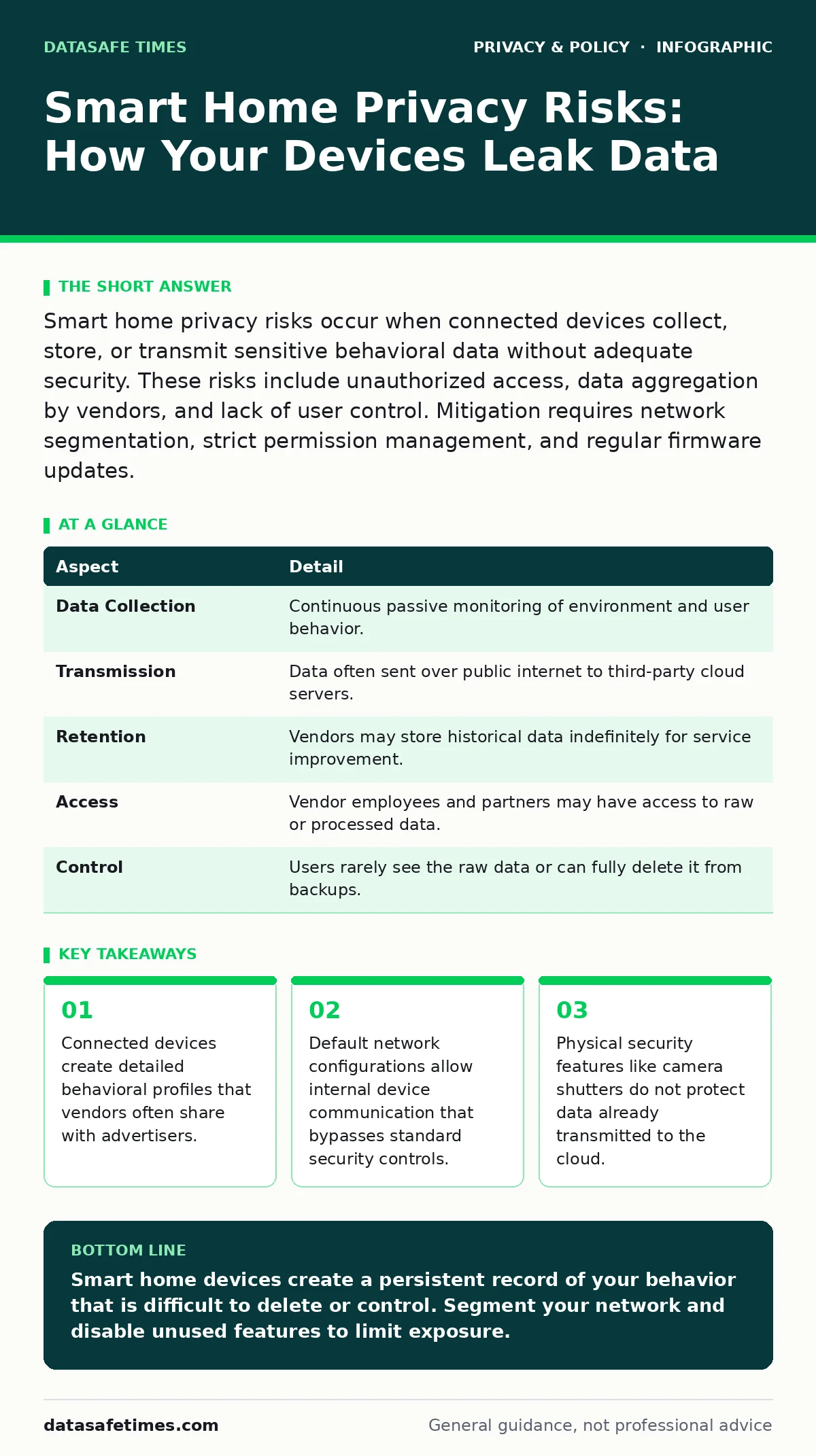
Smart home privacy risks occur when connected devices collect, store, or transmit sensitive behavioral data without adequate security. These risks include unauthorized access, data aggregation by vendors, and lack of user control. Mitigation requires network segmentation, strict permission management, and regular firmware updates.
The Digital Panopticon Effect
Imagine a house where every light switch, door lock, and thermostat records its usage. Now imagine that record is sent to a central server owned by a company you do not know. This is the baseline operation of a smart home. The risk is not merely that a hacker might peek in. The primary privacy risk is the continuous, automated creation of a behavioral profile.
These devices do not just respond to commands. They listen for patterns. A smart speaker monitors ambient noise to detect wake words. A smart thermostat learns when you are home to adjust heating. A smart lock records entry and exit times. When combined, these data points reveal your routine, your guests, and your absence.
The danger lies in the aggregation. One device provides a snapshot. A hundred devices provide a biography. You are not just sharing data; you are outsourcing your memory of daily life to corporate servers. This data persists even if you delete the app on your phone.
| Aspect | Detail |
|---|---|
| Data Collection | Continuous passive monitoring of environment and user behavior. |
| Transmission | Data often sent over public internet to third-party cloud servers. |
| Retention | Vendors may store historical data indefinitely for service improvement. |
| Access | Vendor employees and partners may have access to raw or processed data. |
| Control | Users rarely see the raw data or can fully delete it from backups. |
The Hidden Cost of Convenience
Smart devices trade privacy for automation. The mechanism is simple: the device must know what is happening to act on it. To know if you are sleeping, the device must monitor movement or sound. To know if you are cooking, it must monitor heat or appliance usage.
This creates a non-obvious consequence. You cannot "turn off" the privacy risk without turning off the functionality. There is no middle ground where the device automates your life without observing it. The observation is the prerequisite for the automation.
Developers often assume that local processing solves this. Suppose a device processes voice commands locally. It still needs to send updates to the cloud to sync with other devices. It still needs an internet connection to receive firmware patches. The local processing is a feature, not a privacy guarantee. The device remains part of a larger network that requires data exchange.
Common Forms of Exposure
The most common risk is insecure default settings. Manufacturers ship devices with open ports or default credentials to ensure easy setup. If you do not change these, the device remains accessible to anyone on your network, or sometimes the public internet.
Another form is the supply chain risk. The app on your phone talks to the device, but it also talks to the vendor's server. If the vendor's server is compromised, your device settings and data are exposed. This is not a flaw in your device, but in the infrastructure supporting it.
Third-party integrations add another layer. You might connect your smart home to a fitness app or a social media platform. Each integration grants the third party access to specific data streams. A fitness app might need to know when you leave the house. A social media app might want to post when you play music. These permissions are often granted broadly and forgotten.
Who Is Affected
Everyone who installs a connected device is affected. However, the impact varies by usage. A user with one smart bulb faces low risk. A user with a full home automation system faces high risk. The risk scales with the number of data points collected.
Vulnerable populations are at greater risk. Elderly users may not understand privacy settings. Children may interact with devices in ways that record sensitive conversations. The data collected can reveal health conditions, financial status, or family dynamics.
Vendors are also affected. They hold the liability for data breaches. They face regulatory scrutiny if they mishandle user data. This creates a conflict of interest. Vendors want to collect more data to improve services and sell insights. They want to collect less data to reduce liability. Users are caught in the middle.
What People Usually Get Wrong
Many users believe that using private browsing mode protects their smart home data. This is incorrect. Private browsing mode prevents the browser on your computer from storing history and cookies. It does not affect the traffic from your smart thermostat or security camera. Those devices operate on the network layer, not the application layer of your web browser.
Another common error is assuming that anonymization protects the data. Vendors often claim to anonymize data by removing names and addresses. However, behavioral data is often unique. The pattern of your energy usage, combined with your schedule, can re-identify you. Anonymization is a legal shield for the vendor, not a technical guarantee for the user.
Users also misunderstand end-to-end encryption. This protocol ensures that only the sender and receiver can read the message. It does not prevent the server from seeing that a message was sent. It does not hide the metadata. The vendor still knows when you unlocked your door, even if they cannot see the video feed.
Reducing the Risk
You can reduce risk through network segmentation. Create a separate virtual local area network (VLAN) for your IoT devices. This isolates them from your personal computers and phones. If a smart bulb is compromised, the attacker cannot jump to your laptop. This requires a router that supports VLANs or guest networks.
Update your firmware regularly. Manufacturers release patches to fix security holes. If you disable automatic updates, you remain vulnerable to known exploits. Check for updates monthly. If a device has not been updated in a year, consider replacing it. Abandoned devices are permanent risks.
Review permissions critically. Do not grant a smart speaker access to your location if it does not need it. Do not allow a smart TV to access your microphone if you do not use voice control. Disable features you do not use. Each disabled feature is a closed door for potential attackers.
The Long-Term View
Privacy is not a one-time setting. It is a continuous process. Devices age. Support ends. Security patches stop. A device that is secure today may be vulnerable tomorrow. You must plan for the end of life.
Consider the data you leave behind. When you sell your home, you must reset all devices. When you cancel a service, you must request data deletion. Use data subject access requests to know what is stored. Use GDPR rights if you are in the relevant jurisdictions. These tools are slow, but they are the only way to verify deletion.
The goal is not perfect privacy. That is impossible in a connected world. The goal is minimizing the footprint. Reduce the amount of data collected. Limit the access to that data. Keep the data local where possible. Understand that convenience has a cost, and pay it consciously.
Key takeaways
- Connected devices create detailed behavioral profiles that vendors often share with advertisers.
- Default network configurations allow internal device communication that bypasses standard security controls.
- Physical security features like camera shutters do not protect data already transmitted to the cloud.
Smart home devices create a persistent record of your behavior that is difficult to delete or control. Segment your network and disable unused features to limit exposure.
Frequently asked questions
Do smart home devices listen to me when I am not speaking?
Most devices do not continuously transmit audio. They listen locally for a wake word. However, they may record short buffers of audio to improve accuracy, which are often deleted but may be retained in some cases.
Can I use smart devices without an internet connection?
Some devices can function locally, but most require internet for setup, updates, and remote access. Local-only devices are rare and often lack advanced features.
How do I know if my smart home data is secure?
You usually cannot know for sure. Check the vendor's privacy policy and security certifications. Look for devices that support local processing and offer clear data deletion options.
Is it better to disable all smart features?
Disabling features reduces risk but eliminates convenience. The best approach is to use features that do not require sensitive data, such as automated lighting, while avoiding devices that capture audio or video.
How this guide was produced: written by the DataSafe Times editorial team with AI assistance, checked against the public references listed below, and reviewed when the facts change. See our editorial policy or report an error.