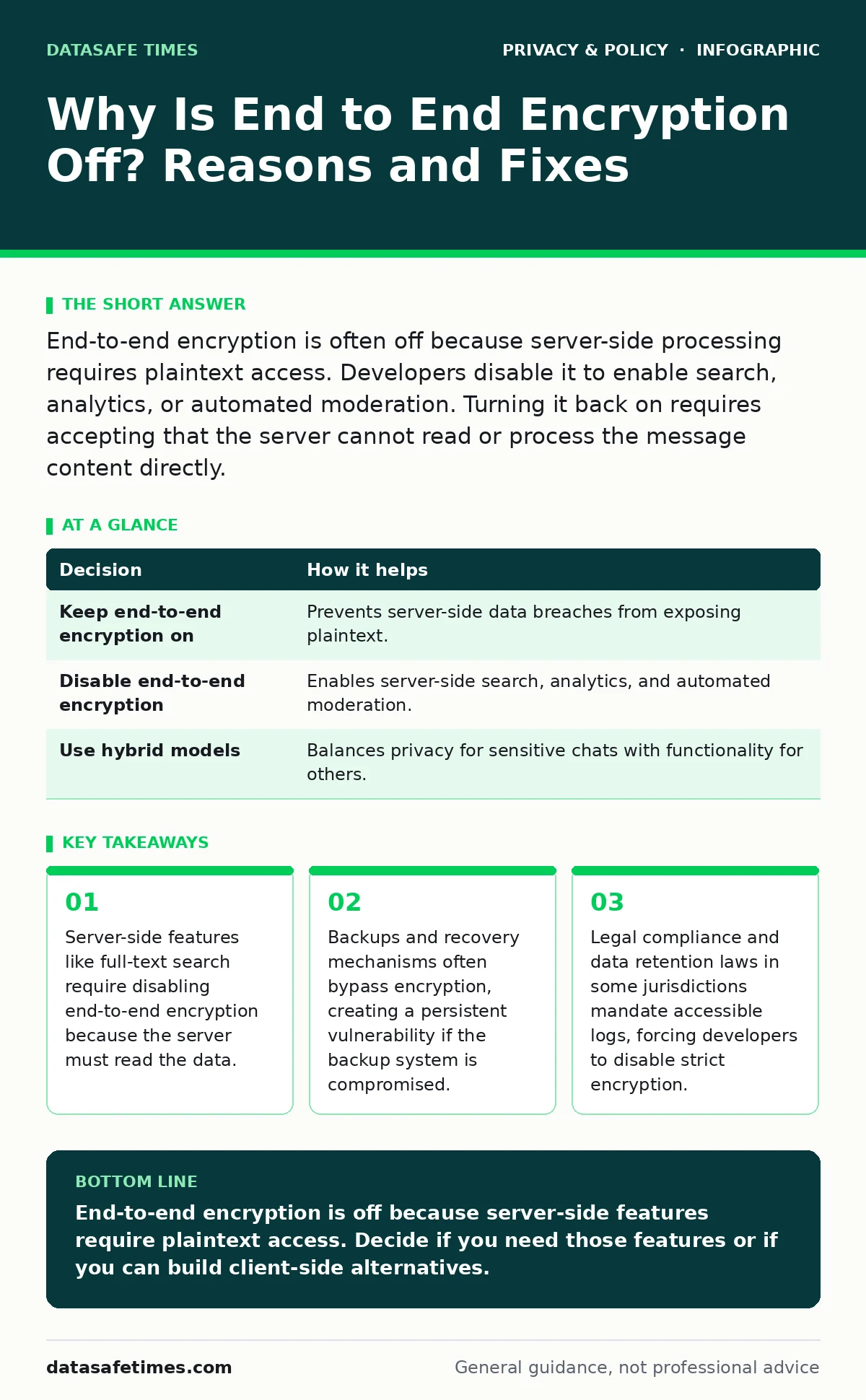
End-to-end encryption is often off because server-side processing requires plaintext access. Developers disable it to enable search, analytics, or automated moderation. Turning it back on requires accepting that the server cannot read or process the message content directly.
Why Is End to End Encryption Off
End-to-end encryption is off because the application architecture requires the server to read the data. This is the primary reason developers disable the feature. When data is encrypted end-to-end, only the sender and receiver hold the keys. The server acts as a blind pipe. It cannot inspect, store, or process the payload. If your application needs to search message contents, trigger automated responses, or perform content moderation, the server must decrypt the data first. This breaks the end-to-end model. The encryption becomes in-transit only. The server holds the keys. You lose the guarantee that no third party, including the provider, can read the data.
The Architecture Trade-Off
Developers face a binary choice between functionality and privacy. End-to-end encryption provides maximum privacy but zero server-side visibility. In-transit encryption provides moderate privacy with full server-side control. Most commercial messaging platforms choose in-transit encryption. They prioritize features like cloud sync, cross-device search, and spam filtering. These features require the server to hold the decryption keys. The trade-off is explicit. You gain convenience and functionality. You surrender the ability to prove that the provider did not read your messages. This is not a bug. It is a design decision.
What Goes Wrong Without It
When end-to-end encryption is off, the server becomes a high-value target. Attackers focus on the server because it holds the keys. Compromising the server grants access to all user data. This is easier than attacking individual devices. The attack surface shifts from millions of endpoints to one central location. Insider threats also increase. Employees with admin access can read any message. Legal requests for data become trivial. The provider hands over plaintext data. There is no cryptographic proof that the data was not read during transit. The trust model relies entirely on the provider’s integrity and security posture.
Hidden Costs of Disabling Encryption
Disabling end-to-end encryption introduces hidden operational costs. Compliance audits become more complex. You must prove that access controls are strict. Logging requirements increase. You must track who accessed what data and when. This creates a massive administrative burden. Legal liability rises. If the server is breached, you are responsible for all exposed data. With end-to-end encryption, the breach contains only ciphertext. The damage is limited. The cost of implementing end-to-end encryption is high. It requires careful key management. It complicates backup strategies. But the long-term risk is lower.
| Decision | How it helps |
|---|---|
| Keep end-to-end encryption on | Prevents server-side data breaches from exposing plaintext. |
| Disable end-to-end encryption | Enables server-side search, analytics, and automated moderation. |
| Use hybrid models | Balances privacy for sensitive chats with functionality for others. |
What To Do With That Knowledge
You must decide what matters more: privacy or functionality. If privacy is paramount, keep end-to-end encryption on. Accept the limitations. You cannot search message history on the server. You cannot rely on cloud backups for recovery. You must manage keys on each device. If functionality is paramount, disable end-to-end encryption. Ensure the server is secure. Implement strict access controls. Log all admin access. Be transparent with users. Tell them the server can read their data. Do not hide this fact. Users deserve to know the trade-off.
Handling Key Management
Key management is the hardest part of end-to-end encryption. Users lose devices. They lose keys. They cannot recover their data. This is a fundamental flaw. Developers often disable encryption to solve this. They store keys on the server. This breaks the model. A better approach is social recovery. Users share keys with trusted contacts. If they lose their device, friends can help recover it. This keeps the server blind. It puts the burden on the user. It is complex. But it preserves privacy. Another option is local backups. Users export encrypted backups to their own storage. The server never sees the keys.
Legal and Compliance Pressures
Some jurisdictions require data retention. Laws may mandate that providers keep logs of communications. End-to-end encryption makes this impossible. The provider cannot produce the data. It does not have it. This creates legal risk. Providers may be forced to disable encryption. Or they may face penalties. This is a growing conflict. Privacy advocates argue for strong encryption. Law enforcement argues for access. Developers are caught in the middle. They must navigate these laws carefully. They may need to implement client-side search. This allows users to search their own data. The server remains blind. This satisfies some legal requirements. It preserves privacy.
Related Privacy Measures
End-to-end encryption is one tool. It is not the only one. You should also consider digital privacy rights. Understand what data you can request. Use data subject access requests to audit what companies hold. Be aware of online tracking. Encryption does not stop metadata collection. The server knows who you talk to and when. Use DNS over HTTPS to hide your browsing habits. Consider encrypted cloud storage for backups. Do not rely on a single layer. Layer your defenses. Use two-factor authentication for personal accounts to protect access. Understand social media privacy risks. These platforms rarely use end-to-end encryption. They monetize your data.
Bottom Line for Developers
You must choose between control and privacy. End-to-end encryption gives you privacy. It takes away control. The server cannot help you. It cannot search. It cannot moderate. You must build your own solutions. Client-side search. Local backups. Social key recovery. These are hard problems. But they are solvable. If you disable encryption, be honest. Tell users the server can read their data. Do not hide behind technical jargon. Transparency builds trust. Even if the product is not private.
Key takeaways
- Server-side features like full-text search require disabling end-to-end encryption because the server must read the data.
- Backups and recovery mechanisms often bypass encryption, creating a persistent vulnerability if the backup system is compromised.
- Legal compliance and data retention laws in some jurisdictions mandate accessible logs, forcing developers to disable strict encryption.
End-to-end encryption is off because server-side features require plaintext access. Decide if you need those features or if you can build client-side alternatives.
Frequently asked questions
Can I turn on end-to-end encryption later?
Yes, but you must re-encrypt all existing data. Old messages remain accessible to the server unless you delete them. New messages will be protected.
Does end-to-end encryption hide metadata?
No. The server still sees who you talk to, when, and how much data is sent. Metadata reveals a lot about your behavior.
Is in-transit encryption safe?
It protects data from network eavesdroppers. It does not protect data from the server provider
How this guide was produced: written by the DataSafe Times editorial team with AI assistance, checked against the public references listed below, and reviewed when the facts change. See our editorial policy or report an error.