
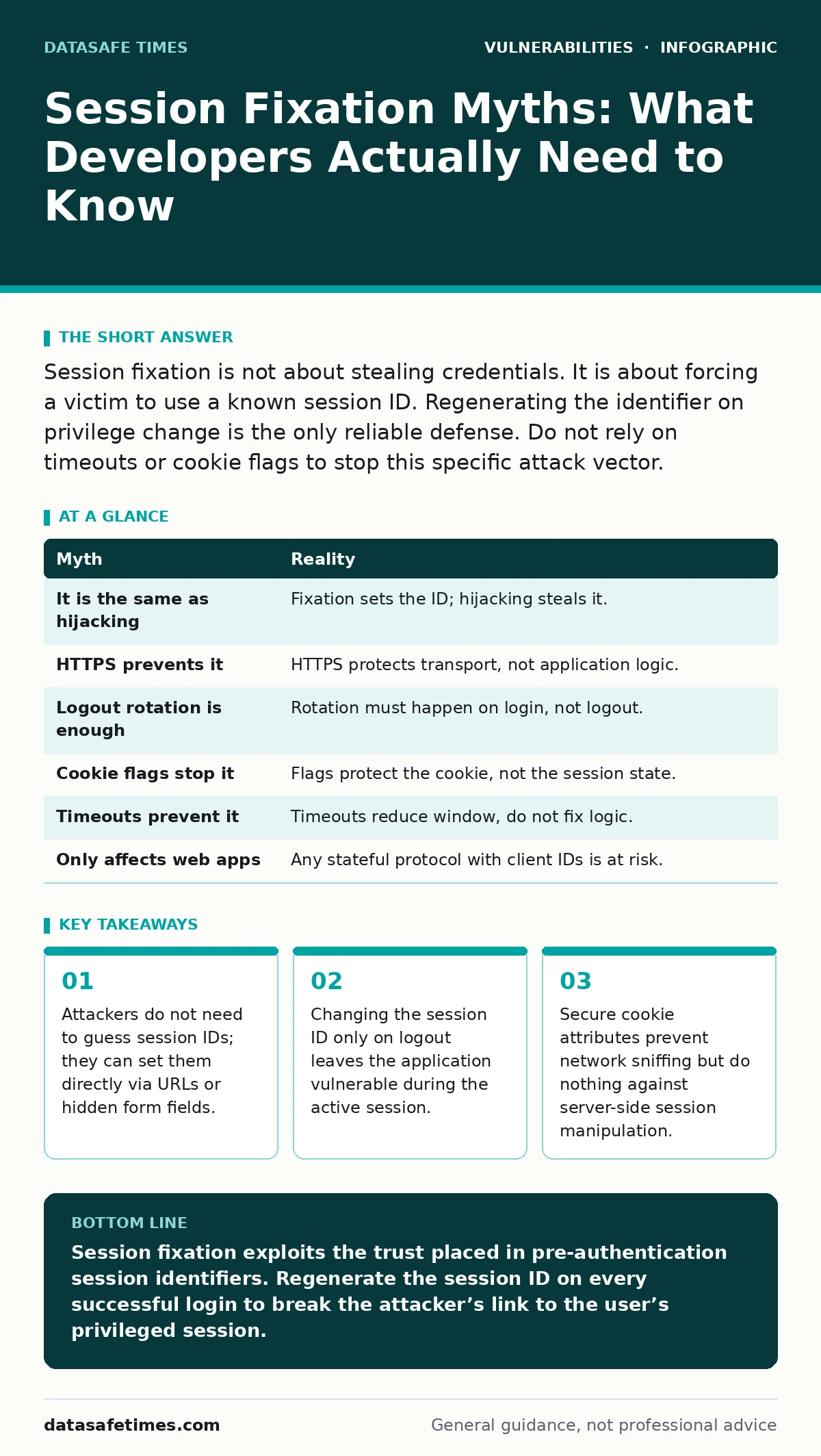
Session fixation is not about stealing credentials. It is about forcing a victim to use a known session ID. Regenerating the identifier on privilege change is the only reliable defense. Do not rely on timeouts or cookie flags to stop this specific attack vector.
Myth: Session fixation is the same as session hijacking
Reality: These are distinct attack vectors with different requirements. Session hijacking involves an attacker stealing an existing, valid session identifier from a victim, often through network eavesdropping or cross-site scripting. The attacker then uses that stolen ID to impersonate the user. Session fixation, by contrast, involves the attacker setting a valid session identifier for the victim before the victim authenticates. The victim logs in using the attacker’s chosen ID. The attacker already knows the ID, so they do not need to steal anything. They simply wait for the victim to elevate their privileges under that known identifier.
Imagine an attacker sends you a link containing a specific session token. You click it, and your browser accepts the token. You then log in to your email. The server sees you are logging in with that specific token and upgrades its permissions. The attacker, knowing the token, can now access your email without ever knowing your password. This distinction matters because defenses against hijacking, like encrypting traffic, do not prevent fixation.
Myth: Using HTTPS prevents session fixation
Reality: HTTPS protects data in transit from being intercepted by third parties on the network. It ensures that the session identifier traveling between your browser and the server cannot be read by a man-in-the-middle. However, session fixation often occurs at the application layer, not the network layer.
An attacker can deliver a fixed session ID via a crafted URL, a hidden form field, or a redirection. Your browser willingly sends this ID to the server over the secure connection. The encryption protects the confidentiality of the transmission, but it does not validate the origin or legitimacy of the session ID itself. The server still accepts the attacker-provided ID as valid.
This is why secure transport layers are necessary but insufficient. You can have perfect encryption and still suffer from fixation if the application logic trusts client-supplied session identifiers. The vulnerability lies in how the server handles the state change, not how the data travels.
Myth: Regenerating session IDs on logout is sufficient
Reality: Many developers believe that destroying the session when the user logs out prevents fixation. This is incorrect because the attack window exists between the time the attacker sets the ID and the time the victim logs in. If the victim logs in with the fixed ID, the session becomes valid and privileged. Logging out later destroys that session, but the damage is already done. The attacker had access during the active session. The critical moment is authentication, not termination. You must regenerate the session identifier at the point of privilege elevation, which is typically the login event.
Failing to rotate the ID on login allows the attacker to maintain access for the duration of the session. Even if you implement strict timeout policies, the attacker has the entire timeout window to act. The session ID must change before the user gains access to protected resources, not after they leave them.
Myth: Secure and HttpOnly cookie flags stop fixation
Reality: The Secure flag ensures cookies are only sent over HTTPS connections. The HttpOnly flag prevents client-side scripts, such as JavaScript, from accessing the cookie. These flags are excellent for mitigating cross-site scripting (XSS) and man-in-the-middle attacks. They make it harder for an attacker to steal a session ID once it is set in the browser. However, session fixation does not require stealing the cookie. It requires the server to accept a cookie value provided by the attacker before authentication. The HttpOnly flag does not stop the browser from sending a cookie that was set via a URL parameter or a response header from a previous request. The server receives the ID regardless of these flags.
These attributes are defensive measures for data protection, not for session integrity. They do not address the core issue of trusting a pre-existing session ID during the authentication process. Relying on them alone leaves a significant gap in your authentication flow.
Myth: Short session timeouts prevent fixation
Reality: Setting a short idle timeout, such as fifteen minutes, reduces the window of opportunity for an attacker. It does not prevent the attack. If the attacker forces the victim to use a specific ID, and the victim logs in within that short window, the attack succeeds. The attacker can then perform actions immediately. Short timeouts are a mitigation strategy for general session management, not a fix for the logic flaw that allows fixation. They assume the attacker needs time to act, but in many cases, the attacker can act instantly once the victim authenticates.
This misconception leads developers to prioritize timeout configuration over session rotation logic. While timeouts are good practice, they do not address the root cause. The root cause is the server accepting a known session ID during authentication. No amount of time restriction fixes the trust issue.
See also: Prevent PHP Application Vulnerabilities: The Priority Order That Works · XML External Entity Attacks: Response, Recovery and Prevention Steps
Myth: Session fixation is only a risk for web applications
Reality: While most commonly associated with web browsers, any stateful protocol that uses client-provided session tokens can be vulnerable. APIs that accept session tokens in headers or query parameters face the same risk. If an API allows a client to specify a session ID before authentication, an attacker can fix that ID. This applies to mobile applications, desktop clients, and service-to-service communication. The mechanism is identical: the server must not trust the client to provide a valid, unique session identifier prior to authentication.
Developers often overlook this in API design, assuming that because the client is an application rather than a browser, it is safer. This is false. The security model depends on the protocol and the server’s validation logic, not the client type. If the server accepts the ID, the risk exists.
| Myth | Reality |
|---|---|
| It is the same as hijacking | Fixation sets the ID; hijacking steals it. |
| HTTPS prevents it | HTTPS protects transport, not application logic. |
| Logout rotation is enough | Rotation must happen on login, not logout. |
| Cookie flags stop it | Flags protect the cookie, not the session state. |
| Timeouts prevent it | Timeouts reduce window, do not fix logic. |
| Only affects web apps | Any stateful protocol with client IDs is at risk. |
Developers should treat session management as a critical part of the authentication flow. Consider how your application handles state transitions. If you are building complex data handling systems, understanding how external inputs can corrupt internal state is similar to defending against XML external entity (XXE) attacks. In both cases, the server must strictly validate and control data sources rather than trusting incoming parameters.
Review your authentication endpoints. Ensure that upon successful login, the server discards the old session and creates a new one with a fresh identifier. This single step mitigates the vast majority of fixation attempts. It is a small code change with a large security impact.
Key takeaways
- Attackers do not need to guess session IDs; they can set them directly via URLs or hidden form fields.
- Changing the session ID only on logout leaves the application vulnerable during the active session.
- Secure cookie attributes prevent network sniffing but do nothing against server-side session manipulation.
Session fixation exploits the trust placed in pre-authentication session identifiers. Regenerate the session ID on every successful login to break the attacker’s link to the user’s privileged session.
Frequently asked questions
Does using a framework prevent session fixation?
Most modern frameworks handle session rotation automatically, but you must verify this behavior in your specific configuration. Custom authentication logic often bypasses these safeguards.
Can I detect a session fixation attack?
Detection is difficult because the traffic looks normal. Prevention via session rotation is the only reliable strategy. Monitoring for multiple logins on the same ID may help, but it is not a fix.
What if I use token-based authentication like JWT?
JWTs are stateless and signed, which changes the attack model. However, if you store the token in a session or allow token refresh with fixed parameters, similar risks can emerge. Ensure tokens are rotated on privilege change.
Is this related to cross-site request forgery?
They are different. CSRF tricks a user into performing an action. Fixitation tricks the server into accepting a known session ID. They can be combined, but they are distinct vulnerabilities.
How this guide was produced: written by the DataSafe Times editorial team with AI assistance, checked against the public references listed below, and reviewed when the facts change. See our editorial policy or report an error.