Prioritize output encoding over input validation to stop injection. Enforce least privilege for file operations. Use prepared statements for all database queries. Disable dangerous functions like eval. These measures remove risk systematically without relying on user behavior or complex filtering rules that attackers can bypass.
Output Encoding Stops Injection Attacks
Output encoding transforms data into a safe format before it reaches the interpreter or browser. This approach stops cross-site scripting and server-side template injection (SSTI) by ensuring the parser treats data as text, not code. You must encode data at the point of output, not at the point of entry. Encoding at entry fails when data moves between contexts, such as from a database to an email template.
Context-aware encoding is required for different sinks. HTML entities prevent script execution in web pages. URL encoding prevents parameter tampering in links. JSON encoding prevents injection in API responses. You must identify every sink where data leaves your application. Missing even one sink creates a persistent vulnerability that attackers can exploit for months.
Prepared Statements Eliminate SQL Injection
Prepared statements separate SQL logic from data values. The database engine parses the query structure first, then binds the data. This separation prevents an attacker from altering the query intent. You must use prepared statements for every database interaction that includes user input. Ad-hoc string concatenation is never safe, even if you sanitize the input.
Parameter binding handles escaping automatically. The database driver manages the syntax differences between MySQL, PostgreSQL, and SQLite. You do not need to write custom escaping functions. Custom escaping is error-prone and often fails with multi-byte character sets. Prepared statements work consistently across different database engines and configurations.
Least Privilege Limits File System Damage
File operations require strict permission controls. Your application should only access files it needs to function. Running the web server process with minimal user permissions limits the damage of a path traversal vulnerability. If an attacker forces the application to read a file, they can only access files the web server user can read.
Disable functions that execute system commands. Functions like exec, system, and shell_exec provide direct access to the operating system. Removing these functions prevents remote code execution via command injection. You must audit your codebase for any use of these functions. Replace them with safe alternatives or specific libraries that handle the task without invoking a shell.
Dependency Management Prevents Supply Chain Issues
Third-party libraries introduce unknown risks. You must verify the integrity of every package you include. Vulnerable third-party libraries are a common entry point for attackers. Using a package manager that checks signatures ensures the code has not been altered. You must update dependencies regularly to patch known issues.
Automate the detection of outdated packages. Tools that scan your lock files can alert you to new vulnerabilities. You must review these alerts promptly. Ignoring them leaves your application exposed to known exploits. You should also minimize the number of dependencies. Fewer dependencies mean a smaller attack surface and less code to audit.
Session Security Prevents Account Takeover
Session management requires secure cookie flags. Set the HttpOnly flag to prevent JavaScript access to session IDs. Set the Secure flag to ensure cookies are only sent over HTTPS. Set the SameSite attribute to prevent cross-site request forgery. These flags are standard browser features that require no server-side code changes.
Rotate session IDs after authentication. A new session ID prevents session fixation attacks. You must invalidate old sessions immediately. Store session data on the server, not in cookies. Client-side storage is easily tampered with. Server-side storage allows you to enforce expiration and invalidation rules centrally.
See also: Detecting Memory Corruption Vulnerabilities in Production Systems · TOCTOU Myths: Why Standard Fixes Fail in Concurrent Code
Configuration Hardening Reduces Attack Surface
Disable unnecessary PHP features. Turn off display_errors in production environments. Error messages reveal internal paths and variable values. Attackers use this information to craft targeted exploits. Log errors to a file instead. This preserves diagnostic information without exposing it to users.
Restrict file uploads to safe directories. Store uploaded files outside the web root. This prevents direct execution of uploaded scripts. Validate file types by checking magic numbers, not file extensions. File extensions can be spoofed. Magic numbers are part of the file header and are harder to fake.
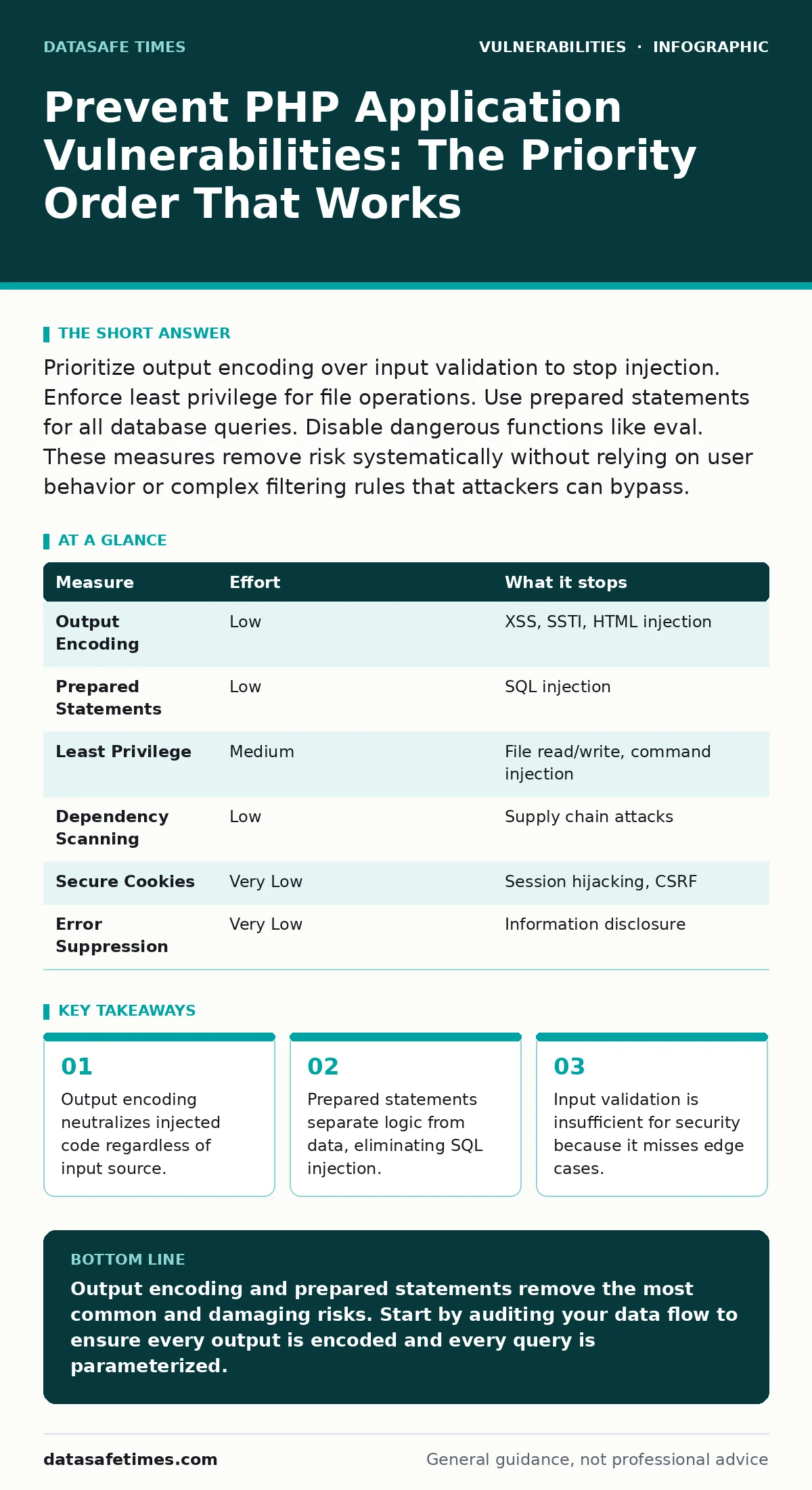
| Measure | Effort | What it stops |
|---|---|---|
| Output Encoding | Low | XSS, SSTI, HTML injection |
| Prepared Statements | Low | SQL injection |
| Least Privilege | Medium | File read/write, command injection |
| Dependency Scanning | Low | Supply chain attacks |
| Secure Cookies | Very Low | Session hijacking, CSRF |
| Error Suppression | Very Low | Information disclosure |
What Does Not Work
Blacklisting input patterns is ineffective. Attackers find variations that bypass simple filters. Whitelisting is better but still insufficient for complex data. Relying on a web application firewall alone is dangerous. Firewalls miss novel attacks and generate false positives. You must implement security in the application code.
Obfuscating code does not hide vulnerabilities. Attackers deobfuscate code easily. Security through obscurity fails when the attacker has time. Focus on correct implementation rather than hiding logic. Code clarity allows for better auditing and faster patching.
Closing Checklist for Today
- Audit all output points for proper encoding.
- Verify all database queries use prepared statements.
- Disable dangerous functions in your configuration.
Key takeaways
- Output encoding neutralizes injected code regardless of input source.
- Prepared statements separate logic from data, eliminating SQL injection.
- Input validation is insufficient for security because it misses edge cases.
Output encoding and prepared statements remove the most common and damaging risks. Start by auditing your data flow to ensure every output is encoded and every query is parameterized.
Frequently asked questions
How do I know if my PHP version is secure?
Use the latest stable release. Older versions stop receiving security patches. Check the official PHP website for the current supported versions.
Should I use a framework for security?
Frameworks provide built-in protections for common issues. They reduce the chance of manual errors. You must still configure them correctly and update them regularly.
What is the difference between sanitization and validation?
Sanitization modifies input to remove harmful characters. Validation checks if input matches a specific format. Neither prevents injection alone. You must encode output regardless of input handling.
How do I handle legacy code?
Wrap legacy code with modern security layers. Use output encoding at the presentation layer. Gradually refactor critical components to use prepared statements and safe functions.
How this guide was produced: written by the DataSafe Times editorial team with AI assistance, checked against the public references listed below, and reviewed when the facts change. See our editorial policy or report an error.