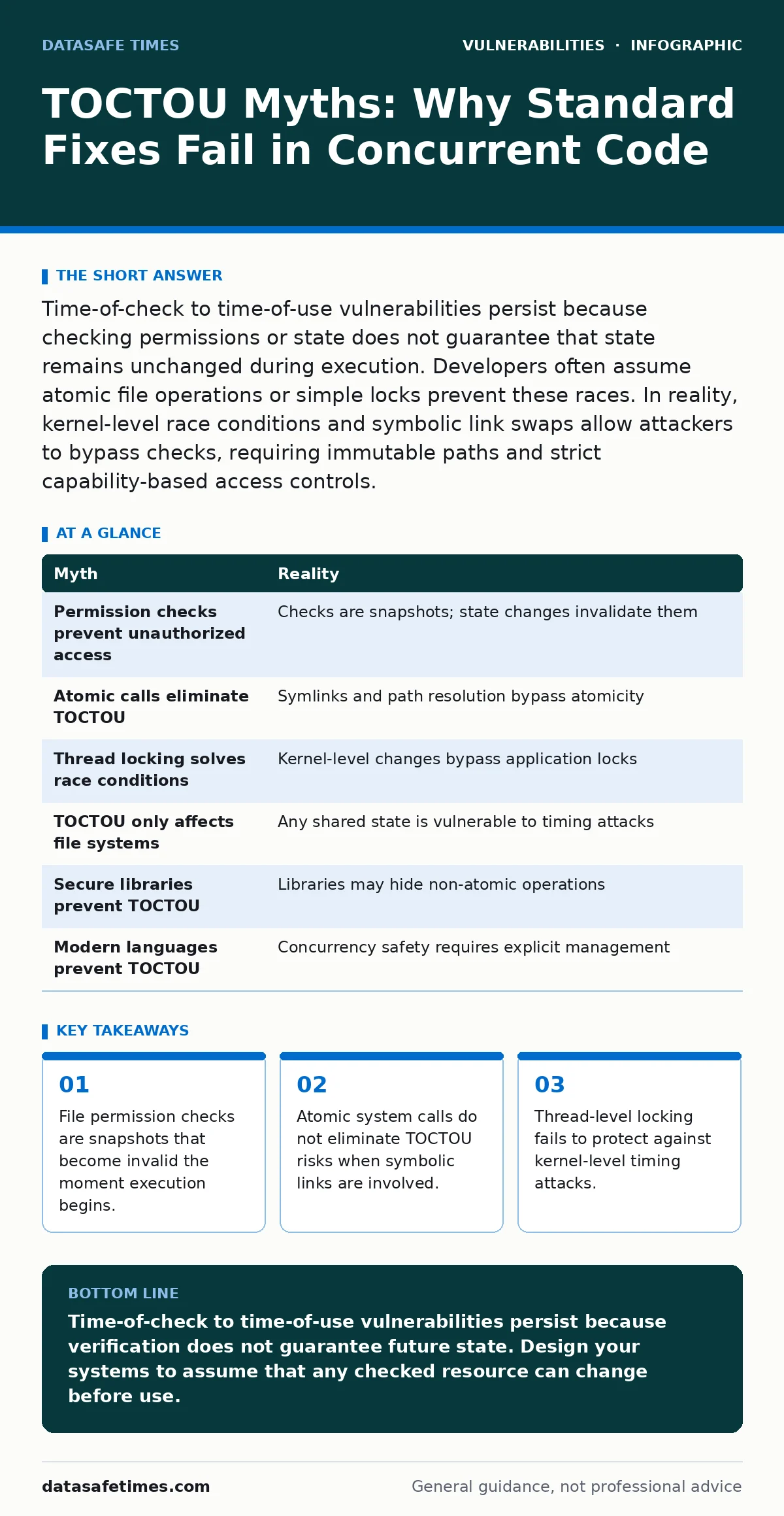
Time-of-check to time-of-use vulnerabilities persist because checking permissions or state does not guarantee that state remains unchanged during execution. Developers often assume atomic file operations or simple locks prevent these races. In reality, kernel-level race conditions and symbolic link swaps allow attackers to bypass checks, requiring immutable paths and strict capability-based access controls.
Myth: Checking Permissions Prevents Unauthorized Access
Reality: Permission checks are point-in-time validations that do not secure the subsequent operation. When software verifies that a user has read access to a file, it captures the permission state at that exact microsecond. An attacker can modify those permissions or swap the file object before the software opens it.
This window creates a race condition where the initial check passes, but the final action executes on a different resource. The system grants access based on stale data. This flaw exists in any system that separates verification from execution. You cannot assume that a passed check guarantees safety for the next instruction. The gap between check and use is where the vulnerability lives.
Imagine a banking application that checks if a user owns an account before processing a transfer. Suppose an attacker swaps the account identifier in memory between the check and the debit instruction. The system processes the transfer on the wrong account. This is not a logic error in the business rules. It is a timing failure in the data handling. The code assumes the world is static. It is not.
Myth: Atomic System Calls Eliminate TOCTOU Bugs
Reality: Atomic operations reduce the window of opportunity but do not remove the risk entirely. Developers often believe that using a single system call to open and read a file prevents race conditions. While this removes the gap between two separate calls, it does not solve the problem of symbolic links. An attacker can replace a legitimate file with a symbolic link pointing to a sensitive system file.
The atomic call follows the link. The check occurs on the link target, which may change after the kernel resolves the path. The operation proceeds on the unintended target. Atomicity protects against external file swaps, not against internal path resolution changes. You must disable symbolic link following to mitigate this.
Myth: Thread Locking Solves Race Conditions
Reality: Application-level locks do not stop kernel-level race conditions. When you wrap a file check and open in a mutex, you prevent other threads in your application from interfering. You do not prevent the operating system or other processes from modifying the file system. The kernel schedules tasks independently of your application’s locking mechanism. An external process can unlink and recreate a file while your thread holds the lock. The lock protects your code’s internal consistency, not the external resource’s integrity. This misconception leads developers to believe their code is safe when it is only internally synchronized. The threat comes from outside the lock.
Myth: TOCTOU Only Affects File Systems
Reality: Time-of-check to time-of-use bugs exist in any shared state. Developers often associate this vulnerability exclusively with file handling. In reality, any shared variable, configuration object, or network session is vulnerable. If a web server checks a session token and then processes a request, an attacker can invalidate the token between those steps.
This applies to in-memory caches, database connections, and hardware registers. The principle is universal: verifying a state does not lock that state. You must treat all shared resources as volatile. Assuming safety in memory structures is as dangerous as assuming safety in file paths. The scope of the vulnerability is as broad as your state management.
Myth: Using Secure Libraries Prevents TOCTOU
Reality: High-level libraries often hide the underlying race conditions. Many standard library functions perform checks and operations in separate steps for convenience. When you use a library function to read a configuration file, it may check for existence before reading. The library abstracts the complexity, but it does not eliminate the timing gap.
You inherit the vulnerabilities of the underlying implementation. Secure coding requires understanding what the library does at the system call level. You cannot delegate safety to an abstraction layer. You must verify that the library uses atomic operations or capability-based access. Blind trust in standard tools creates hidden exposure.
See also: Type Confusion Vulnerabilities Explained: How Data Misinterpretation Breaks Software · How Vulnerability Remediation SLAs Actually Work in Practice
Myth: TOCTOU Is Rare in Modern Languages
Reality: Modern languages do not prevent race conditions by default. Languages with garbage collection and automatic memory management simplify resource handling but do not solve concurrency issues. If your language allows concurrent access to shared objects, TOCTOU bugs are possible. The syntax may be cleaner, but the underlying logic remains vulnerable.
Developers often believe that higher-level abstractions remove the need for careful synchronization. This belief leads to lax practices in multi-threaded applications. The language runtime does not lock your data for you. You must explicitly manage access to shared state. The complexity of the language does not correlate with the safety of the concurrency model.
Myth: TOCTOU Is Easy to Detect with Static Analysis
Reality: Static analysis tools struggle to identify timing-dependent vulnerabilities. These tools examine code structure but cannot predict runtime behavior. They see a check and a use, but they cannot determine if an external event can occur between them. The dependency on system scheduling and external inputs makes static detection unreliable. Dynamic analysis and fuzzing are more effective but also incomplete. You must design with the assumption that any check can be bypassed. Relying on automated tools to find these bugs gives a false sense of security. Manual review and threat modeling are necessary complements. The timing aspect is invisible to structural analysis.
| Myth | Reality |
|---|---|
| Permission checks prevent unauthorized access | Checks are snapshots; state changes invalidate them |
| Atomic calls eliminate TOCTOU | Symlinks and path resolution bypass atomicity |
| Thread locking solves race conditions | Kernel-level changes bypass application locks |
| TOCTOU only affects file systems | Any shared state is vulnerable to timing attacks |
| Secure libraries prevent TOCTOU | Libraries may hide non-atomic operations |
| Modern languages prevent TOCTOU | Concurrency safety requires explicit management |
Key takeaways
- File permission checks are snapshots that become invalid the moment execution begins.
- Atomic system calls do not eliminate TOCTOU risks when symbolic links are involved.
- Thread-level locking fails to protect against kernel-level timing attacks.
Time-of-check to time-of-use vulnerabilities persist because verification does not guarantee future state. Design your systems to assume that any checked resource can change before use.
Frequently asked questions
How do I fix TOCTOU in file handling?
Use open-and-read atomic operations and disable symbolic link following. Validate the file descriptor after opening, not the path before.
Does using a database prevent TOCTOU?
No. Database transactions isolate data, but application-level checks before transaction start remain vulnerable to race conditions.
Are microservices immune to TOCTOU?
No. Distributed systems have larger windows for state changes. Network latency increases the time between check and use.
How does this relate to insecure file permissions?
Insecure permissions allow the initial check to pass. TOCTOU allows the attacker to change the resource after the check. Both are needed for exploitation.
How this guide was produced: written by the DataSafe Times editorial team with AI assistance, checked against the public references listed below, and reviewed when the facts change. See our editorial policy or report an error.