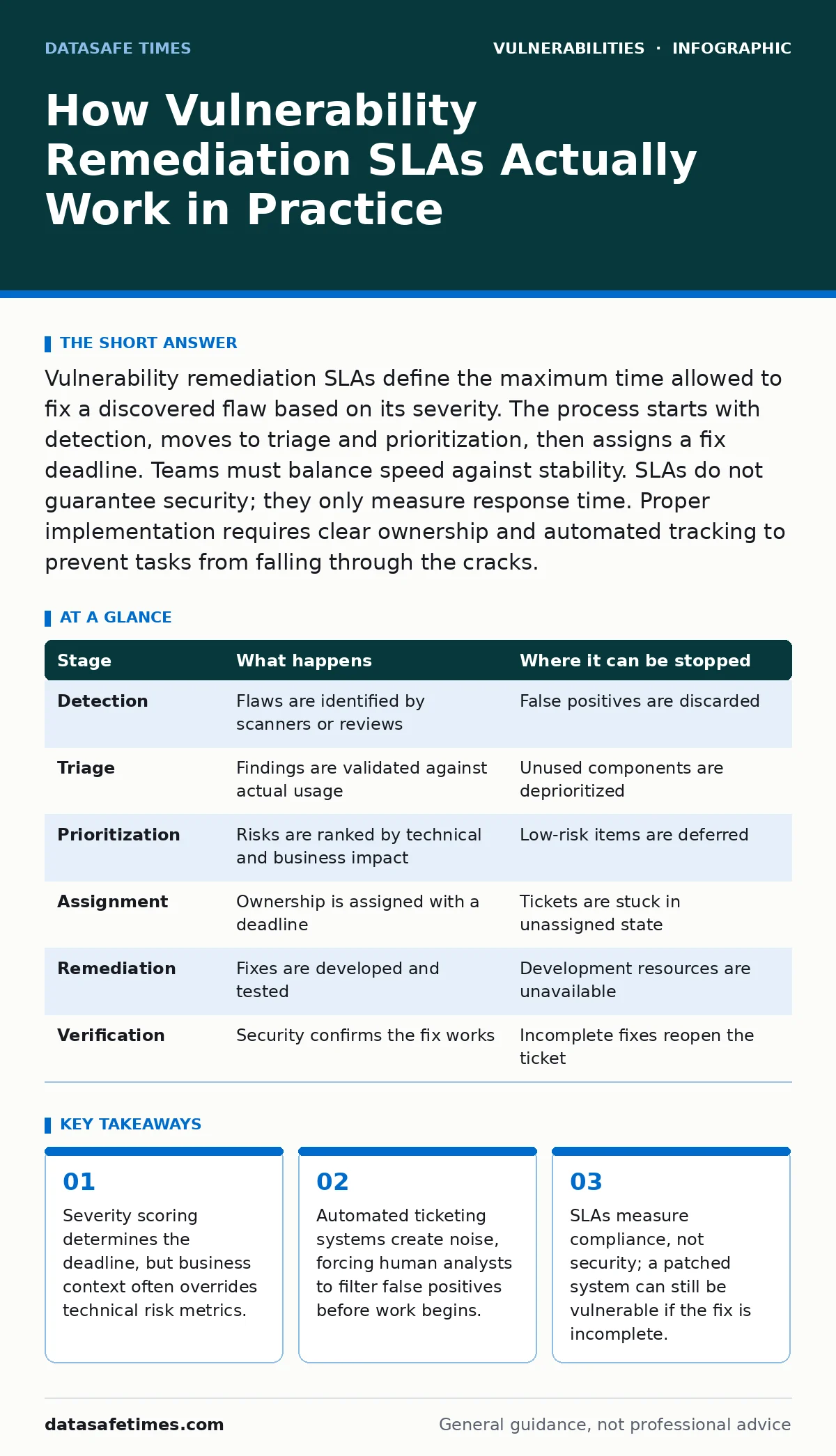
Vulnerability remediation SLAs define the maximum time allowed to fix a discovered flaw based on its severity. The process starts with detection, moves to triage and prioritization, then assigns a fix deadline. Teams must balance speed against stability. SLAs do not guarantee security; they only measure response time. Proper implementation requires clear ownership and automated tracking to prevent tasks from falling through the cracks.
Detection and Intake
Vulnerability remediation SLAs begin the moment a flaw is identified. Detection sources include automated scanners, code reviews, and external disclosures. Each source produces a different type of data. Scanners generate large volumes of technical findings with little context. Code reviews provide high-confidence results with detailed explanations. External disclosures often arrive with public visibility, creating immediate pressure.
The intake system must normalize these inputs into a standard format. This standardization allows the tracking system to apply consistent rules. Without normalization, duplicate tickets and inconsistent severity ratings create confusion. The system assigns a unique identifier to each finding. This identifier links the vulnerability to its location in the codebase or infrastructure.
Triage and Validation
Not every detected vulnerability requires immediate attention. Triage determines whether a finding is a true positive or a false alarm. Analysts review the evidence to confirm the flaw exists in the active environment. They check if the vulnerable component is actually used in production. A library might be present in a dependency tree but never called by the application code.
In such cases, the risk is theoretical rather than practical. Validation also considers the exploitability of the flaw. Some vulnerabilities require specific conditions to trigger. If those conditions cannot be met in the current deployment, the urgency decreases. This step prevents engineering teams from wasting time on irrelevant issues. It also ensures that high-severity deadlines are reserved for genuine threats.
Prioritization and Scoring
Prioritization ranks validated vulnerabilities against each other. Most organizations use a scoring system to assign severity levels. Common frameworks provide base scores based on technical impact. However, base scores ignore business context. A flaw in a public-facing payment gateway carries more risk than the same flaw in an internal tool. Prioritization layers business risk onto technical scores.
This creates a composite risk rating. The rating determines which vulnerabilities get fixed first. It also influences the assigned deadline. High-priority items receive shorter SLAs. Low-priority items may be deferred until a scheduled maintenance window. This approach ensures that limited engineering resources are spent on the most dangerous flaws. It also aligns security efforts with business objectives.
Assignment and Deadline Setting
Once prioritized, the vulnerability is assigned to an owner. Ownership usually falls to the team that maintains the affected component. The SLA defines the maximum time allowed for resolution. Deadlines vary by severity. Critical flaws might require fixes within days. Low-severity issues could have months to resolve. The deadline starts when the ticket is assigned.
It pauses if the owner requests more information or if the fix is blocked by dependencies. Clear assignment prevents ambiguity about who is responsible. If multiple teams share a component, the primary maintainer takes ownership. They coordinate with other teams as needed. The deadline is visible to both security and engineering leadership. This visibility creates accountability. It also allows managers to track progress against targets.
Remediation and Implementation
The assigned team develops and tests a fix. Remediation methods vary. Some flaws are fixed by updating a library version. Others require code changes or configuration adjustments. In some cases, the fix involves accepting the risk if mitigation is too costly. The team must verify that the fix resolves the vulnerability without breaking existing functionality. This verification includes unit tests and integration tests.
Regression testing ensures that the new code does not introduce new bugs. The fix is then deployed to the environment. Deployment may happen in stages to minimize disruption. Canary releases allow teams to monitor the impact before full rollout. Speed matters during this phase. Delays can cause the SLA to breach. However, rushing leads to incomplete fixes. Balance is necessary.
See also: Detecting Memory Corruption Vulnerabilities in Production Systems · TOCTOU Myths: Why Standard Fixes Fail in Concurrent Code
Verification and Closure
The security team verifies that the fix works. They re-scan the environment or review the code changes. If the vulnerability persists, the ticket is reopened. The SLA clock may restart or continue depending on policy. Once verified, the ticket is closed. Closure records the time taken to resolve the issue. This data feeds into metrics and reports. It helps identify bottlenecks in the process.
It also highlights teams that consistently meet or miss deadlines. Closure is not just administrative. It confirms that the risk has been reduced. Without verification, teams might believe a flaw is fixed when it is not. This false sense of security is dangerous. Verification ensures that the remediation effort actually improved the security posture.
| Stage | What happens | Where it can be stopped |
|---|---|---|
| Detection | Flaws are identified by scanners or reviews | False positives are discarded |
| Triage | Findings are validated against actual usage | Unused components are deprioritized |
| Prioritization | Risks are ranked by technical and business impact | Low-risk items are deferred |
| Assignment | Ownership is assigned with a deadline | Tickets are stuck in unassigned state |
| Remediation | Fixes are developed and tested | Development resources are unavailable |
| Verification | Security confirms the fix works | Incomplete fixes reopen the ticket |
Limits and Edge Cases
SLAs have inherent limitations. They measure time, not quality. A team can meet a deadline with a poor fix. The fix might close one flaw while opening another. SLAs also struggle with complex dependencies. A fix might require changes in multiple services. Coordinating these changes takes time. The SLA might expire before the coordinated fix is ready. Another limit is the assumption of linear progress.
Engineering work is rarely linear. Unexpected bugs and competing priorities disrupt plans. SLAs do not account for these disruptions. They create pressure that can lead to shortcuts. Shortcuts reduce security. Finally, SLAs focus on individual vulnerabilities. They do not address systemic issues. A system with many small flaws might be less secure than one with a single critical flaw. SLAs do not capture this nuance.
Integration with Supply Chain
Modern applications rely on external packages. Vulnerabilities in PyPI packages or other repositories affect many projects simultaneously. When a major package is compromised, thousands of applications face the same flaw. SLAs must handle this scale. Manual assignment is impossible. Automation assigns tickets to all affected teams. This creates a surge in workload. Teams must triage quickly to avoid burnout.
A software bill of materials (SBOM) helps identify which teams are affected. It maps dependencies to code ownership. Without an SBOM, teams waste time checking for exposure. Supply chain vulnerabilities also highlight the risk of time-of-check to time-of-use (TOCTOU) bugs. A package might be safe when installed but compromised later. SLAs must account for continuous monitoring, not just initial fixes.
Key takeaways
- Severity scoring determines the deadline, but business context often overrides technical risk metrics.
- Automated ticketing systems create noise, forcing human analysts to filter false positives before work begins.
- SLAs measure compliance, not security; a patched system can still be vulnerable if the fix is incomplete.
Frequently asked questions
How do you handle vulnerabilities in third-party libraries that you do not maintain?
You must update the library version if a patch exists. If no patch exists, you can implement compensating controls like input validation or network restrictions. Document the accepted risk if neither option is viable.
What happens if an engineering team misses an SLA deadline?
The ticket escalates to management for review. Additional resources might be allocated. The team may need to explain the delay. Repeated misses can lead to process changes or stricter penalties.
Can SLAs be adjusted for different types of applications?
Yes. Critical production systems often have shorter SLAs than internal tools or development environments. Adjusting deadlines based on exposure and impact ensures efficient resource allocation.
How do insecure file permissions affect remediation SLAs?
These flaws are often easy to fix but easy to miss. They require specific configuration checks rather than code changes. SLAs should include automated configuration audits to detect and resolve these issues quickly. BOTTOM LINE: Remediation SLAs measure response speed, not security strength. Implement automated tracking and regular verification to ensure fixes are both timely and effective.
How this guide was produced: written by the DataSafe Times editorial team with AI assistance, checked against the public references listed below, and reviewed when the facts change. See our editorial policy or report an error.