
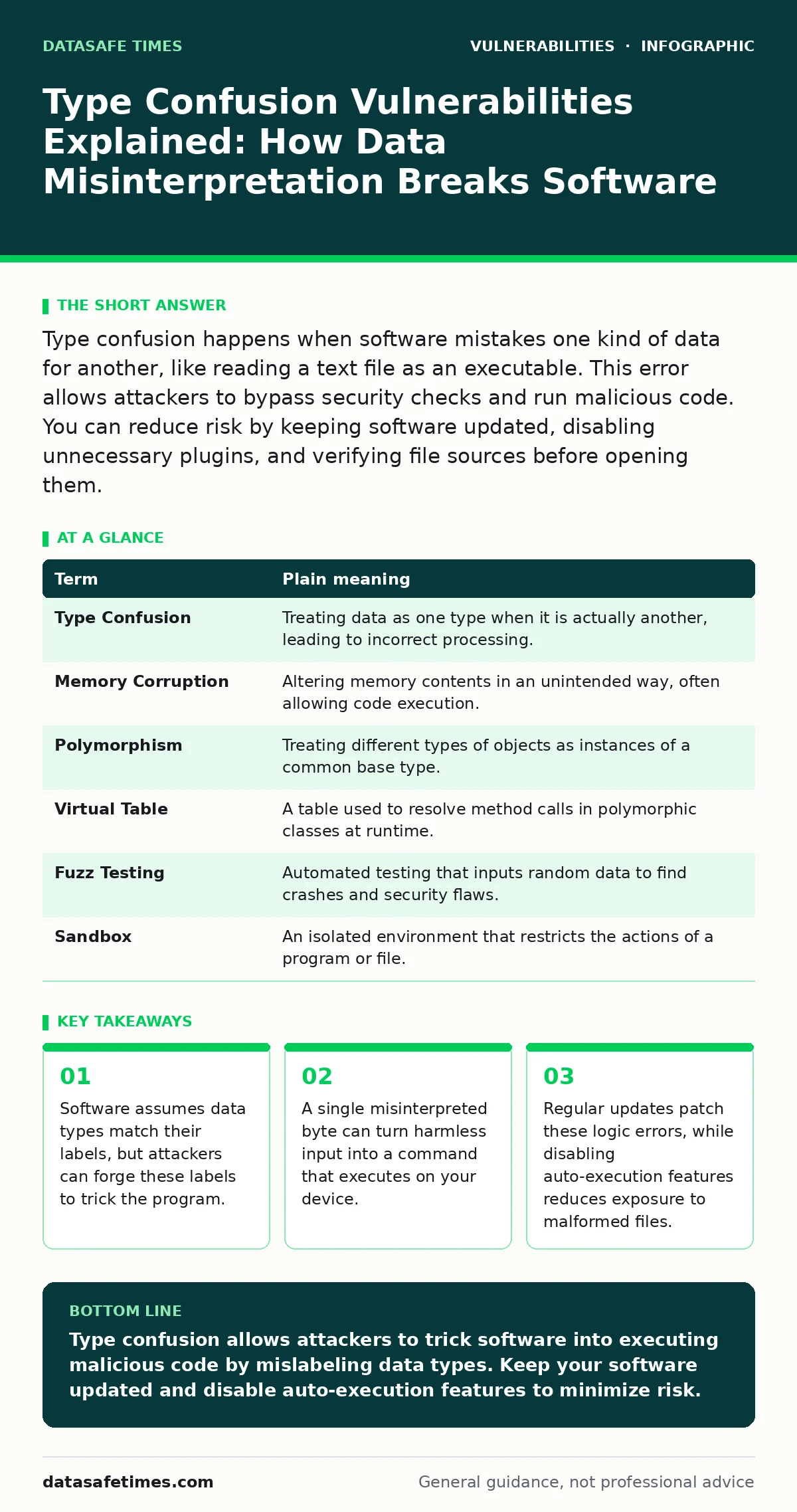
Type confusion happens when software mistakes one kind of data for another, like reading a text file as an executable. This error allows attackers to bypass security checks and run malicious code. You can reduce risk by keeping software updated, disabling unnecessary plugins, and verifying file sources before opening them.
The Library Card Analogy
Imagine a library where every book has a specific card catalog entry. The entry tells the librarian whether the item is a novel, a map, or a fragile manuscript. The librarian handles each type differently. Novels go on open shelves. Maps go in flat drawers. Manuscripts stay in climate-controlled boxes. The system works because the librarian trusts the card catalog entry to define how to handle the physical object.
Suppose an attacker swaps the card catalog entry. They place a heavy, sharp metal tool on the open shelf but label it "Novel." The librarian picks it up, expecting a light book. The librarian tries to shelve it gently. The tool falls, damaging the shelf and injuring the librarian. The physical object did not change. Only the label changed. The librarian’s expectation of the object’s nature was wrong.
In software, this is type confusion. The program expects data to be one type, such as a string of text. The data is actually another type, such as a function pointer. The program processes the data using the rules for text. It writes the data to a location meant for text. The data overwrites memory with executable instructions. The program then jumps to that memory and runs the instructions.
How Type Confusion Occurs
Software relies on strict definitions for data structures. A structure is a container that holds different pieces of data together. Each piece has a defined type. An integer holds numbers. A pointer holds memory addresses. A string holds characters. The compiler generates code that assumes these types remain constant.
Attackers exploit cases where the type check is missing or bypassed. They create a data object that looks like one type but behaves like another. They pass this object to a function that expects the first type. The function processes the object incorrectly. It interprets bits as numbers instead of addresses. It interprets bits as addresses instead of numbers. This misinterpretation leads to memory corruption.
This mechanism differs from buffer overflows. A buffer overflow writes too much data into a fixed space. Type confusion writes the right amount of data into the wrong kind of space. Both result in memory corruption vulnerabilities, but the root cause is different. One is a size error. The other is a logic error.
The Role of Polymorphism
Modern programming languages use polymorphism. Polymorphism allows objects of different classes to be treated as instances of a common superclass. This feature enables flexible code. It allows a single function to handle different types of objects.
The trade-off is complexity. The program must determine the actual type of the object at runtime. It uses a virtual function table to find the correct method to call. If an attacker modifies the pointer to this table, they can redirect execution. They point the table to a malicious function. The program calls the malicious function, believing it is a legitimate method.
This is common in languages like C++ and Java. These languages manage memory manually or semi-manually. They give developers control over object layout. This control increases the risk of type confusion. Developers must ensure that type checks are rigorous. They must validate that an object is truly the type the code expects.
Impact on Ordinary Users
You do not write code that manages memory directly. You use web browsers, office suites, and media players. These applications parse complex file formats. They read PDFs, images, and documents. These formats contain structured data. They define headers, chunks, and metadata.
If a browser has a type confusion flaw, it may misinterpret an image file. It treats image data as executable code. It runs that code in the browser process. The attacker gains control of the browser. They can steal cookies, capture keystrokes, or install malware. The user sees nothing unusual. The page loads normally. The attack happens in the background.
This risk extends to plugins and extensions. Extensions run with high privileges. They can access sensitive data. If an extension has a type confusion flaw, the impact is severe. Attackers target popular extensions. They distribute malicious updates. Users install the update. The update contains the exploit.
Safety Habits for Mitigation
You cannot patch the code yourself. You rely on developers to fix flaws. You can reduce your exposure through behavior. These habits lower the chance of triggering a vulnerability.
- Disable Auto-Execution of Scripts. Configure your browser and office suite to disable automatic script execution. This prevents malicious code from running immediately upon opening a file. You retain control. You choose when to enable content.
- Verify File Sources. Do not open files from untrusted sources. Attackers often distribute exploits via email attachments or download links. Verify the sender. Check the file extension. If the extension is unusual, do not open it.
- Update Software Promptly. Developers release patches for type confusion flaws. These patches fix the logic errors. They add type checks. They harden the memory management. Install updates as soon as they are available. Delaying updates leaves you exposed to known exploits.
See also: Memory-Safe Languages: Real Security Gains and Hidden Costs · Fuzz testing definition: how automated chaos finds hidden bugs
Detection and Prevention in Development
Developers use fuzz testing to find type confusion flaws. Fuzz testing feeds random or malformed data into the program. It observes how the program reacts. If the program crashes or behaves unexpectedly, a flaw may exist.
Static analysis tools also help. These tools examine the code without running it. They look for missing type checks. They identify unsafe casts. They flag potential memory corruption issues. Combining static analysis with fuzz testing provides deeper coverage.
This approach is similar to preventing server-side template injection (SSTI). Both involve validating input. Both require strict type handling. Both demand that developers assume input is malicious.
Mini Glossary
| Term | Plain meaning |
|---|---|
| Type Confusion | Treating data as one type when it is actually another, leading to incorrect processing. |
| Memory Corruption | Altering memory contents in an unintended way, often allowing code execution. |
| Polymorphism | Treating different types of objects as instances of a common base type. |
| Virtual Table | A table used to resolve method calls in polymorphic classes at runtime. |
| Fuzz Testing | Automated testing that inputs random data to find crashes and security flaws. |
| Sandbox | An isolated environment that restricts the actions of a program or file. |
Try This Now
- Check your browser settings. Disable JavaScript for sites you do not trust. Use an extension to manage this per-site.
- Review your installed plugins. Remove any that are not essential. Fewer plugins mean fewer attack surfaces.
- Enable automatic updates. Ensure your operating system and applications update automatically. This ensures you receive patches quickly.
These steps reduce your risk. They do not eliminate it. Type confusion flaws are subtle. They require careful coding. They require rigorous testing. As a user, you control your exposure. You control your updates. You control your trust.
Key takeaways
- Software assumes data types match their labels, but attackers can forge these labels to trick the program.
- A single misinterpreted byte can turn harmless input into a command that executes on your device.
- Regular updates patch these logic errors, while disabling auto-execution features reduces exposure to malformed files.
Type confusion allows attackers to trick software into executing malicious code by mislabeling data types. Keep your software updated and disable auto-execution features to minimize risk.
Frequently asked questions
How is type confusion different from a buffer overflow?
Buffer overflow writes too much data into a fixed space. Type confusion writes correct data into the wrong type of space, causing logic errors rather than size errors.
Can antivirus software detect type confusion exploits?
Antivirus software may detect the resulting malware. It often fails to detect the exploit itself, as the code may be custom and unique to the attack.
Are newer programming languages immune to type confusion?
Languages like Rust and Go offer better memory safety. They reduce the risk significantly but do not eliminate it entirely, especially in complex systems.
Why do developers still use vulnerable languages?
Legacy codebases and performance requirements often dictate the use of C or C++. Migrating to safer languages is costly and time-consuming.
How this guide was produced: written by the DataSafe Times editorial team with AI assistance, checked against the public references listed below, and reviewed when the facts change. See our editorial policy or report an error.