
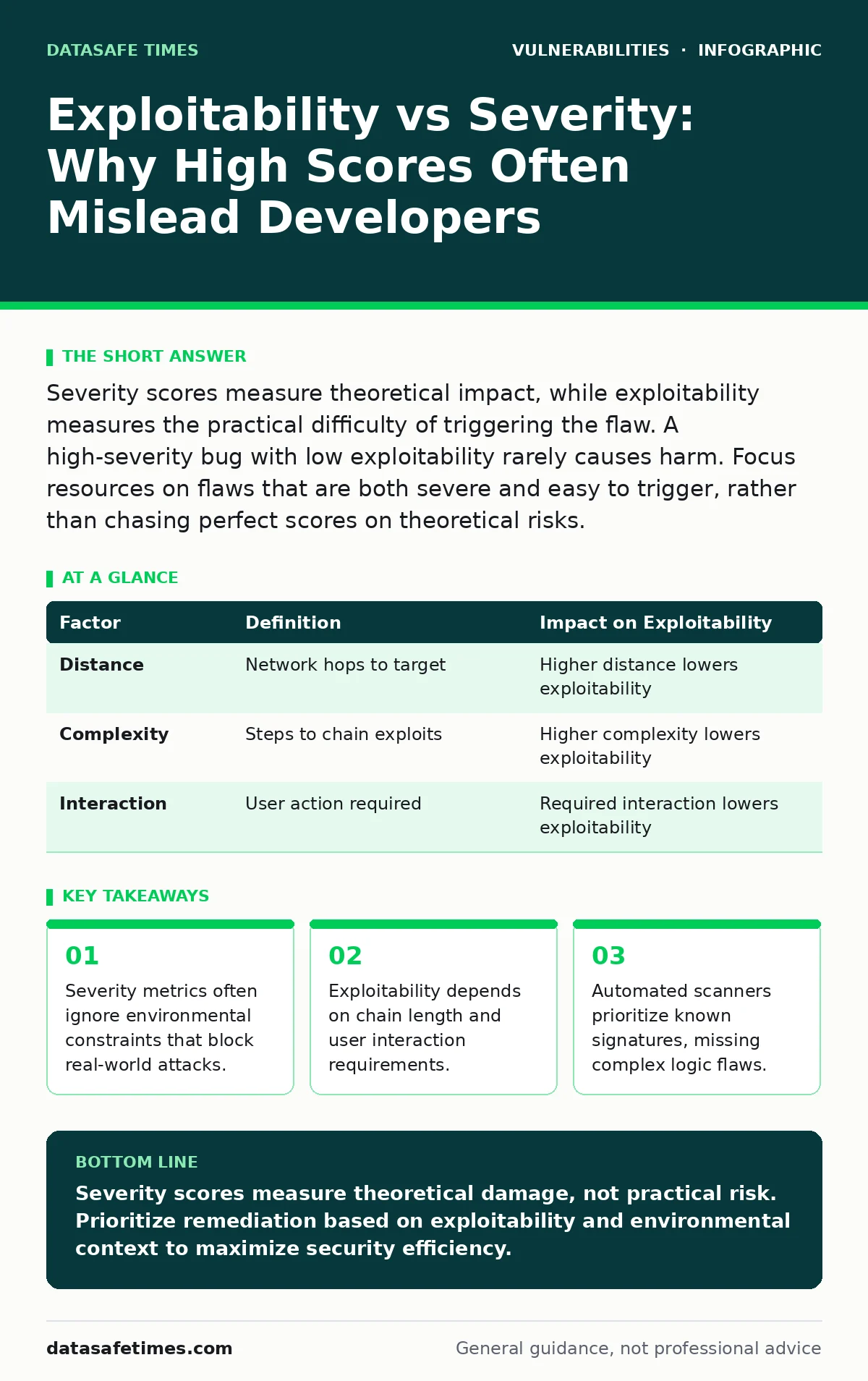
Severity scores measure theoretical impact, while exploitability measures the practical difficulty of triggering the flaw. A high-severity bug with low exploitability rarely causes harm. Focus resources on flaws that are both severe and easy to trigger, rather than chasing perfect scores on theoretical risks.
Why do severity scores fail to predict real-world impact?
Severity scores measure theoretical damage, not practical likelihood. A flaw allowing remote code execution receives a high score regardless of whether the affected service is exposed to the internet. This disconnect occurs because scoring models prioritize worst-case scenarios. They assume the attacker has direct access. They assume no other defenses exist. This creates a gap between reported risk and actual business exposure.
Imagine a server running a service with a critical memory corruption vulnerability. The score is maximum because an attacker could theoretically control the system. However, the service listens only on localhost. External attackers cannot reach it. The severity remains high in databases, but the practical risk is near zero. You must separate the abstract score from the concrete environment.
How does exploitability differ from severity in practice?
Exploitability measures the effort required to trigger a flaw. Severity measures the consequence of a successful trigger. These two dimensions operate independently. A low-effort flaw with minor consequences has high exploitability but low severity. A high-impact flaw with complex prerequisites has low exploitability but high severity. Balancing these factors reveals true priority.
Consider a configuration error that exposes debug logs. The effort to find it is minimal. The impact is limited to information disclosure. Conversely, a deep logic error in a cryptographic routine requires precise conditions to trigger. The impact is total data compromise. The first is easier to fix. The second is harder to find. Both require different remediation strategies.
What makes a vulnerability difficult to exploit?
Three factors reduce exploitability: distance, complexity, and interaction. Distance refers to the network path between attacker and target. Complexity refers to the number of steps required to chain exploits. Interaction refers to the need for a user to perform an action. Each factor adds friction for the attacker. Friction reduces the probability of success.
Suppose a vulnerability requires an attacker to first gain low-privileged access. Then they must escalate privileges using a separate flaw. Finally, they must trigger the main vulnerability. This chain is complex. Each step introduces failure points. If any step fails, the attack stops. Simple, direct flaws are far more dangerous than complex chains.
| Factor | Definition | Impact on Exploitability |
|---|---|---|
| Distance | Network hops to target | Higher distance lowers exploitability |
| Complexity | Steps to chain exploits | Higher complexity lowers exploitability |
| Interaction | User action required | Required interaction lowers exploitability |
Do environmental constraints change the risk profile?
Yes, environmental constraints often negate high severity scores. Firewall rules, network segmentation, and application whitelisting block access. These controls create a gap between theoretical and actual risk. A vulnerability in an internal tool is less dangerous than one in a public API. The context defines the real threat.
Review your network topology before acting on scores. If a service is isolated, its flaws are contained. If it communicates with external partners, its flaws are exposed. Context matters more than the abstract number. You can safely defer patches for isolated systems. This saves resources for critical external-facing assets.
How do scanners handle complex logic flaws?
Automated scanners rely on known signatures and static analysis. They struggle with complex logic flaws that require runtime state. A scanner might miss a race condition because it cannot simulate concurrent threads. It might miss a business logic error because it does not understand workflow rules. These tools provide a baseline, not a complete picture.
Relying solely on scanners leaves blind spots. Manual review catches logic errors. Fuzzing tests runtime behavior. Combining methods improves coverage. Do not trust a clean scan as proof of safety. It only proves the absence of known signatures. New or complex flaws often evade detection.
See also: Cloud Security Posture Management: 6 Common Misunderstandings · Detecting Memory Corruption Vulnerabilities in Production Systems
What is the hidden cost of chasing high severity?
Chasing high severity scores wastes resources on low-risk items. Teams spend time patching theoretical flaws while ignoring practical ones. This creates security theater. It gives a false sense of safety. The real risk remains unaddressed. Prioritization based on exploitability yields better results. It focuses effort where it counts.
Imagine a team fixing a critical flaw in an unused legacy system. They ignore a medium flaw in the active login service. The legacy system poses no risk. The login service is under attack. Resources were misallocated. The organization suffered a breach despite "fixing" critical issues. Contextual prioritization prevents this error.
How does dependency management affect exploitability?
Dependencies introduce hidden attack surfaces. A library might contain a vulnerability that is only exploitable under specific conditions. If your code does not trigger those conditions, the risk is low. A software bill of materials (SBOM) helps track these dependencies. It reveals what you use, not what you expose.
Review your dependency tree regularly. Identify which libraries are actively used. Discard unused dependencies to reduce surface area. Even if a dependency has a flaw, you are safe if you do not call it. This approach reduces noise. It focuses remediation on active code paths.
Why do some high-severity flaws go unpatched?
High-severity flaws often require complex patches or downtime. Organizations delay patching to avoid operational disruption. This delay increases exposure. If the flaw is hard to exploit, the delay might be acceptable. If it is easy to exploit, the delay is dangerous. Risk tolerance dictates timing.
Balance operational needs with security risks. A patch that breaks production is worse than a known flaw. Plan maintenance windows. Test patches in staging. Coordinate with operations teams. Delaying patching is a conscious trade-off. Document the rationale. Re-evaluate periodically.
How do you prioritize remediation efforts?
Prioritize based on a combination of severity and exploitability. Focus on flaws that are both severe and easy to trigger. Ignore flaws that are severe but impossible to reach. Use a matrix to visualize trade-offs. This approach ensures efficient resource use. It maximizes security gain per hour spent.
Create a risk matrix. Plot severity on one axis and exploitability on the other. Address the top-right quadrant first. These are the most dangerous flaws. The top-left quadrant can wait. They are severe but hard to trigger. The bottom-right quadrant needs quick fixes. They are easy to trigger but low impact. The bottom-left quadrant is noise.
What role does user behavior play in exploitability?
User behavior can trigger or prevent exploitation. Phishing attacks rely on user interaction. If users do not click links, the exploit fails. Security training reduces this risk. Technical controls alone are insufficient. Human factors remain a critical variable.
Suppose a vulnerability exists in a web application. It requires a user to click a malicious link. If users are trained to recognize phishing, the exploitability drops. Combine technical fixes with awareness. Do not rely on users to be perfect. Assume they will make mistakes. Design systems that tolerate errors.
Key takeaways
- Severity metrics often ignore environmental constraints that block real-world attacks.
- Exploitability depends on chain length and user interaction requirements.
- Automated scanners prioritize known signatures, missing complex logic flaws.
Severity scores measure theoretical damage, not practical risk. Prioritize remediation based on exploitability and environmental context to maximize security efficiency.
Frequently asked questions
Should I patch a critical vulnerability in an internal-only service?
If the service is truly isolated and no external access exists, you can defer patching. Monitor for changes in network topology that might expose it.
How do I calculate exploitability for a new flaw?
Assess the distance, complexity, and interaction requirements. High values in these areas indicate low exploitability.
Is it safe to ignore low-severity vulnerabilities?
Low-severity flaws can chain together to create high-risk scenarios. Review them for potential combination effects.
Do severity scores change over time?
Scores remain static unless the flaw itself changes. Exploitability can change as new tools or techniques emerge.
How this guide was produced: written by the DataSafe Times editorial team with AI assistance, checked against the public references listed below, and reviewed when the facts change. See our editorial policy or report an error.