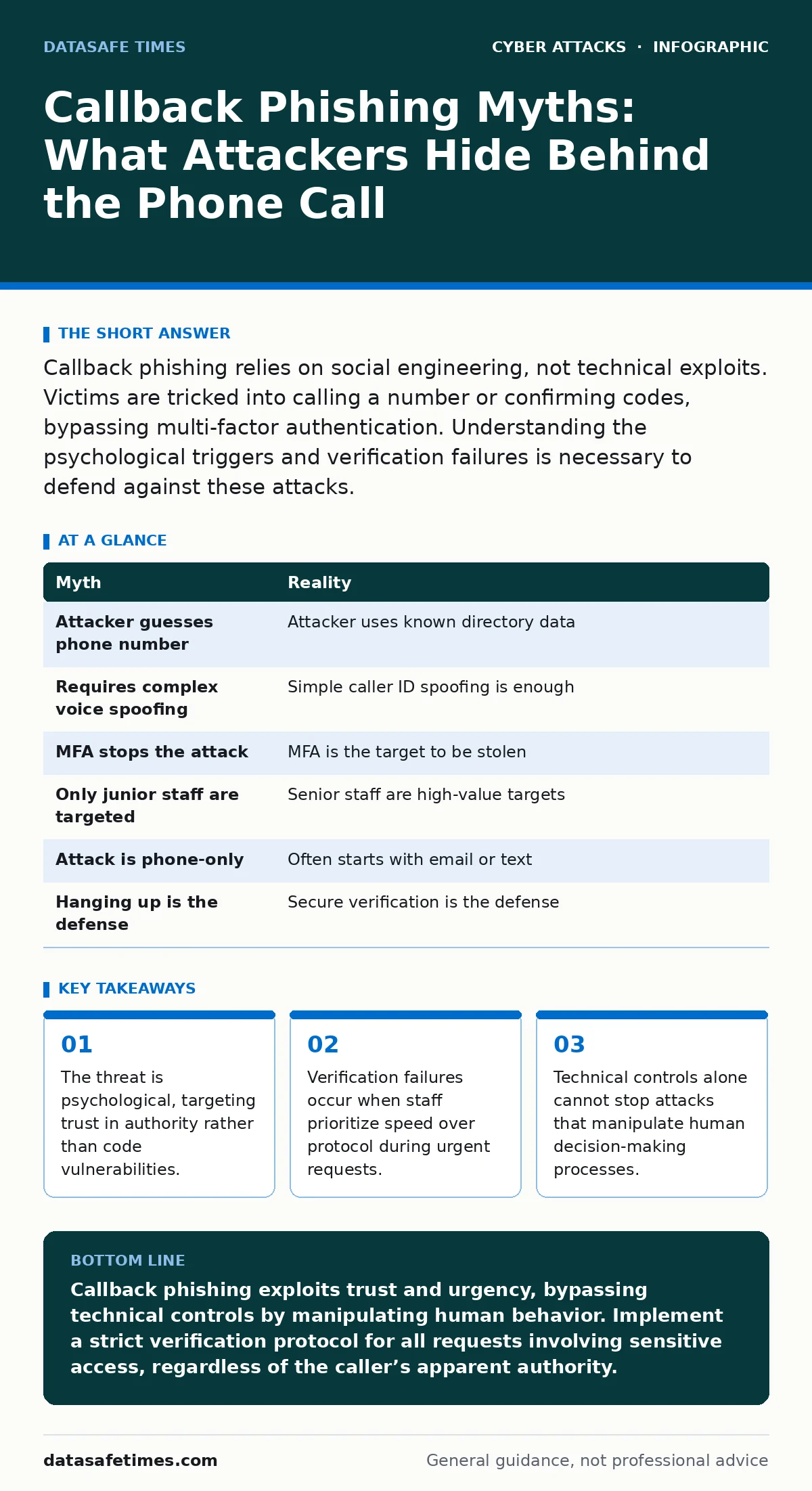
Callback phishing relies on social engineering, not technical exploits. Victims are tricked into calling a number or confirming codes, bypassing multi-factor authentication. Understanding the psychological triggers and verification failures is necessary to defend against these attacks.
Myth: The attacker must guess the phone number
Reality: The attacker already knows the number. In a callback scenario, the threat actor does not dial out blindly. They use data obtained from previous breaches or public records to find the specific extension or direct line of an IT support staff member. The attack begins with a voicemail or text that appears to come from a trusted source, such as a senior executive or a vendor.
This pre-knowledge eliminates the guesswork. The attacker crafts a message that creates immediate urgency, demanding a return call. Because the number in the "from" field is spoofed to match a known contact, the recipient assumes the request is legitimate. You do not need to defend against random dialing. You must defend against targeted requests that appear to originate from within your organization.
Myth: The attack requires complex voice spoofing technology
Reality: Simple caller ID spoofing is sufficient for most attacks. The attacker does not need to mimic the voice of the executive. They need only to display a phone number that matches the directory listing for that person. The psychological weight comes from the name and title associated with that number, not from audio manipulation.
Imagine receiving a call from your CEO’s number asking for immediate password reset. The technical barrier is low. The attacker uses over-the-phone VoIP services that allow easy header manipulation. The sophistication lies in the timing and the narrative, not in the audio engineering. Defending against this requires verifying the request through a secondary channel, not analyzing the call quality.
Myth: Multi-factor authentication stops callback phishing
Reality: MFA is often the target of the attack, not a barrier. The attacker’s goal is to obtain the second factor, such as a one-time passcode or a push notification approval. By posing as IT support, they request the code to "verify your identity" or "reset your account." The victim willingly provides the token, believing they are assisting with troubleshooting.
This turns the security control into a delivery mechanism for the attacker. The system sees a valid code and a valid username. It cannot distinguish between a user logging in normally and a user handing over credentials to an imposter. This overlaps with MFA fatigue attacks, where persistence wears down defenses. Here, the fatigue is replaced by authority. The control fails because the human element is manipulated into bypassing its own protection.
Myth: Only junior staff fall for these requests
Reality: Senior engineers and managers are frequent targets. Attackers tailor the urgency to match the recipient’s level of responsibility. A request for a database restore or a server reboot carries more weight for a senior administrator than a simple password reset. The attacker leverages the victim’s expertise and pressure to maintain uptime.
High-level staff often have broader access and less time for verification. They are conditioned to act quickly to resolve critical incidents. This creates a window where standard verification steps are skipped. The attack exploits the assumption that a colleague would not lie about a system outage. You must assume that authority implies truth, which is a dangerous default in security contexts.
Myth: The attack happens entirely over the phone
Reality: The attack often begins with an email or text message. The initial contact sets the stage by creating a sense of emergency. It provides the callback number and the reason for the contact. This written trail can be used later to justify the urgency if questioned.
The phone call is the execution phase, not the initiation. The written message ensures the victim has the number handy and the context prepared. When the call arrives, it feels like a continuation of an existing conversation. This hybrid approach makes it harder to identify the attack as phishing. It blends into normal business communication patterns.
Myth: Training employees to hang up is enough
Reality: Hanging up without verification breaks operational workflows. In a busy IT environment, ignoring a call from a known executive can delay critical repairs. The defense is not avoidance; it is verification. Employees need a clear, low-friction process for confirming requests that involve sensitive actions.
This process should be separate from the communication channel used in the request. If the call asks for a password reset, the verification should come via a different method, such as a ticketing system or a direct message on a secure internal platform. Tabletop exercises can help staff practice these scenarios under pressure. They reveal where the verification steps are too cumbersome to follow in real time.
Myth: Technical controls can detect the attack
Reality: Network monitoring tools cannot see the social engineering. The phone call occurs outside the IT network. The subsequent login attempt uses valid credentials and factors. To the security operations center, the activity looks like a normal user session.
You cannot patch human behavior with software. The gap exists between the technical perimeter and the human decision. While rate limiting can stop automated brute force attacks, it does not stop a single, well-timed request for a password reset. The attack succeeds because it mimics legitimate help desk interactions. Detection requires behavioral analysis, not just network logs.
| Myth | Reality |
|---|---|
| Attacker guesses phone number | Attacker uses known directory data |
| Requires complex voice spoofing | Simple caller ID spoofing is enough |
| MFA stops the attack | MFA is the target to be stolen |
| Only junior staff are targeted | Senior staff are high-value targets |
| Attack is phone-only | Often starts with email or text |
| Hanging up is the defense | Secure verification is the defense |
Myth: The attack is rare compared to email phishing
Reality: Voice-based attacks are increasing as email filters improve. Attackers adapt to where the defenses are weakest. Email security is mature, with advanced filtering and sandboxing. Voice channels are largely unmonitored and lack similar automated defenses.
This shift represents a rational adaptation by threat actors. They move to the path of least resistance. The human element remains the common denominator. As you improve email security, the relative risk of voice attacks rises. This is similar to how formjacking emerged as browser extensions became harder to infect. The vector changes, but the goal remains credential theft.
Key takeaways
- The threat is psychological, targeting trust in authority rather than code vulnerabilities.
- Verification failures occur when staff prioritize speed over protocol during urgent requests.
- Technical controls alone cannot stop attacks that manipulate human decision-making processes.
Callback phishing exploits trust and urgency, bypassing technical controls by manipulating human behavior. Implement a strict verification protocol for all requests involving sensitive access, regardless of the caller’s apparent authority.
Frequently asked questions
How do I verify a caller’s identity without delaying urgent work?
Use a pre-established secondary channel, such as a secure internal messaging platform or a ticketing system, to confirm the request. Do not rely on the information provided in the initial call.
Can I use call recording to prove the attack later?
Call recordings may provide evidence, but they do not prevent the breach. The damage occurs during the call. Focus on prevention through verification rather than post-incident analysis.
What if the attacker claims to be from external vendor support?
Hang up and contact the vendor using a phone number from their official website or your contract documents. Never call back the number provided in the unsolicited call.
Does using a mobile app for MFA make this attack harder?
No. Attackers can request approval for push notifications just as easily as they request SMS codes. The vulnerability is in the user’s willingness to approve, not the delivery method.
How this guide was produced: written by the DataSafe Times editorial team with AI assistance, checked against the public references listed below, and reviewed when the facts change. See our editorial policy or report an error.