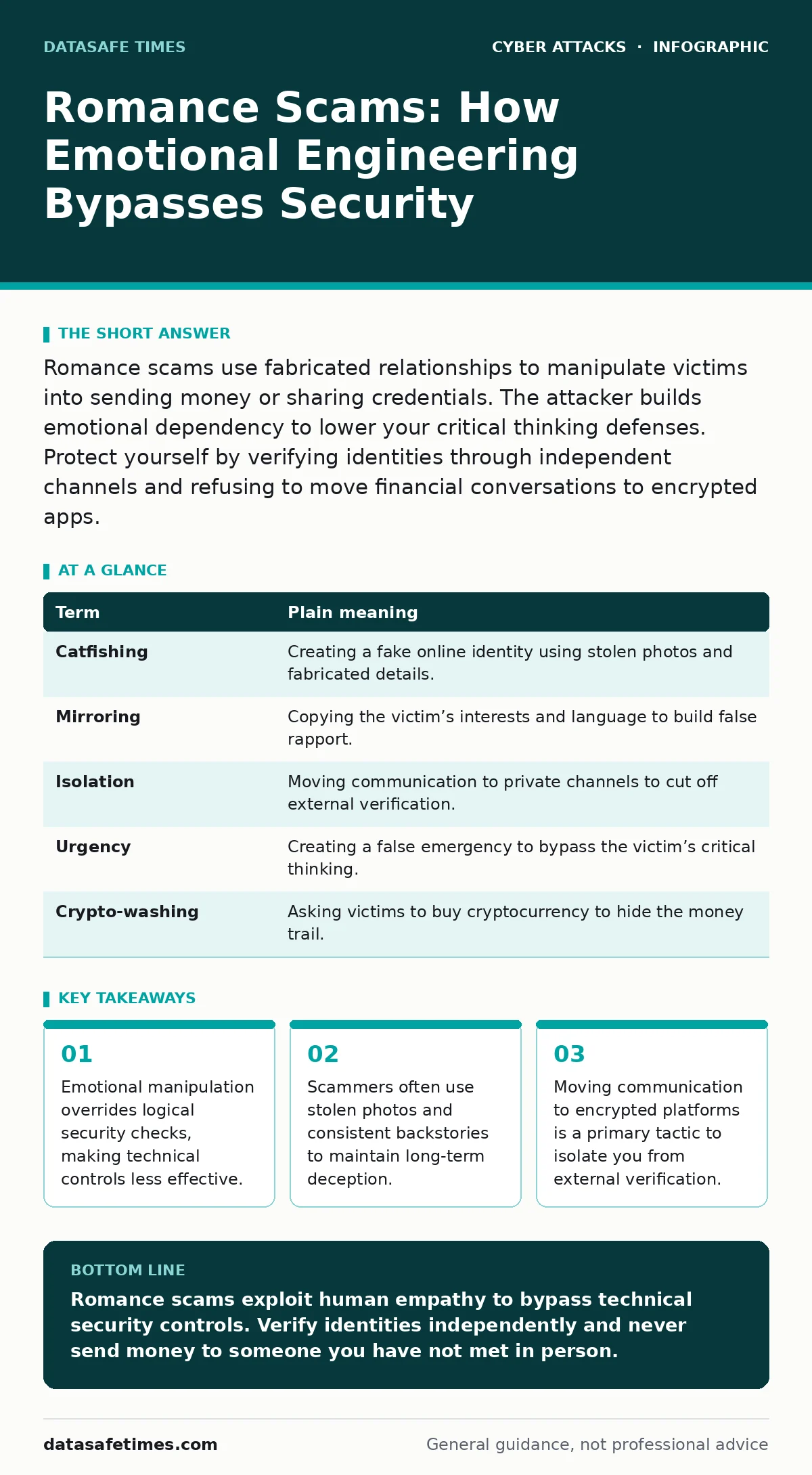
Romance scams use fabricated relationships to manipulate victims into sending money or sharing credentials. The attacker builds emotional dependency to lower your critical thinking defenses. Protect yourself by verifying identities through independent channels and refusing to move financial conversations to encrypted apps.
The Architecture of Trust
Imagine you are building a house. You install a steel door, a deadbolt, and a motion-sensor alarm. These are your technical controls. They stop intruders who try to break in by force. Now imagine someone knocks on the door, claims to be a long-lost relative, and you invite them in. The door was never broken. The alarm never sounded. The entry was authorized by you.
Romance scams operate on this principle of authorized entry. The attacker does not hack your bank account directly. Instead, they hack your judgment. They create a persona that appeals to your desire for connection. Once you trust this persona, you voluntarily lower your defenses. You share information you would never give a stranger. You transfer funds you would never send to an unknown entity.
This is not a technical failure. It is a human one. The attacker exploits the fact that humans are social animals wired to trust familiar faces and shared stories. When that trust is established, your brain stops running its usual security checks.
The Mechanics of the Deception
The process begins with reconnaissance. The attacker creates a profile on a dating site or social platform. The photos are often stolen from real people who have no idea they are being used. The bio is carefully crafted to appeal to a broad demographic. It might mention a job that requires travel, such as engineering or military service. This explains why they cannot meet in person.
Next comes the engagement. The attacker mirrors your interests. If you like hiking, they talk about trails. If you are lonely, they offer comfort. This is called mirroring. It creates a false sense of intimacy. The conversation moves quickly. They declare feelings early. This accelerates the emotional bond. You feel special. You feel understood.
The isolation phase follows. The attacker suggests moving the conversation to a private messaging app. They claim the dating site is too public or that they want to keep the relationship private. This removes the platform’s safety features. It prevents friends or family from seeing the conversation. You are now in a closed loop with the attacker.
| Term | Plain meaning |
|---|---|
| Catfishing | Creating a fake online identity using stolen photos and fabricated details. |
| Mirroring | Copying the victim’s interests and language to build false rapport. |
| Isolation | Moving communication to private channels to cut off external verification. |
| Urgency | Creating a false emergency to bypass the victim’s critical thinking. |
| Crypto-washing | Asking victims to buy cryptocurrency to hide the money trail. |
The Financial Extraction
Once the emotional bond is strong, the crisis arrives. The attacker claims to have an emergency. They need money for a plane ticket to see you. They need funds for a medical bill. They need help with a business opportunity. The request is specific and urgent.
The attacker explains why they cannot pay. They might say their bank account is frozen. They might say they are in a remote location without access to cards. They ask you to send money via wire transfer or gift cards. These methods are irreversible. Once the money is sent, it cannot be retrieved.
Sometimes the request is not for cash. The attacker might ask for login credentials. They claim they need to access a shared account to plan a trip. They might ask you to install remote access software to "show" you their home. This is a pretext for stealing your digital identity.
Why Technical Controls Fail
You might think that using strong passwords or multi-factor authentication will stop this. It will not. Multi-factor authentication protects against unauthorized access. It does not protect against authorized access by a trusted user. If you voluntarily give the attacker your password, the system sees it as a valid login.
This is similar to MFA fatigue attacks, where attackers bombard you with approval requests until you click "yes" out of annoyance. In romance scams, you click "yes" out of love or sympathy. The mechanism is different, but the result is the same. You bypass the security control willingly.
The attacker may also use callback phishing techniques. They might call you from a spoofed number that looks like your bank. They claim there is an issue with your account. Because you trust the caller’s voice (which they have studied from your calls), you provide information. The technical indicator of a spoofed number is ignored because the emotional context overrides it.
The Hidden Costs of Compliance
The cost is not just financial. It is psychological. Victims often feel shame. They hide the deception from friends and family. This isolation makes it harder to recover. The attacker knows this. They use the secret to maintain control. They threaten to expose the victim if they do not comply.
For developers, this highlights a blind spot in security design. We assume users are rational actors. We design systems that protect against external threats. We rarely design for internal betrayal caused by manipulation. This is where tabletop exercises help. By simulating social engineering scenarios, teams can identify where human judgment is the weakest link.
The attacker’s goal is to keep you engaged. They may use botnet attacks to maintain their infrastructure. They use compromised devices to host their fake profiles. This allows them to disappear and reappear with new identities. Your report to one platform is ineffective if they have hundreds of other accounts.
Simple Safety Habits
You can protect yourself by changing how you verify identity. Do not rely on the platform’s chat. If someone you meet online asks to move to a private app, be suspicious. Keep the conversation on the original platform as long as possible. This allows the platform to monitor for suspicious behavior.
Verify the person’s identity independently. Ask for a video call. If they refuse, citing camera issues or shyness, this is a red flag. Reverse image search their photos. If the images appear on other profiles or stock photo sites, they are fake. This is a basic check that stops many scams early.
Never send money to someone you have not met in person. No matter how urgent the story, no matter how convincing the voice. If they need money, they will find another way. Real partners do not rely on strangers for financial survival.
- Keep conversations on the original dating platform for at least a few weeks.
- Video call before sharing any personal or financial information.
- Reverse image search all profile photos to check for stolen content.
The Role of Verification
Verification is not about distrust. It is about confirmation. You can trust someone and still verify their identity. This is a standard practice in many industries. We verify driver’s licenses. We verify bank accounts. We should verify online partners.
If someone asks you to install remote access software, refuse. This is never necessary for a relationship. It is a tool for theft. If they ask for your password, refuse. This is a violation of your privacy. A real partner will respect your boundaries.
Remember that session cookie theft is a common technical attack. If you share your login details, the attacker can use your session cookie to access your account without needing your password. This gives them full control. Do not share credentials. Ever.
Key takeaways
- Emotional manipulation overrides logical security checks, making technical controls less effective.
- Scammers often use stolen photos and consistent backstories to maintain long-term deception.
- Moving communication to encrypted platforms is a primary tactic to isolate you from external verification.
Romance scams exploit human empathy to bypass technical security controls. Verify identities independently and never send money to someone you have not met in person.
Frequently asked questions
Can I trace money sent through gift cards?
No. Gift cards are treated like cash. Once the code is shared, the funds are usually spent immediately and cannot be recovered.
How do scammers get photos of real people?
They steal images from public social media profiles or stock photo websites. The person in the photo is unaware they are being used.
Is video calling enough to verify identity?
It is a strong indicator, but not proof. Advanced attackers can use pre-recorded videos. Look for real-time responses to specific questions.
Should I report the scam to the dating site?
Yes. Reporting helps the platform remove the fake profile and may prevent others from being targeted. It also creates a record of the incident.
How this guide was produced: written by the DataSafe Times editorial team with AI assistance, checked against the public references listed below, and reviewed when the facts change. See our editorial policy or report an error.