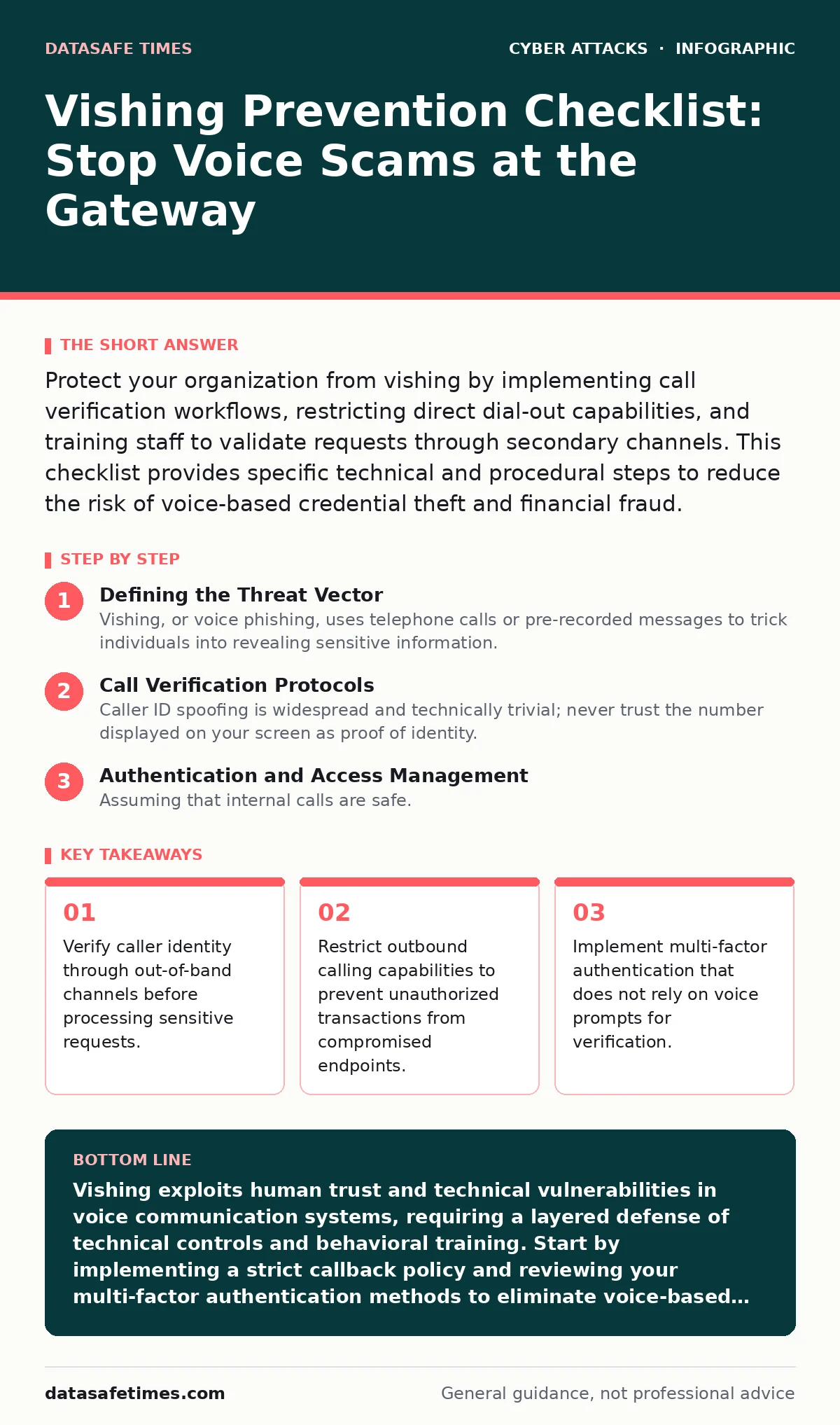
Protect your organization from vishing by implementing call verification workflows, restricting direct dial-out capabilities, and training staff to validate requests through secondary channels. This checklist provides specific technical and procedural steps to reduce the risk of voice-based credential theft and financial fraud.
Defining the Threat Vector
Vishing, or voice phishing, uses telephone calls or pre-recorded messages to trick individuals into revealing sensitive information. Unlike email-based attacks, voice interactions create a sense of urgency and personal connection that bypasses standard security reflexes. Attackers often spoof caller IDs to mimic trusted entities, making visual verification unreliable. You must treat incoming calls from unknown numbers as potential threats until proven otherwise. The human tendency to comply with perceived authority makes voice channels particularly dangerous for credential harvesting and fraud.
Call Verification Protocols
- Implement a callback policy: Require callers to hang up and call a known, official number to verify identity. This prevents caller ID spoofing from deceiving staff.
- Use out-of-band verification: Confirm sensitive requests via a separate communication channel, such as email or secure messaging. This ensures the request originates from a verified source.
- Establish a trusted contact list: Maintain internal directories of official numbers for critical vendors and partners. This reduces reliance on potentially spoofed caller ID data.
- Train staff to recognize urgency cues: Identify language designed to create panic or bypass standard procedures. This helps employees pause and verify before acting.
Technical Call Controls
- Restrict outbound dialing: Limit the ability of compromised endpoints to make international or premium-rate calls. This prevents attackers from initiating fraudulent transactions directly.
- Enable call authentication: Use standards like STIR/SHAKEN to verify the legitimacy of incoming calls. This adds a layer of cryptographic validation to caller ID information.
- Monitor call patterns: Implement logging and analysis of call volumes and destinations for anomalies. This helps detect compromised accounts being used for malicious purposes.
- Disable direct inward dialing for sensitive roles: Route calls to general lines rather than direct extensions for high-risk personnel. This adds a barrier between attackers and specific targets.
Authentication and Access Management
- Avoid voice-based MFA: Do not use phone calls as a second factor for authentication. Attackers can intercept or redirect voice calls to bypass this control.
- Use hardware security keys: Implement physical devices for multi-factor authentication where possible. This provides a robust alternative to vulnerable voice or SMS-based methods.
- Enforce strict account lockout policies: Lock accounts after a few failed login attempts to prevent brute-force attacks. This limits the window of opportunity for attackers trying to guess credentials.
- Regularly rotate credentials: Change passwords and access codes periodically to reduce the risk of long-term compromise. This minimizes the impact if credentials are leaked or stolen.
Employee Training and Awareness
- Conduct regular phishing simulations: Include voice-based scenarios in your training programs to prepare staff for real-world attacks. This helps employees recognize and respond to vishing attempts effectively.
- Create clear reporting procedures: Establish simple steps for employees to report suspicious calls. This enables rapid response and investigation of potential security incidents.
- Review incident response plans: Ensure your plans include specific steps for handling voice-based social engineering. This ensures a coordinated and effective response to vishing attacks.
- Perform tabletop exercises: Simulate vishing scenarios to test the effectiveness of your policies and procedures. This identifies gaps in your defenses before a real attack occurs.
Operational Hygiene and Monitoring
- Audit call logs regularly: Review records for unusual patterns or unauthorized calls. This helps detect compromised accounts or insider threats early.
- Implement rate limiting on API endpoints: Restrict the number of requests to sensitive systems to prevent automated attacks. This adds a layer of protection against bot-driven exploitation.
- Keep software updated: Ensure all communication systems and endpoints are patched with the latest security fixes. This closes known vulnerabilities that attackers could exploit.
- Monitor for session cookie theft: Watch for signs of stolen session tokens that could allow unauthorized access. This protects against attacks that bypass traditional login mechanisms.
Key takeaways
- Verify caller identity through out-of-band channels before processing sensitive requests.
- Restrict outbound calling capabilities to prevent unauthorized transactions from compromised endpoints.
- Implement multi-factor authentication that does not rely on voice prompts for verification.
Vishing exploits human trust and technical vulnerabilities in voice communication systems, requiring a layered defense of technical controls and behavioral training. Start by implementing a strict callback policy and reviewing your multi-factor authentication methods to eliminate voice-based verification.
Frequently asked questions
How can I tell if a call is spoofed?
Caller ID spoofing makes it difficult to verify identity visually. Always hang up and call back using a known, official number to confirm the caller's identity.
Is using a VoIP system more secure than traditional phones?
VoIP systems offer more control over call routing and logging, but they also introduce new vulnerabilities. Proper configuration and monitoring are required to mitigate risks.
What should I do if I accidentally share sensitive information?
Immediately change your passwords, revoke any shared access, and report the incident to your security team. This helps contain the damage and prevent further exploitation.
Can AI voice cloning be used in vishing attacks?
Yes, AI voice cloning can replicate voices with high accuracy, making it harder to detect impersonation. Always verify requests through secondary, secure channels.
How this guide was produced: written by the DataSafe Times editorial team with AI assistance, checked against the public references listed below, and reviewed when the facts change. See our editorial policy or report an error.