
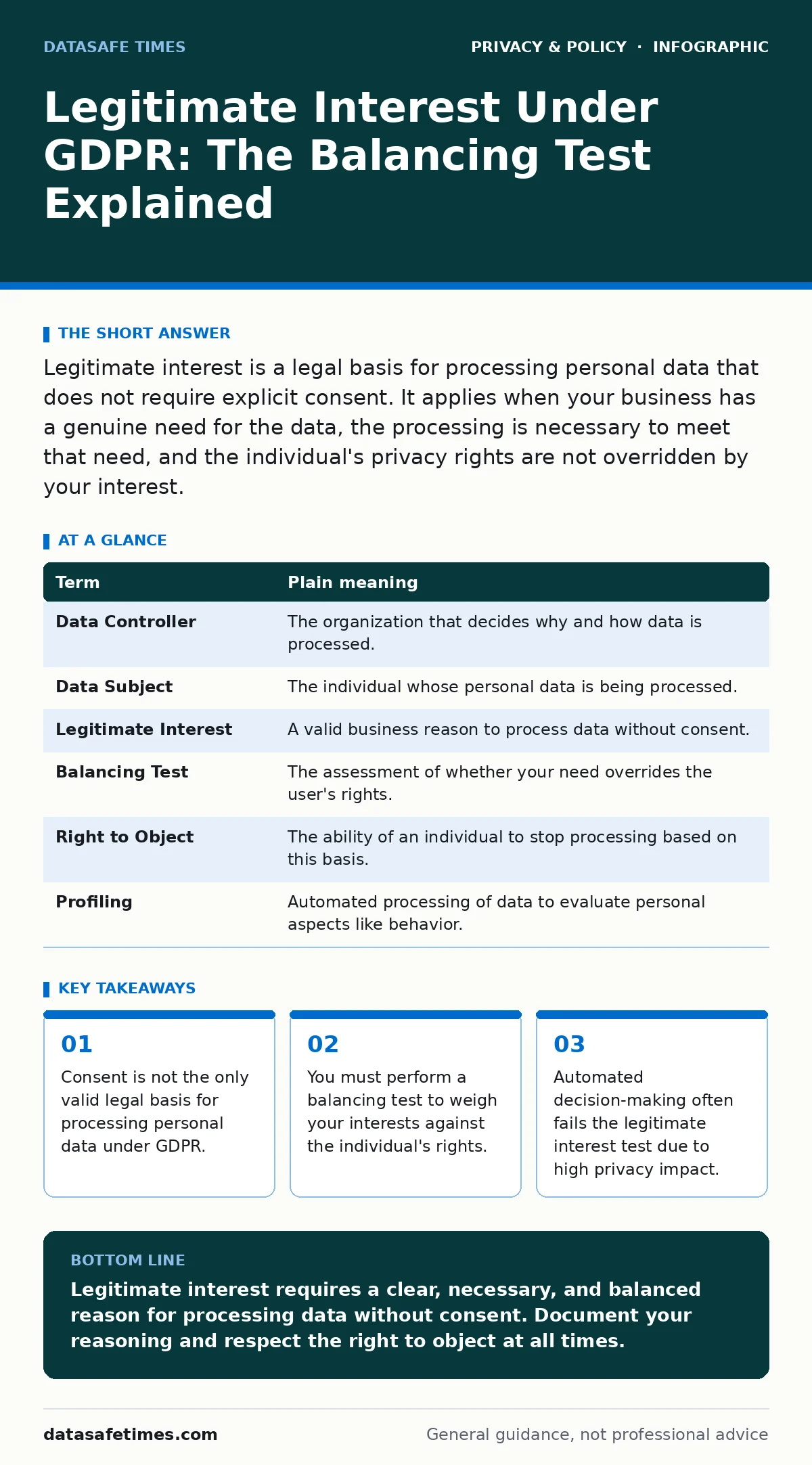
Legitimate interest is a legal basis for processing personal data that does not require explicit consent. It applies when your business has a genuine need for the data, the processing is necessary to meet that need, and the individual's privacy rights are not overridden by your interest.
The Library Borrowing Card
Imagine you run a small library. You need to know who borrows books to ensure they are returned. This is a legitimate interest. You do not need to ask every patron for permission to record their name and the book title. However, you cannot record which pages they read or track their reading speed. That level of detail serves no operational purpose and intrudes on their private life. The rule is simple: take only what you need to run the service, nothing more.
This analogy maps directly to data protection law. When you process personal data, you must identify a specific purpose. That purpose must be real and current. You cannot claim an interest in data you might use someday. The interest must be connected to the present action.
The Three-Part Balancing Test
The framework for this legal basis requires three checks. First, you identify the interest. This is the purpose test. Second, you check if the processing is necessary. This is the necessity test. Third, you weigh your interest against the individual's rights. This is the balancing test. All three must pass. If one fails, you cannot use this basis.
Many organizations fail at the second step. They assume that because they want data, they need it. Necessity means there is no less intrusive way to achieve the same result. If you can anonymize the data, you must do so. If you can aggregate it, you should. Only use identifiable data when the task is impossible otherwise.
Common Points of Confusion
A frequent error is treating this basis as a backup plan for failed consent. It is not. It is a primary legal ground. You choose it because it fits the processing activity, not because consent was hard to get. Another confusion is assuming it applies to direct marketing. While it can, many individuals have the right to object to such processing. You must honor that objection immediately.
Suppose you send promotional emails based on a purchase. That is a legitimate interest. If the recipient clicks "unsubscribe," you must stop. You cannot argue that your interest in sales outweighs their wish to stop receiving mail. The right to object is absolute for direct marketing.
| Term | Plain meaning |
|---|---|
| Data Controller | The organization that decides why and how data is processed. |
| Data Subject | The individual whose personal data is being processed. |
| Legitimate Interest | A valid business reason to process data without consent. |
| Balancing Test | The assessment of whether your need overrides the user's rights. |
| Right to Object | The ability of an individual to stop processing based on this basis. |
| Profiling | Automated processing of data to evaluate personal aspects like behavior. |
When the Analogy Breaks Down
The library example works for simple records. It fails when you move to analysis. Suppose you track how long patrons stay in the library to optimize staffing. This is still a legitimate interest. But if you combine that data with external sources to predict political views, the balance shifts. The intrusion becomes too high. The purpose becomes too speculative.
You must document this shift. The documentation is called a Data Protection Impact Assessment. You should perform this before starting complex processing. It forces you to list risks and mitigation steps. Without this record, you cannot prove you considered the individual's rights. For more on tracking behaviors, see our guide on online tracking.
The Hidden Cost of Documentation
The biggest cost of this basis is not technical. It is administrative. You must record your reasoning. You must update it if the purpose changes. You must be ready to explain it to a regulator or an individual. This is why many organizations prefer consent. Consent is easier to document. It is harder to defend. Consent can be withdrawn at any time. This basis is stable if your reason remains valid.
If you rely on this basis, your privacy notices must be clear. You cannot hide the reason in fine print. You must state the interest and the right to object. Clarity reduces legal risk. It builds trust. It also simplifies compliance. For guidance on appointing a specialist, see our guide on data protection officers.
Try This Now
- List every data field you collect. Next to each, write the specific business reason you need it. If you cannot write a reason, delete the field.
- Review your privacy policy. Ensure it mentions legitimate interest where applicable. Provide a clear link to object to processing.
- Audit your third-party tools. Many analytics tools use cookies that require consent. Do not assume their settings apply to your legitimate interest claims. See our guide on DNS over HTTPS for secure data transmission practices.
Edge Cases to Avoid
Do not use this basis for sensitive data. Health, political opinions, and biometric data require higher thresholds. Special rules apply to these categories. You generally need explicit consent or a specific legal exception. Also, avoid using it for international transfers without proper safeguards. Data movement adds risk. It complicates the balancing test.
Imagine you use a cloud provider in another country. The provider processes data for maintenance. That is their legitimate interest. Your interest is storage. Both must be valid. You must check their contracts. You must verify their security measures. For storage security, see our guide on encrypted cloud storage.
Final Checks
Before you proceed, ask if the individual expects this processing. If a user expects you to know their address for delivery, that is fair. If they do not expect you to analyze their typing speed, that is not. Reasonable expectation is part of the balancing test. It is not a legal term, but it guides the interpretation.
This basis provides flexibility. It allows innovation without constant consent requests. But it demands rigor. You must prove your need. You must respect the individual. You must document the choice. For identity verification, see our guide on two-factor authentication for personal accounts.
Key takeaways
- Consent is not the only valid legal basis for processing personal data under GDPR.
- You must perform a balancing test to weigh your interests against the individual's rights.
- Automated decision-making often fails the legitimate interest test due to high privacy impact.
Legitimate interest requires a clear, necessary, and balanced reason for processing data without consent. Document your reasoning and respect the right to object at all times.
Frequently asked questions
Can I use legitimate interest for email marketing?
Yes, if you have an existing relationship with the customer. You must provide an easy opt-out mechanism and honor objections immediately.
How is this different from consent?
Consent requires a clear, affirmative action by the user. Legitimate interest relies on your valid business need and a
How this guide was produced: written by the DataSafe Times editorial team with AI assistance, checked against the public references listed below, and reviewed when the facts change. See our editorial policy or report an error.