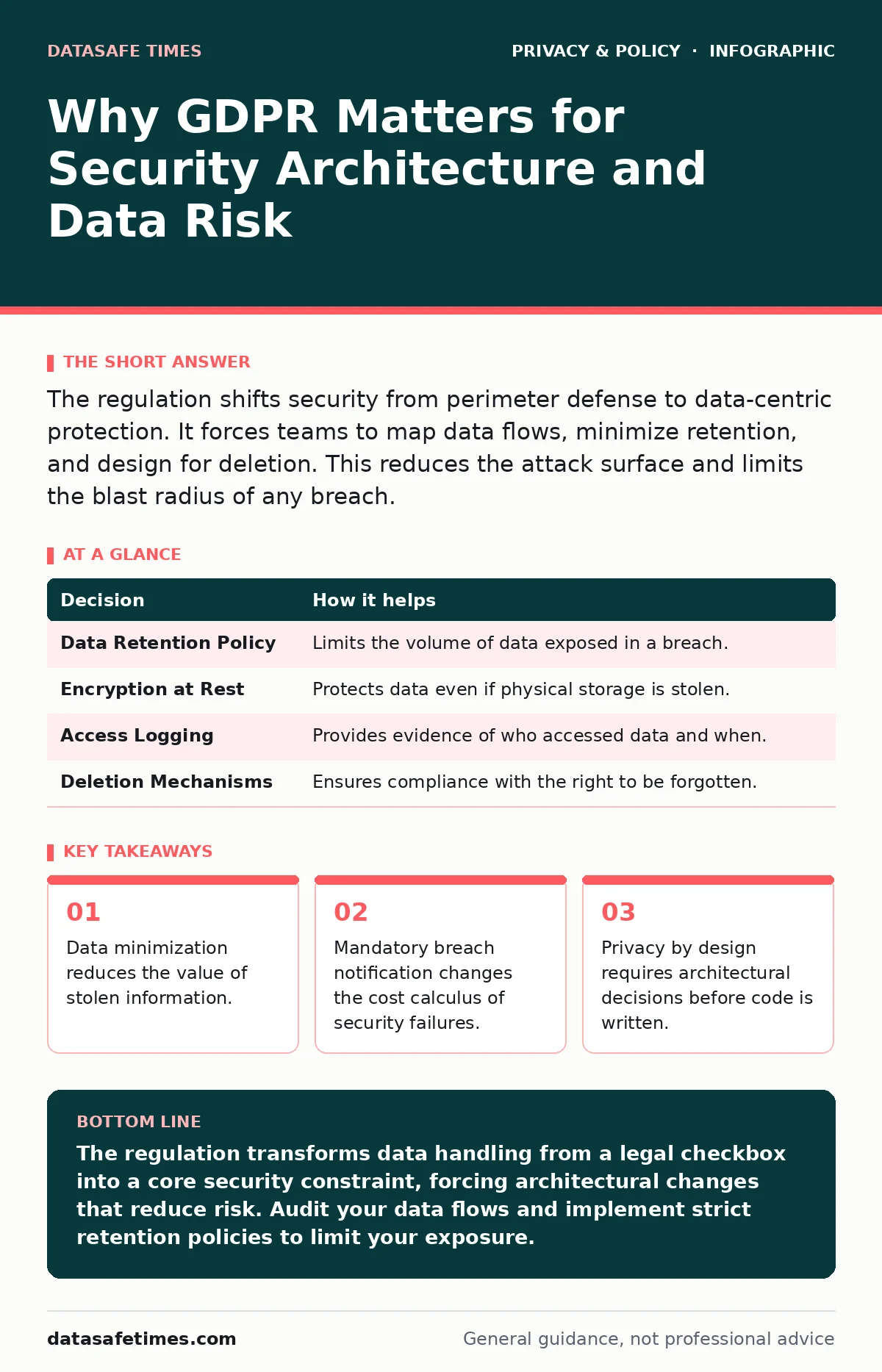
The regulation shifts security from perimeter defense to data-centric protection. It forces teams to map data flows, minimize retention, and design for deletion. This reduces the attack surface and limits the blast radius of any breach.
The Shift from Perimeter to Data
Traditional security focused on keeping intruders out of the network. Firewalls and intrusion detection systems served as the primary line of defense. This model assumed that if the perimeter held, the data inside was safe. The regulation dismantles this assumption by making the handling of data itself the primary compliance target.
You can have a perfectly secured network while still violating the law. If your application stores more user data than necessary, or if it retains that data indefinitely, you are non-compliant. The security posture must shift from protecting the container to protecting the contents. This means every database query, every log entry, and every backup becomes a potential liability.
Architectural Constraints by Law
Engineers often view legal requirements as external noise. This regulation embeds constraints directly into the software architecture. You must design systems that allow for the deletion of specific records. This is not always technically trivial when data is replicated across distributed systems.
Consider the concept of data minimization. You should only collect what is strictly necessary for the stated purpose. This limits the amount of data available to an attacker. If you do not have it, you cannot lose it. This principle forces a rigorous review of every field in every form. It challenges the habit of collecting data "just in case" it might be useful later.
| Decision | How it helps |
|---|---|
| Data Retention Policy | Limits the volume of data exposed in a breach. |
| Encryption at Rest | Protects data even if physical storage is stolen. |
| Access Logging | Provides evidence of who accessed data and when. |
| Deletion Mechanisms | Ensures compliance with the right to be forgotten. |
The Cost of Silent Breaches
One of the most significant security drivers is the mandatory notification of data breaches. You must report certain incidents to authorities within a strict timeframe. This removes the option of quietly patching a vulnerability and hoping no one notices. The threat of reputational damage and fines forces immediate attention to security incidents.
This requirement changes the internal priority of security alerts. A bug that allows data extraction is no longer just a technical debt item. It is a potential legal event. Teams must have clear procedures for identifying, assessing, and reporting incidents. This creates a culture where security issues are escalated quickly rather than buried in backlog tickets.
Mapping the Invisible Flows
Many organizations do not know where their data lives. It sits in legacy databases, third-party APIs, and backup tapes. The regulation requires a record of processing activities. This forces teams to map data flows from ingestion to deletion. You cannot protect what you cannot see.
This mapping reveals hidden dependencies. You might find that a third-party analytics provider holds more user data than your own systems. You might discover that logs contain personally identifiable information that should have been stripped. These findings often lead to significant architectural changes. They expose the gap between how data is intended to flow and how it actually flows.
The Role of Anonymization
Anonymization is the process of removing identifiers so that an individual cannot be re-identified. This technique is distinct from pseudonymization, where data can be re-linked with a key. True anonymization removes the data from the scope of the regulation. This makes it a powerful security and compliance tool.
However, achieving true anonymization is difficult. Modern techniques can often re-identify individuals from seemingly anonymous datasets by cross-referencing other public data. You must understand the limits of your anonymization methods. If the method fails, you are still liable. This requires a deep understanding of the data and the potential for linkage attacks.
See also: Encrypted Cloud Storage: How Zero-Knowledge Architecture Protects Files
Integrating Privacy into Development
Privacy by design is not a phase at the end of the project. It is a continuous process throughout the development lifecycle. You must consider privacy implications when designing APIs, defining data models, and writing code. This requires collaboration between legal, security, and engineering teams.
Security teams often focus on confidentiality, integrity, and availability. Privacy adds a fourth dimension: purpose limitation. You must ensure that data is only used for the purposes for which it was collected. This restricts how data can be shared internally. It prevents the casual reuse of customer data for new features without explicit consent or a valid legal basis.
The Hidden Costs of Compliance
Compliance is often viewed as a cost center. It requires time, tools, and expertise. However, the hidden cost of non-compliance is much higher. Breaches result in fines, legal fees, and loss of customer trust. The cost of rebuilding trust far exceeds the cost of implementing privacy controls.
There is also a hidden benefit. Systems designed with privacy in mind are often simpler and more maintainable. They have less data, fewer dependencies, and clearer boundaries. This reduces technical debt and makes the system easier to secure. Privacy and security are not opposing forces. They are complementary disciplines that reinforce each other.
Beyond the Basics
Many teams focus on the obvious requirements like consent and cookies. They overlook the deeper structural changes required. For instance, private browsing mode does not protect you from server-side logging. Users may assume their data is hidden, but your systems still record their interactions. You must be transparent about what you collect, regardless of the client-side settings.
Similarly, email tracking pixels collect data about user behavior. You cannot treat metadata as exempt. Every piece of information that can be linked to an individual is in scope. This includes IP addresses, device identifiers, and location data.
Building a Resilient Culture
The regulation is a catalyst for cultural change. It forces organizations to take data responsibility seriously. This leads to better documentation, clearer processes, and more accountability. Security becomes a shared responsibility rather than a siloed function.
You must train your teams on the principles of data protection. They need to understand why certain practices are prohibited. They need to know how to identify personal data. They need to understand the risks of data misuse. This training should be ongoing and practical. It should focus on real-world scenarios and specific actions.
The Long-Term View
The regulation is not a one-time project. It is a continuous obligation. Data practices evolve, technologies change, and threats emerge. You must continuously review and update your compliance efforts. This requires ongoing monitoring and assessment.
Security and privacy are dynamic disciplines. They require constant attention and adaptation. By embedding these principles into your engineering culture, you build a more resilient organization. You reduce risk, improve trust, and create better products. The regulation provides the framework, but you must build the structure.
Key takeaways
- Data minimization reduces the value of stolen information.
- Mandatory breach notification changes the cost calculus of security failures.
- Privacy by design requires architectural decisions before code is written.
The regulation transforms data handling from a legal checkbox into a core security constraint, forcing architectural changes that reduce risk. Audit your data flows and implement strict retention policies to limit your exposure.
Frequently asked questions
Does GDPR apply to my company if we are not in Europe?
Yes, if you process the personal data of individuals in the European Economic Area, regardless of where your company is located.
What is the difference between anonymization and pseudonymization?
Anonymization removes identifiers permanently, while pseudonymization replaces them with reversible keys. Only anonymization removes data from the regulation's scope.
Do I need consent for all data processing?
No, there are six legal bases for processing data. Consent is just one. Legitimate interest is another common basis, but it requires careful assessment.
How long do I have to report a breach?
You must report certain breaches to the supervisory authority within seventy-two hours of becoming aware of it.
How this guide was produced: written by the DataSafe Times editorial team with AI assistance, checked against the public references listed below, and reviewed when the facts change. See our editorial policy or report an error.