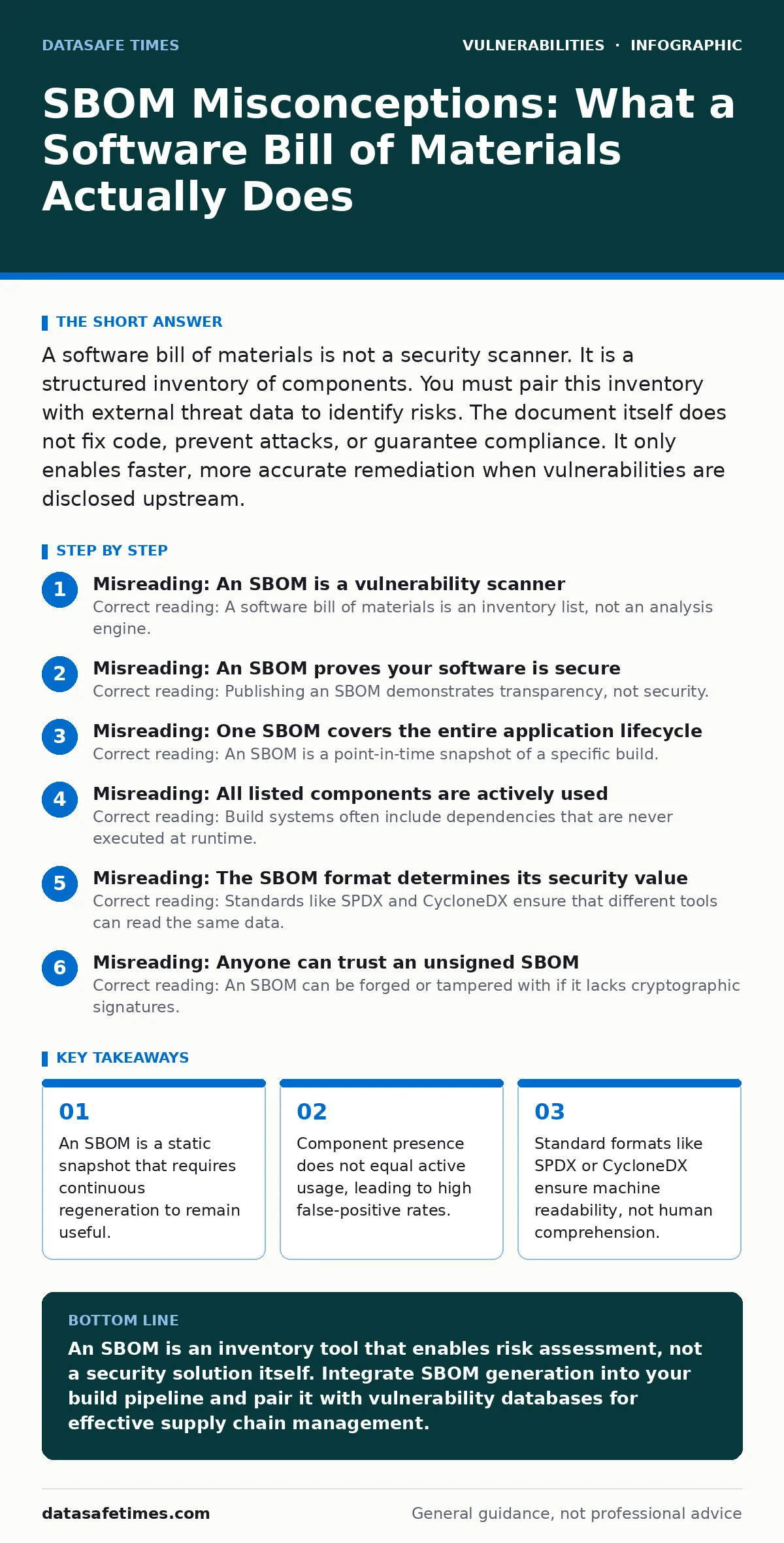
A software bill of materials is not a security scanner. It is a structured inventory of components. You must pair this inventory with external threat data to identify risks. The document itself does not fix code, prevent attacks, or guarantee compliance. It only enables faster, more accurate remediation when vulnerabilities are disclosed upstream.
Misreading: An SBOM is a vulnerability scanner
Correct reading: A software bill of materials is an inventory list, not an analysis engine. It records what components exist in your build, but it does not evaluate their security posture. Treating an SBOM as a scanner leads to blind spots because the document lacks context about how components interact. You must feed the SBOM into a vulnerability database or a policy engine to identify known flaws. The SBOM provides the "what," while external tools provide the "so what." Without this separation of concerns, you cannot automate remediation workflows effectively.
Misreading: An SBOM proves your software is secure
Correct reading: Publishing an SBOM demonstrates transparency, not security. It shows you know what is in your product, but it does not prove those components are free from defects. Many organizations generate SBOMs to satisfy regulatory requirements without addressing the underlying risks. This creates a false sense of safety. The document is a starting point for risk assessment, not an endpoint for security validation. You still need to assess the risk of each component based on its criticality and exposure.
Misreading: One SBOM covers the entire application lifecycle
Correct reading: An SBOM is a point-in-time snapshot of a specific build. It becomes stale the moment you add a dependency, update a library, or recompile the code. Maintaining a single static document is impossible for dynamic software projects. You need a process that generates a new SBOM for every significant change. This often integrates with your continuous integration pipeline. If your SBOM does not match the current binary, it is misleading. Stale inventories cause teams to waste time investigating vulnerabilities in components that no longer exist.
Misreading: All listed components are actively used
Correct reading: Build systems often include dependencies that are never executed at runtime. These "ghost dependencies" appear in the SBOM but pose no risk if they cannot be triggered. Treating every listed component as a live threat inflates your workload with false positives. You must distinguish between build-time dependencies and runtime dependencies. Static analysis tools can help identify dead code, but they are not perfect. Focusing only on the SBOM without runtime verification leads to alert fatigue. Developers ignore real threats when buried under noise from unused libraries.
Misreading: The SBOM format determines its security value
Correct reading: Standards like SPDX and CycloneDX ensure that different tools can read the same data. They do not make the data more accurate or secure. A poorly populated SBOM in a standard format is still useless. The value lies in the completeness and accuracy of the component metadata, not the schema itself. You must ensure that your generation tool captures all transitive dependencies. Missing nested dependencies creates gaps in your visibility. Format compliance is a technical requirement; data integrity is a security requirement.
See also: Exploitability vs Severity: Why High Scores Often Mislead Developers · Type Confusion Vulnerabilities Explained: How Data Misinterpretation Breaks Software
Misreading: Anyone can trust an unsigned SBOM
Correct reading: An SBOM can be forged or tampered with if it lacks cryptographic signatures. Without a digital signature from a trusted source, you cannot verify that the inventory matches the binary. Attackers can modify the SBOM to hide malicious components. You must verify the signature chain from the component author to the final assembler. This adds complexity but prevents supply chain substitution attacks. Trusting an unsigned document is similar to trusting an unsigned email. The content may look correct, but the source is unverified.
Misreading: SBOMs replace secure coding practices
Correct reading: An SBOM helps you manage third-party risks, but it does not protect against bugs in your own code. Vulnerabilities in custom logic, such as logic errors or improper input validation, will not appear in the SBOM. You must still follow secure coding principles to prevent these issues. The SBOM is a tool for supply chain management, not application security. It complements other practices like memory-safe programming languages and code reviews. Relying solely on an SBOM leaves your custom code exposed to attacks that inventory tools cannot detect.
Misreading: SBOMs solve all supply chain risks
Correct reading: An SBOM identifies components, but it does not assess the trustworthiness of the maintainers. A component can be free of known vulnerabilities but still be maintained by an untrusted actor. You need additional signals, such as maintainership history and contribution patterns, to assess risk. The SBOM is one piece of a larger puzzle. It works best when combined with other risk indicators. For example, you might cross-reference SBOM data with an EPSS score to prioritize remediation efforts. This combination provides a more realistic view of potential threats.
Misreading: Human-readable SBOMs are sufficient
Correct reading: SBOMs are primarily designed for machine consumption. Humans cannot efficiently parse hundreds of components to identify risks. You need tools that automate the correlation between SBOM data and vulnerability databases. Manual review is error-prone and slow. Focus on integrating SBOMs into your security orchestration platform. This allows for automated policy enforcement and remediation tracking. Human intervention should be reserved for complex decisions, not routine inventory checks. Machine-readable formats enable the scale necessary for modern software development.
Misreading: SBOMs are only for external compliance
Correct reading: While regulations often mandate SBOMs, their primary value is internal risk management. They help you understand your attack surface and prioritize patches. Compliance is a byproduct, not the main goal. Using SBOMs only for audits wastes their potential for operational security. Integrate them into your daily development workflow. This enables proactive risk reduction rather than reactive compliance. Teams that use SBOMs for internal decision-making respond faster to emerging threats.
Key takeaways
- An SBOM is a static snapshot that requires continuous regeneration to remain useful.
- Component presence does not equal active usage, leading to high false-positive rates.
- Standard formats like SPDX or CycloneDX ensure machine readability, not human comprehension.
- Supply chain trust depends on who signs the SBOM, not just its content.
An SBOM is an inventory tool that enables risk assessment, not a security solution itself. Integrate SBOM generation into your build pipeline and pair it with vulnerability databases for effective supply chain management.
Frequently asked questions
Does an SBOM show me if my code has bugs?
No, an SBOM only lists third-party components and their versions. It does not analyze your custom code for logic errors or implementation flaws.
How often should I regenerate my SBOM?
You should regenerate the SBOM for every significant change to your dependencies or source code. Ideally, this happens automatically during the build process.
Can I use an SBOM to track license compliance?
Yes, SBOMs include license information for each component. You can use this data to ensure you are not violating open-source license terms in your product.
What is the difference between an SBOM and a vulnerability scan?
An SBOM is a list of ingredients, while a vulnerability scan is an analysis of those ingredients for known risks. You need both to understand and manage security.
How this guide was produced: written by the DataSafe Times editorial team with AI assistance, checked against the public references listed below, and reviewed when the facts change. See our editorial policy or report an error.