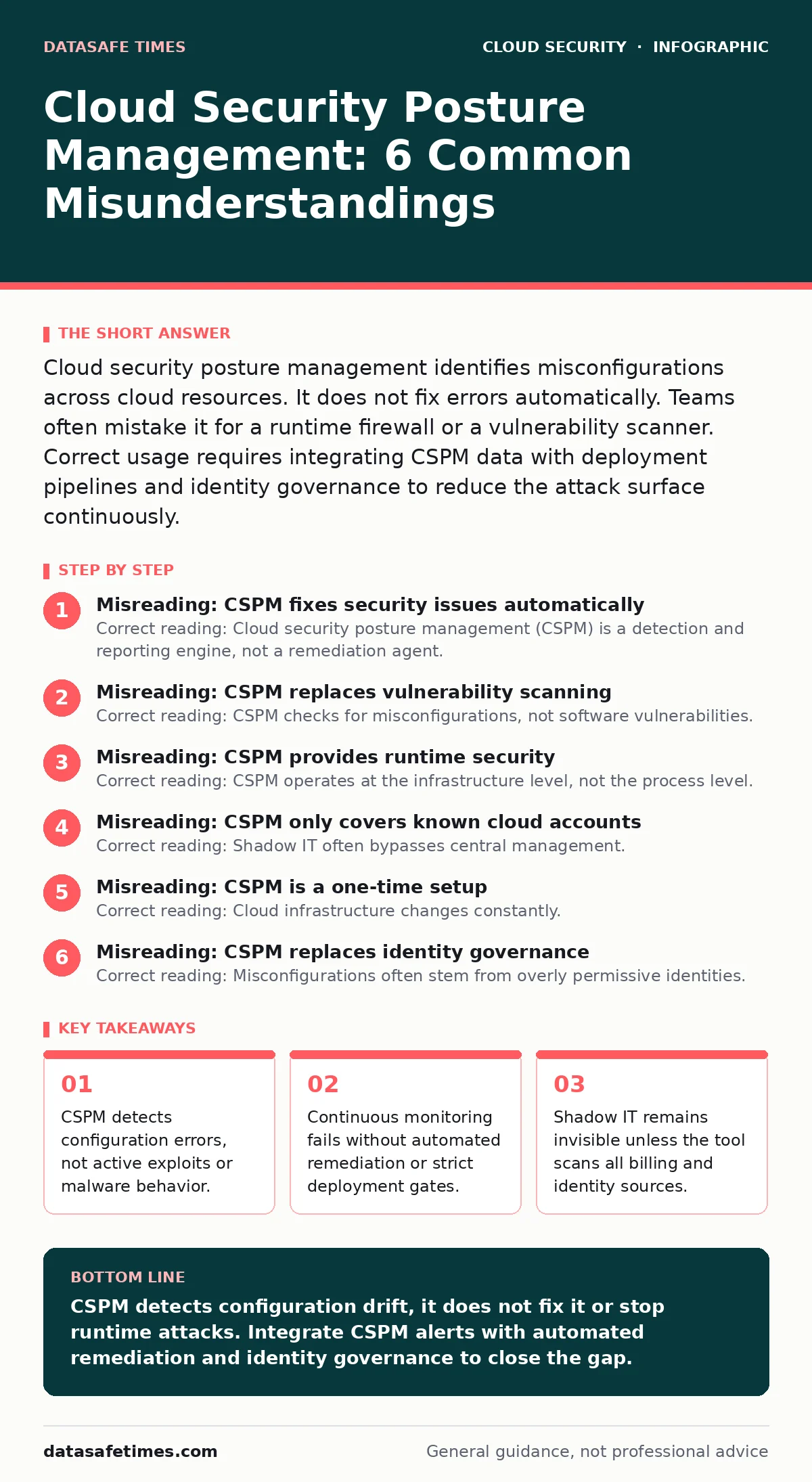
Cloud security posture management identifies misconfigurations across cloud resources. It does not fix errors automatically. Teams often mistake it for a runtime firewall or a vulnerability scanner. Correct usage requires integrating CSPM data with deployment pipelines and identity governance to reduce the attack surface continuously.
Misreading: CSPM fixes security issues automatically
Correct reading: Cloud security posture management (CSPM) is a detection and reporting engine, not a remediation agent. The tool scans cloud resources against a set of best-practice rules. It flags deviations from the desired state. It does not change the configuration. You must build the pipeline that applies the fix.
Imagine a storage bucket left publicly accessible. The CSPM dashboard turns red. The bucket remains open until a script or a person closes it. Relying on alerts without automated correction creates alert fatigue. Teams stop looking at the dashboard because the noise never decreases. The gap between detection and resolution is where breaches occur.
Misreading: CSPM replaces vulnerability scanning
Correct reading: CSPM checks for misconfigurations, not software vulnerabilities. A misconfiguration is an incorrect setting, such as an open port or weak encryption. A vulnerability is a flaw in the code or operating system. CSPM cannot see inside a container image. It cannot detect an outdated library with a known exploit.
You need separate tools for software composition analysis and host-based intrusion detection. CSPM tells you if your database is encrypted at rest. It does not tell you if the application connecting to that database has a SQL injection flaw. Combining these views gives you a complete picture. Treating CSPM as a scanner leaves code-level risks unaddressed.
Misreading: CSPM provides runtime security
Correct reading: CSPM operates at the infrastructure level, not the process level. It validates the state of resources like virtual machines and network rules. It does not monitor traffic flows or process execution. A server can be perfectly configured but still serve malicious content. CSPM will report the server as compliant.
Runtime protection requires different mechanisms. You need application firewalls and endpoint detection systems for that layer. CSPM ensures the foundation is solid. It does not watch what happens on top of that foundation. Understanding this boundary prevents false confidence. You secure the house structure with CSPM. You secure the inhabitants with runtime tools.
Misreading: CSPM only covers known cloud accounts
Correct reading: Shadow IT often bypasses central management. Developers may create personal cloud accounts for testing. These accounts fall outside standard CSPM coverage. If the tool only scans approved billing accounts, it misses the entire shadow environment. The most exposed resources are often the ones nobody tracks.
Expand the scope of your CSPM to include identity federation. Link the tool to your identity provider. This allows the scanner to discover resources created by any authenticated user. Without this link, you have blind spots. The cloud attack surface grows faster than your inventory. Continuous discovery is required to keep the perimeter visible.
Misreading: CSPM is a one-time setup
Correct reading: Cloud infrastructure changes constantly. Developers spin up resources for demos. They delete them later. The configuration drifts. A setting that was secure at deployment may become insecure after an update. CSPM must run continuously. A single snapshot provides no value.
Integrate CSPM into your shift-left security practices. Check configurations before they reach production. This prevents drift from starting. Post-deployment scanning catches errors that slipped through. Both stages are necessary. Static checks in the pipeline stop bad code. Continuous checks in the cloud stop bad configurations. The combination reduces risk significantly.
See also: Encrypted Cloud Storage: How Client-Side Encryption Protects You · Shared Responsibility Model: Where Your Security Ends
Misreading: CSPM replaces identity governance
Correct reading: Misconfigurations often stem from overly permissive identities. A user with admin rights can create insecure resources. CSPM flags the insecure resource. It does not fix the underlying identity problem. You need separate identity and access management controls. These controls enforce least privilege.
Review access key rotation policies regularly. Ensure that service accounts have minimal permissions. CSPM data can inform these reviews. It shows which identities create the most risk. Use that data to tighten access. Identity governance and CSPM work together. One manages who can act. The other checks what they did. Both are required for a secure posture.
Misreading: CSPM works equally well in hybrid clouds
Correct reading: CSPM tools are optimized for public cloud APIs. They may struggle with on-premises or hybrid environments. The data models differ. The visibility is inconsistent. A hybrid cloud security strategy requires additional connectors or agents. These agents extend the view to private infrastructure.
Without proper integration, your hybrid environment becomes a blind spot. Attackers exploit these gaps. They move laterally from public to private. Ensure your CSPM provider supports your specific hybrid setup. Test the coverage thoroughly. Do not assume the tool works everywhere. Verify the data quality for each environment.
Misreading: CSPM eliminates the need for network segmentation
Correct reading: CSPM checks individual resource configurations. It does not enforce network isolation. You can have secure servers in a flat network. CSPM will report them as compliant. The risk comes from lateral movement. An attacker who compromises one server can reach all others.
Implement cloud network segmentation. Use virtual private clouds to isolate workloads. Apply strict security groups and network ACLs. CSPM can verify that these rules exist. It cannot create the isolation. The architecture must support segmentation. CSPM validates the implementation. The two concepts are complementary, not substitutive.
Misreading: CSPM is sufficient for immutable infrastructure
Correct reading: Immutable infrastructure means resources are never modified. They are replaced when changes are needed. CSPM still has a role here. It validates the templates and images used to create resources. It checks the deployment pipeline. It ensures the new instance is secure from birth.
Immutable systems reduce configuration drift. They do not eliminate the need for validation. If the base image is vulnerable, the immutable resource is vulnerable. CSPM checks the configuration of the running instance. It does not scan the image content. Combine CSPM with image scanning tools. This ensures both the container and the configuration are secure.
Key takeaways
- CSPM detects configuration errors, not active exploits or malware behavior.
- Continuous monitoring fails without automated remediation or strict deployment gates.
- Shadow IT remains invisible unless the tool scans all billing and identity sources.
CSPM detects configuration drift, it does not fix it or stop runtime attacks. Integrate CSPM alerts with automated remediation and identity governance to close the gap.
Frequently asked questions
Does CSPM scan for malware?
No, CSPM checks for misconfigurations and compliance violations. It does not scan files or processes for malware signatures or behavior.
Can CSPM stop a data breach?
CSPM reduces the likelihood of a breach by fixing misconfigurations. It does not block active attacks or exfiltration attempts in real time.
How often should CSPM run?
CSPM should run continuously. Cloud configurations change frequently. Continuous monitoring ensures you catch drift as soon as it happens.
Is CSPM enough for compliance?
CSPM provides evidence of compliance. It does not guarantee compliance. You still need policies, procedures, and human review to meet regulatory requirements.
How this guide was produced: written by the DataSafe Times editorial team with AI assistance, checked against the public references listed below, and reviewed when the facts change. See our editorial policy or report an error.