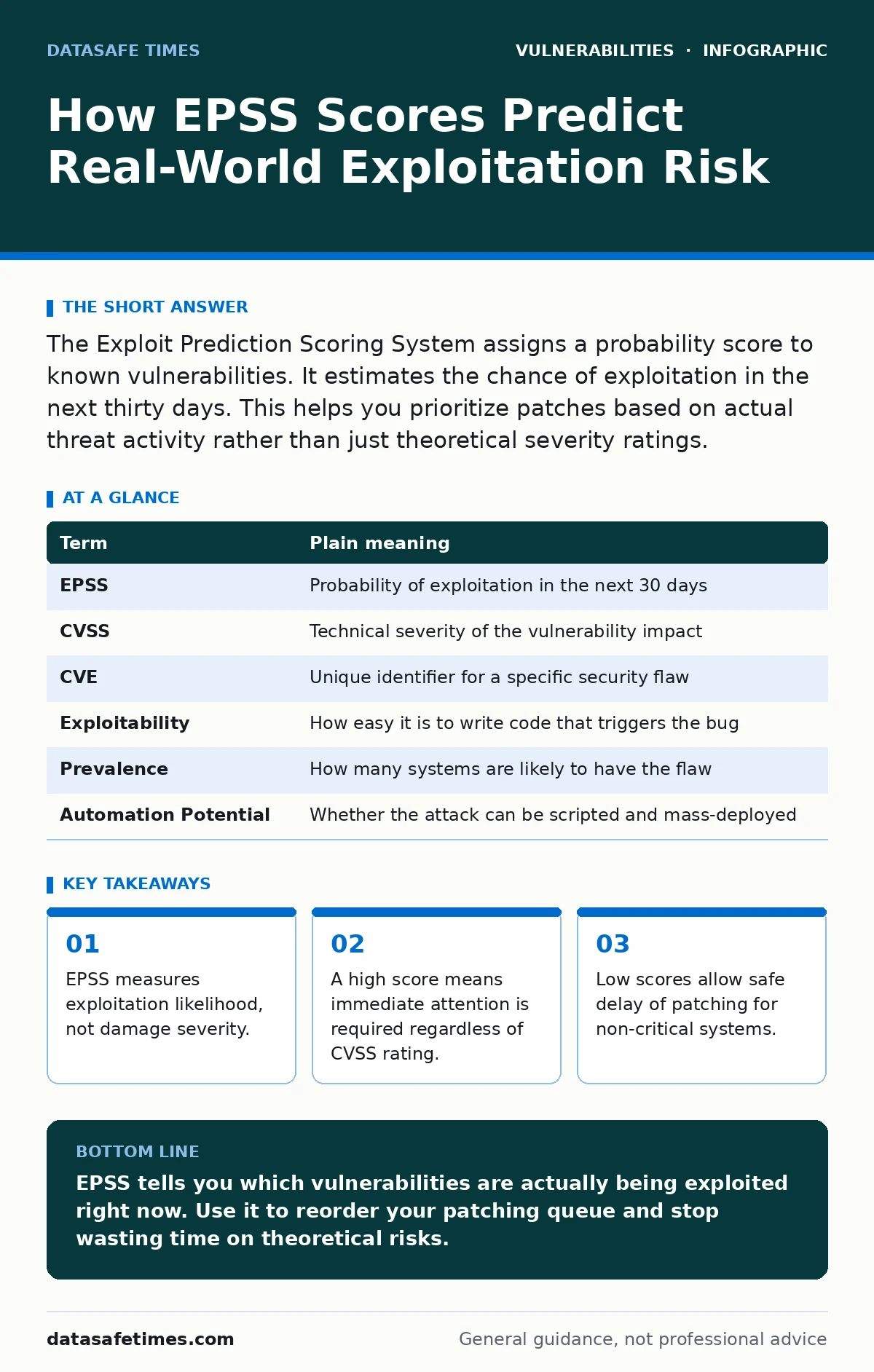
The Exploit Prediction Scoring System assigns a probability score to known vulnerabilities. It estimates the chance of exploitation in the next thirty days. This helps you prioritize patches based on actual threat activity rather than just theoretical severity ratings.
The Broken Window Analogy
Imagine you manage a row of storefronts. One shop has a cracked window. Another has a display of expensive electronics with no alarm. The broken window is a vulnerability. The expensive display is another. Not every crack invites a burglar. Most people walk past them. However, the open display draws immediate attention. You must decide which issue to fix first. You cannot fix every crack in the city at once. You must prioritize based on who is looking and what they want.
Defining the Core Metrics
The industry relies on two main numbers to talk about risk. The Common Vulnerability Scoring System (CVSS) measures the potential impact if an attacker succeeds. It answers the question: how bad is this if it happens? The Exploit Prediction Scoring System (EPSS) measures the probability that an attacker will actually try. It answers the question: will this happen?
CVSS is technical and static. It looks at the code. EPSS is behavioral and dynamic. It looks at the attackers. A vulnerability can have a perfect CVSS score of ten but an EPSS score near zero. This happens when the flaw is complex to exploit or requires rare conditions. Conversely, a low-severity bug might have a high EPSS score if it is easy to automate and widely used.
| Term | Plain meaning |
|---|---|
| EPSS | Probability of exploitation in the next 30 days |
| CVSS | Technical severity of the vulnerability impact |
| CVE | Unique identifier for a specific security flaw |
| Exploitability | How easy it is to write code that triggers the bug |
| Prevalence | How many systems are likely to have the flaw |
| Automation Potential | Whether the attack can be scripted and mass-deployed |
Why Severity Is Not Enough
Developers often default to CVSS for prioritization. This creates a hidden cost. You spend hours patching theoretical risks while ignoring active threats. Suppose you have a memory leak in an internal tool. It has a moderate CVSS score. Now imagine a remote code execution flaw in your public-facing login page. It has a lower CVSS score but is easy to exploit. If you patch by CVSS alone, you leave the door open.
EPSS incorporates historical data on how often similar flaws are attacked. It weighs factors like whether the vulnerability allows remote access. It considers if the attack requires user interaction. It also looks at whether the flaw exists in widely used software. This creates a more realistic view of your risk surface. It shifts focus from what is dangerous to what is targeted.
The Cost of Automation
Attackers are not infinite resources. They prioritize targets that yield quick results. Vulnerabilities that allow easy automation are disproportionately likely to be exploited. This is where EPSS diverges sharply from CVSS. A complex logic error might be severe but hard to exploit at scale. A simple configuration error might be mild but easy to scan for.
This dynamic affects how you view legacy systems. Old software often contains flaws that are easy to exploit. Even if the software is not critical, the high EPSS score signals risk. You must evaluate whether the system needs to exist at all. If it does, you may need to isolate it from the network. This reduces the attack surface without requiring immediate patching.
Integration With Other Frameworks
EPSS does not replace other security practices. It complements them. You should cross-reference EPSS scores with the CISA Known Exploited Vulnerabilities catalog. This list identifies flaws currently being used in active campaigns. If a vulnerability appears on both lists, you have a clear signal to act.
Consider how automatic software updates interact with this data. Updates fix known issues. However, they may also introduce new ones. By monitoring EPSS trends, you can anticipate which updates are most critical. This helps you balance stability with security. It also informs decisions about memory-safe programming languages. These languages prevent entire classes of memory corruption bugs. While they do not change existing EPSS scores, they reduce the creation of new high-risk vulnerabilities over time.
See also: Detecting Memory Corruption Vulnerabilities in Production Systems · TOCTOU Myths: Why Standard Fixes Fail in Concurrent Code
Handling Common Confusion
Many readers confuse EPSS with a severity rating. It is not. It is a probability. These numbers are relative. They help you compare vulnerabilities against each other. They do not tell you the absolute risk to your specific organization.
Another point of confusion is the time window. EPSS predicts the next thirty days. After that period, the prediction resets. You must re-evaluate your priorities regularly. This is not a one-time calculation. It is a continuous process. You should also consider firmware vulnerabilities. These are often harder to patch and may have different exploitation patterns. EPSS helps identify which firmware flaws are actively targeted.
Try This Now
- Export your current list of unpatched vulnerabilities. Add the EPSS score for each CVE.
- Sort the list by EPSS score in descending order. Identify the top five items.
- Compare these top five against your critical asset inventory. Prioritize patching for systems that are both high-risk and high-value.
This process takes less than an hour. It provides immediate clarity on where your efforts will have the most impact. It moves you from reactive patching to predictive risk management. You reduce the noise of minor issues. You focus on the threats that matter.
Key takeaways
- EPSS measures exploitation likelihood, not damage severity.
- A high score means immediate attention is required regardless of CVSS rating.
- Low scores allow safe delay of patching for non-critical systems.
EPSS tells you which vulnerabilities are actually being exploited right now. Use it to reorder your patching queue and stop wasting time on theoretical risks.
Frequently asked questions
Can I trust EPSS scores for internal-only applications?
EPSS is based on global data. Internal apps may have lower exposure, but the likelihood of the underlying code being targeted remains valid. Use it as a baseline, not a final verdict.
How often do EPSS scores change?
Scores are updated daily. They reflect new data on exploitation trends. You should check them weekly to stay aligned with the current threat environment.
Does a low EPSS score mean I don't need to patch?
No. It means you can delay. You should still patch eventually. Low scores indicate lower immediate risk, allowing you to batch updates for efficiency.
Is EPSS better than CVSS?
They serve different purposes. CVSS measures impact. EPSS measures likelihood. You need both to make informed decisions. Use CVSS for impact analysis and EPSS for prioritization.
How this guide was produced: written by the DataSafe Times editorial team with AI assistance, checked against the public references listed below, and reviewed when the facts change. See our editorial policy or report an error.