
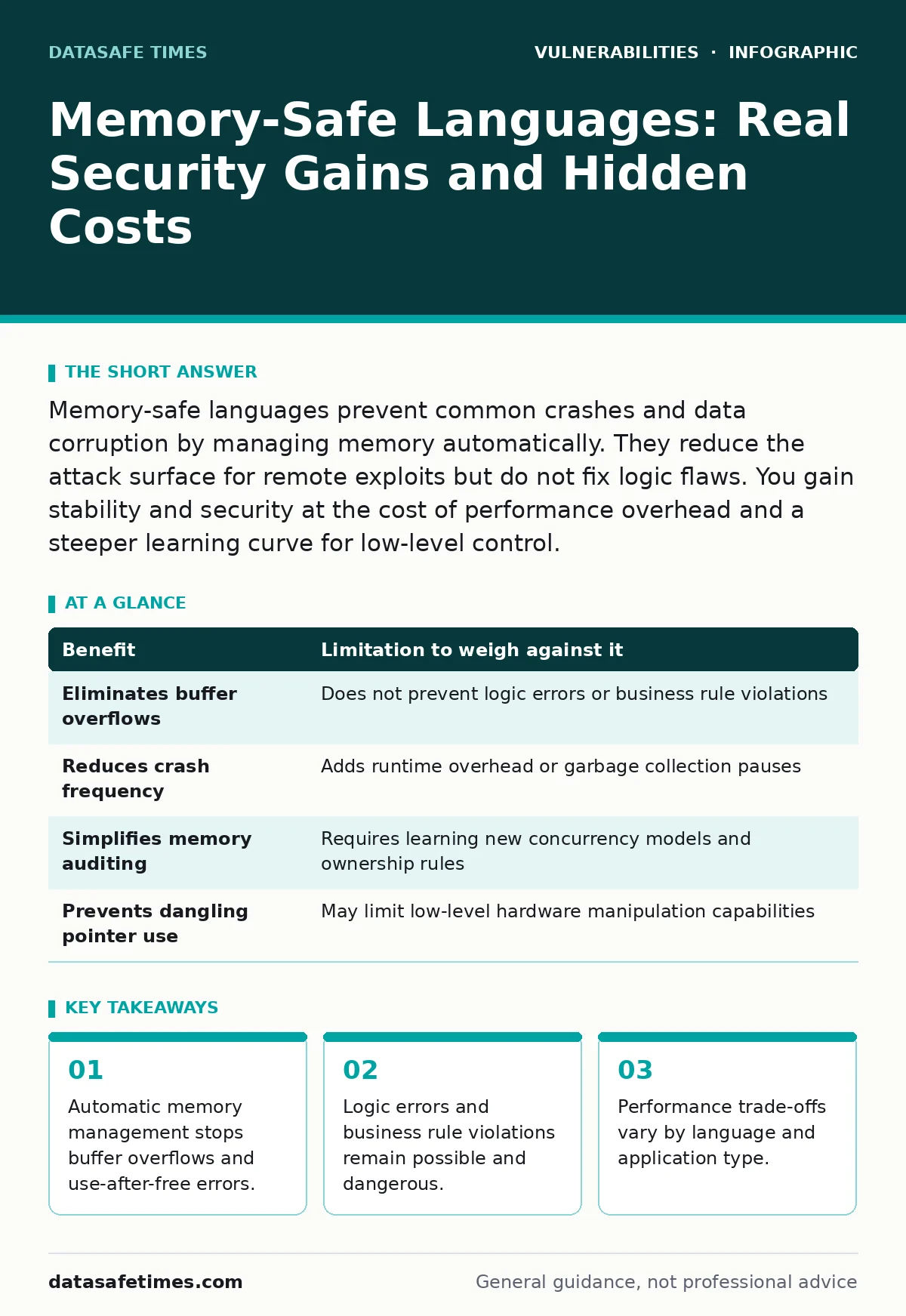
Memory-safe languages prevent common crashes and data corruption by managing memory automatically. They reduce the attack surface for remote exploits but do not fix logic flaws. You gain stability and security at the cost of performance overhead and a steeper learning curve for low-level control.
The Mechanics of Memory Safety
Memory safety refers to the property of a program that prevents invalid memory access. In unsafe languages, developers manually allocate and release memory. If the code miscalculates the size of a buffer or accesses freed memory, the program can crash or allow an attacker to execute arbitrary code. Safe languages handle this automatically. They track object lifetimes and enforce bounds checks at runtime or compile time. This removes a entire class of vulnerabilities from the codebase.
Imagine a web server processing user input. In an unsafe language, a long input could overflow a fixed-size buffer, overwriting adjacent memory. A safe language detects this boundary violation and stops the operation before corruption occurs. The mechanism is straightforward: the runtime or compiler inserts checks that unsafe languages omit. This shifts the burden from the developer to the language implementation.
Concrete Benefits for System Integrity
The primary benefit is the elimination of memory corruption vulnerabilities. These flaws have historically been the most common cause of severe security breaches. By preventing buffer overflows, integer overflows, and use-after-free errors, safe languages drastically reduce the attack surface. You no longer need to audit every pointer dereference or manual free call. The compiler or runtime enforces these rules consistently.
This consistency leads to more stable systems. Crashes caused by memory errors are rare in safe environments. This stability is valuable for long-running services that cannot afford downtime. It also simplifies debugging. When a crash occurs in a safe language, it is usually due to a logic error or a resource limit, not a corrupted memory state. This makes root cause analysis faster and more predictable.
Honest Limitations and Trade-Offs
Memory safety does not protect against logic errors. If your authentication logic allows a user to access another user’s data, a memory-safe language will not stop it. The code executes exactly as written, even if the outcome is a security failure. Attackers shift their focus to these logical flaws, such as broken access control or injection attacks. You must still validate inputs and enforce business rules carefully.
Performance is another consideration. Automatic memory management requires computation. Garbage collection pauses or runtime bounds checks add overhead. For high-frequency trading systems or real-time embedded controls, this latency may be unacceptable. You trade some speed for safety. The impact varies by language and workload. Some safe languages approach the performance of unsafe ones, but they rarely match the absolute floor of manual control.
| Benefit | Limitation to weigh against it |
|---|---|
| Eliminates buffer overflows | Does not prevent logic errors or business rule violations |
| Reduces crash frequency | Adds runtime overhead or garbage collection pauses |
| Simplifies memory auditing | Requires learning new concurrency models and ownership rules |
| Prevents dangling pointer use | May limit low-level hardware manipulation capabilities |
When It Is Worth It
Adopt memory-safe languages for network-facing services. These applications process untrusted input from the internet. The risk of remote exploitation via memory corruption is high. Using a safe language removes this vector entirely. Web servers, APIs, and database connectors are ideal candidates. The stability gains justify the performance cost in these contexts.
It is also worth it for complex concurrent applications. Safe languages often provide better tools for managing concurrent access to data. They prevent data races, which are difficult to debug in unsafe languages. If your application requires multiple threads to share state, a safe language reduces the likelihood of race conditions. This leads to more reliable multi-threaded code.
Consider it for long-term projects. Code written in safe languages tends to be easier to maintain. The explicit ownership models encourage clear data flow. New developers can understand who owns what data without tracing complex pointer chains. This reduces technical debt over time.
When It Is Not
Avoid memory-safe languages for bare-metal embedded systems with strict timing constraints. If your device controls a motor or processes sensor data in microseconds, garbage collection pauses are unacceptable. You need deterministic execution times. Unsafe languages give you direct control over hardware registers and memory layouts. The risk of memory errors must be managed through rigorous testing, such as penetration testing, rather than language guarantees.
It is not worth it for small, isolated scripts. If a script runs locally with trusted input and no network exposure, the security benefit is minimal. The overhead of setting up a safe runtime may outweigh the protection gained. Simple automation tasks do not require the complexity of modern safe language ecosystems.
Do not switch solely for performance. If your bottleneck is algorithmic complexity or I/O latency, a language change will not help. Profile your application first. Ensure that memory management is actually the cause of your performance issues. Often, it is not.
See also: Fuzz Testing Meaning: How Random Inputs Break Your Code · Parameterized Queries: 6 Misunderstandings That Leave Code Exposed
Integration with Security Practices
Memory safety is one layer of defense. It does not replace other security measures. You still need to manage dependencies carefully. Supply chain risks, such as dependency confusion attacks, remain a threat regardless of the language. You must verify the integrity of third-party libraries.
Regular updates are necessary. Safe languages and their runtimes evolve. You must apply patches for new vulnerabilities in the standard library or runtime. Rely on automatic software updates where possible to reduce the window of exposure. Combine memory safety with input validation and least privilege principles. This creates a deeper defense in depth.
The Future of Secure Development
The industry is moving toward memory safety. Many organizations are rewriting critical components in safe languages. This shift reduces the overall number of exploitable vulnerabilities in the wild. It changes the attacker’s playbook. As memory corruption becomes harder to exploit, attackers focus more on logic flaws and configuration errors.
You should prepare for this transition. Learn the concepts of ownership and borrowing. Understand how safe languages handle concurrency. This knowledge will be valuable even if you continue to use unsafe languages for specific tasks. The principles of explicit resource management improve code quality in any context.
Key takeaways
- Automatic memory management stops buffer overflows and use-after-free errors.
- Logic errors and business rule violations remain possible and dangerous.
- Performance trade-offs vary by language and application type.
Frequently asked questions
Does using a memory-safe language eliminate the need for penetration testing?
No. Penetration testing is still required to find logic errors, configuration issues, and business rule violations that the language cannot detect.
Can memory-safe languages run on the same hardware as unsafe languages?
Yes. They compile to the same machine code or run on the same virtual machines, but they may have different runtime requirements and performance characteristics.
How do memory-safe languages handle concurrent access to data?
They use compile-time checks or runtime locks to prevent data races, ensuring that only one thread can modify data at a time or that access is properly synchronized.
Is it possible to mix memory-safe and unsafe code in the same application?
Yes. Many safe languages provide interfaces to call unsafe code. This allows you to use safe code for most logic and unsafe code only for specific performance-critical sections. BOTTOM LINE: Memory safety prevents a specific class of severe vulnerabilities but does not secure your application against logic errors. Evaluate your performance requirements and attack surface before choosing a language.
How this guide was produced: written by the DataSafe Times editorial team with AI assistance, checked against the public references listed below, and reviewed when the facts change. See our editorial policy or report an error.