
Parameterized queries separate code from data by using placeholders. They do not sanitize input, prevent logic errors, or protect against non-SQL interfaces. Misunderstanding this leads to false security, leaving applications vulnerable to injection through dynamic table names, stored procedures, or ORM misconfigurations.
Misreading: Parameters Sanitize Input Data
Correct reading: Parameterized queries do not clean or validate data. They enforce a structural boundary between the query template and the values. The database engine treats the parameter as a literal value, never as executable syntax. Input validation remains a separate responsibility. You must still check for length, format, and business logic constraints. Relying on parameters to filter malicious content ignores the fact that valid data can still cause application errors or logic failures. Validation ensures the data is safe for your application’s context, while parameterization ensures it is safe for the database engine.
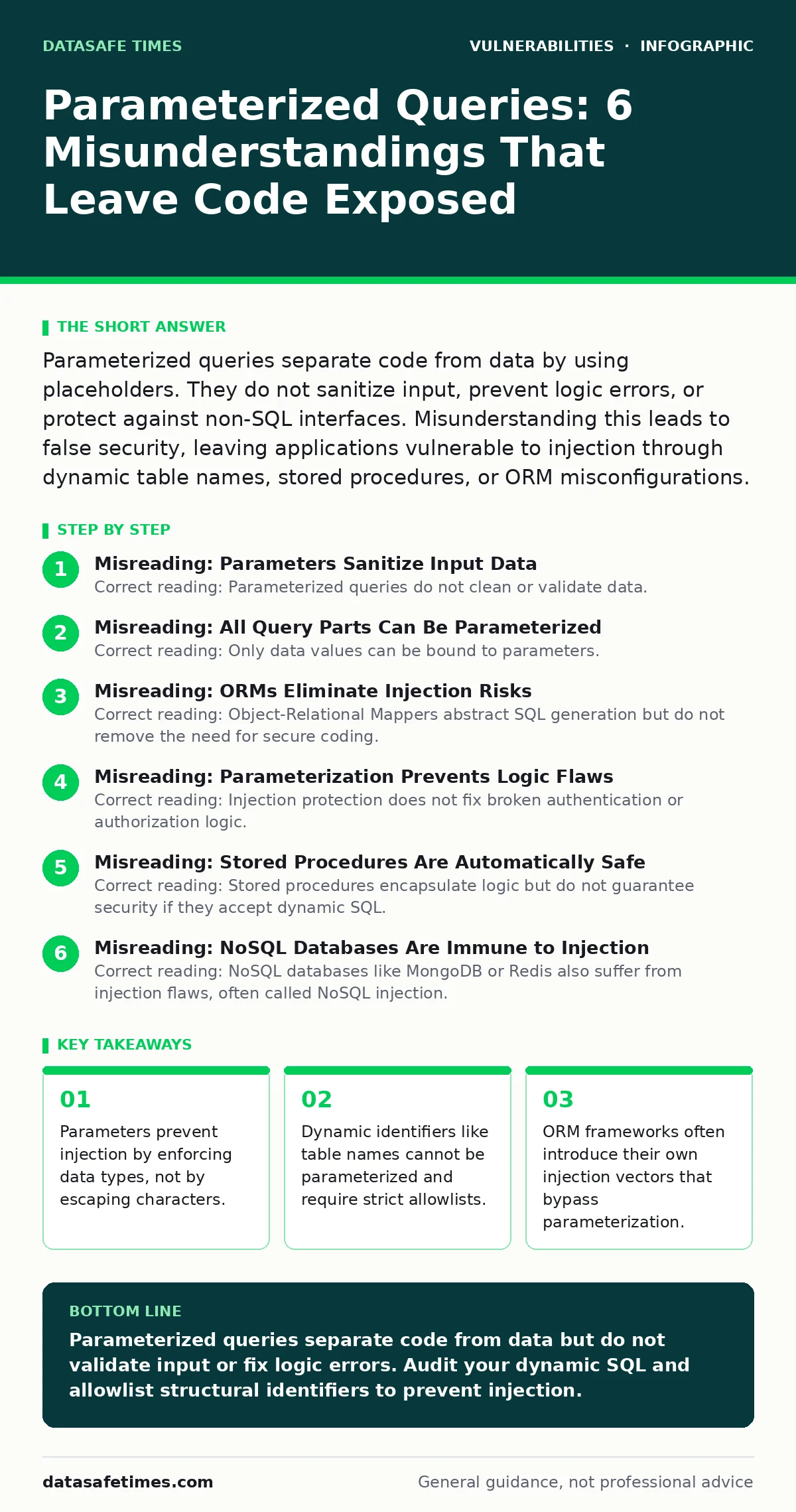
Misreading: All Query Parts Can Be Parameterized
Correct reading: Only data values can be bound to parameters. Structural elements like table names, column names, and sort directions cannot be parameterized in standard SQL. Imagine you build a query dynamically to sort results by a user-selected column. You cannot bind that column name to a parameter. The database needs the identifier at parse time. If you concatenate the column name directly, you expose the query to injection. The correct approach is to use a strict allowlist of known column names. Map the user input to an internal index or constant. This prevents arbitrary SQL fragments from entering the structural part of the command.
Misreading: ORMs Eliminate Injection Risks
Correct reading: Object-Relational Mappers abstract SQL generation but do not remove the need for secure coding. Many ORMs allow raw SQL queries or dynamic condition builders. Developers often assume the framework handles security automatically. This assumption fails when using features like string interpolation in query builders or custom SQL snippets. The ORM might parameterize simple selects but leave complex joins or subqueries vulnerable. You must inspect the generated SQL to verify that all dynamic inputs are properly bound. Treating the ORM as a black box hides how it constructs the final command, leading to overlooked injection points in advanced query methods.
Misreading: Parameterization Prevents Logic Flaws
Correct reading: Injection protection does not fix broken authentication or authorization logic. Suppose a query checks if a username and password match. If the logic allows bypassing the password check through a OR 1=1 condition, parameterization stops the injection but not the flawed logic design if the query structure itself is insecure. More commonly, developers use parameterized queries for data retrieval but fail to verify that the returned data belongs to the current user. This leads to Insecure Direct Object References. The query executes safely, but the application returns data it should not. Security requires both safe data handling and correct access control checks.
Misreading: Stored Procedures Are Automatically Safe
Correct reading: Stored procedures encapsulate logic but do not guarantee security if they accept dynamic SQL. Many procedures accept parameters and then concatenate them into an internal SQL string before execution. This technique, known as dynamic SQL, re-introduces injection risks inside the procedure. The parameterization happens at the application layer, but the procedure rebuilds the query internally. You must audit the procedure code to ensure it uses parameterized execution internally as well. Calling a stored procedure with parameters does not magically secure the procedure’s internal implementation. The security boundary extends into the database object itself.
See also: Memory-Safe Languages: Real Security Gains and Hidden Costs · Path Traversal Vulnerabilities: Step-by-Step Breakdown
Misreading: NoSQL Databases Are Immune to Injection
Correct reading: NoSQL databases like MongoDB or Redis also suffer from injection flaws, often called NoSQL injection. These databases use query languages based on JSON or other structures. If an application merges user input directly into the query object, attackers can manipulate operators. For example, injecting a $ne (not equal) operator can bypass authentication checks. Parameterization in NoSQL contexts means ensuring that user input is treated as data, not as part of the query structure. You must validate and type-check inputs before merging them into the query document. Assuming SQL injection is the only vector leaves NoSQL interfaces exposed to similar structural attacks.
Misreading: Prepared Statements Are Just Escaping
Correct reading: Prepared statements work by sending the query structure and data separately to the database. The database parses and compiles the query plan first. Then it binds the data. This two-step process prevents the data from influencing the query structure. Escaping characters is a different mechanism that modifies the input to make it safe for concatenation.
Escaping is error-prone and dependent on the character set. Prepared statements are superior because they rely on the database engine’s parsing rules, not on the application’s escaping logic. Understanding this distinction helps you choose the right defense. Use prepared statements whenever your database driver supports them.
Misreading: Parameterization Solves All Data Issues
Correct reading: Secure query construction is only one layer of defense. It does not protect against open redirect vulnerabilities in URLs or path traversal vulnerabilities in file systems. It does not prevent session fixation attacks. You must maintain a software bill of materials (SBOM) to track dependencies that might introduce their own injection flaws. Reviewing the EPSS score of your components helps prioritize patching efforts. Security is a system property. Fixing one vulnerability type does not secure the entire application. You must apply context-specific controls for each data flow.
Key takeaways
- Parameters prevent injection by enforcing data types, not by escaping characters.
- Dynamic identifiers like table names cannot be parameterized and require strict allowlists.
- ORM frameworks often introduce their own injection vectors that bypass parameterization.
Parameterized queries separate code from data but do not validate input or fix logic errors. Audit your dynamic SQL and allowlist structural identifiers to prevent injection.
Frequently asked questions
Can I use parameterization for table names?
No, standard SQL does not support parameterizing identifiers. Use a strict allowlist to map user input to valid table names before constructing the query.
Does parameterization prevent SQL injection in NoSQL databases?
NoSQL injection requires different mitigation, such as type checking and avoiding dynamic query construction. The principle of separating data from structure still applies.
Are stored procedures safe from injection?
Only if they do not use dynamic SQL internally. If the procedure concatenates parameters into a string, it remains vulnerable. Audit the procedure code.
How do I check if my ORM is safe?
Inspect the generated SQL for raw queries. Ensure that dynamic inputs are bound as parameters and not interpolated into the query string.
How this guide was produced: written by the DataSafe Times editorial team with AI assistance, checked against the public references listed below, and reviewed when the facts change. See our editorial policy or report an error.