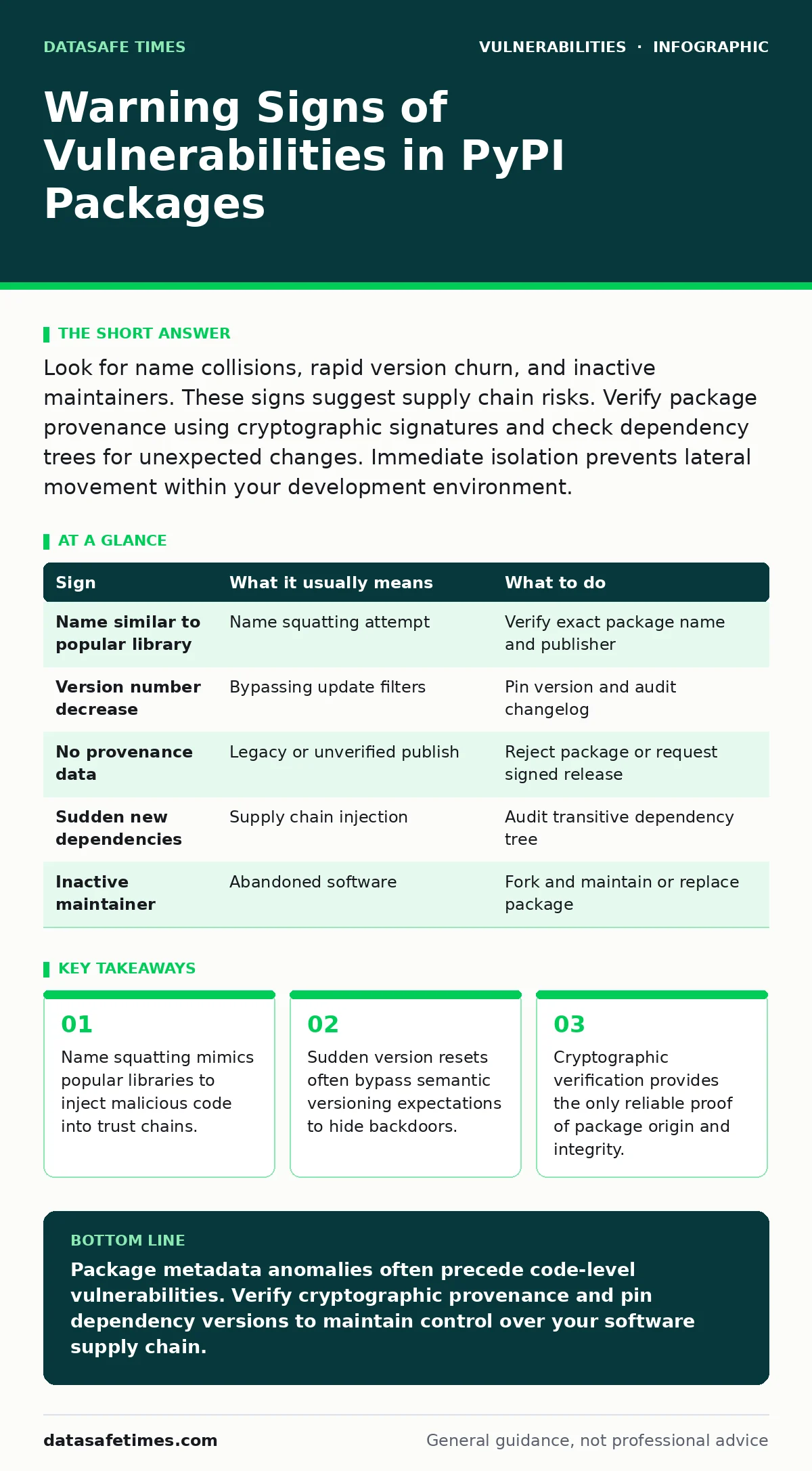
Look for name collisions, rapid version churn, and inactive maintainers. These signs suggest supply chain risks. Verify package provenance using cryptographic signatures and check dependency trees for unexpected changes. Immediate isolation prevents lateral movement within your development environment.
Obvious Indicators of Compromised Packages
You notice obvious indicators when the package metadata conflicts with established community standards. Name squatting occurs when a new package uses a name similar to a widely used library. This tactic relies on developers typing incorrect package names during installation. The installer fetches the malicious package instead of the intended tool.
Sudden version resets represent another visible red flag. A package jumps from version 1.2.0 to 0.0.1. Semantic versioning rules dictate that major version increases indicate breaking changes. Decreasing the major version number suggests the maintainer does not understand version control or intends to bypass automated update filters. This behavior disrupts dependency resolution logic in your build system.
Subtle Supply Chain Signals
Subtle signals hide within the code structure and maintenance patterns. Look for packages with minimal historical activity. A repository created months ago with thousands of stars and high download counts lacks organic growth trajectories. Organic growth shows gradual increases in commits and issues. Sudden spikes often indicate coordinated manipulation or pre-seeded popularity.
Dependency confusion attacks exploit the way package managers resolve names. Internal private packages share names with public PyPI packages. If the public package has a higher version number than your internal one, the manager may fetch the public version. This allows attackers to inject code by publishing a higher version of a common internal name. You must audit your internal naming conventions to prevent this overlap.
Metadata and Provenance Checks
Metadata verification requires checking the publisher identity. PyPI now supports publishing via trusted publishers. Packages published through GitHub Actions or other CI systems have visible provenance. Packages published via legacy token methods lack this cryptographic link. You cannot trust a package solely because it appears on PyPI. You must verify the publisher configuration matches the expected source repository.
Check the last update date against the repository activity. A package updated six months ago with no recent commits may be abandoned. Abandoned packages stop receiving security patches. They become liability carriers as underlying dependencies evolve. You should monitor these packages for critical vulnerabilities that you cannot patch directly. This creates a maintenance burden that grows over time.
Dependency Tree Analysis
Your project depends on direct and transitive dependencies. Transitive dependencies are libraries required by your direct dependencies. Attackers often target low-level libraries with wide adoption. These libraries appear deep in your dependency tree. You may not notice a vulnerability until it affects multiple projects simultaneously.
Use tools to generate a software bill of materials (SBOM). This document lists every component in your application. It allows you to track changes across updates. When a new version of a transitive dependency introduces a new dependency, investigate the reason. Unexpected new dependencies can introduce additional attack surfaces. They may also signal that the maintainer has lost control of the codebase.
Response Protocol for Suspicious Packages
When you identify a suspicious package, isolate it immediately. Do not run the package in a production environment. Create a sandboxed environment to analyze the package contents. Check the source code for network calls, file system access, or cryptographic operations. Legitimate utility packages rarely perform these actions without explicit user interaction.
Revert to a previous known-good version if possible. Pin the version number in your requirements file. This prevents automatic updates from pulling in the compromised version. Report the package to the PyPI security team. They can remove the package or disable the maintainer account. This action protects other developers from encountering the same threat.
| Sign | What it usually means | What to do |
|---|---|---|
| Name similar to popular library | Name squatting attempt | Verify exact package name and publisher |
| Version number decrease | Bypassing update filters | Pin version and audit changelog |
| No provenance data | Legacy or unverified publish | Reject package or request signed release |
| Sudden new dependencies | Supply chain injection | Audit transitive dependency tree |
| Inactive maintainer | Abandoned software | Fork and maintain or replace package |
See also: TOCTOU Myths: Why Standard Fixes Fail in Concurrent Code · Exploitability vs Severity: Why High Scores Often Mislead Developers
Mitigation Through Verification
You cannot rely on reputation alone for package security. Implement cryptographic verification for all dependencies. Sigstore and other frameworks provide signing capabilities. Verify signatures before installing packages. This ensures the code has not been altered since the maintainer published it.
Combine verification with strict dependency management. Use lock files to record exact versions of all dependencies. This prevents accidental upgrades to compromised versions. Regularly update your lock files to apply security patches. Balance stability with security by testing updates in a staging environment before deployment.
Long Term Security Posture
Supply chain attacks evolve as defenses improve. Attackers shift from injecting code into hijacking build systems. You must monitor the entire software development lifecycle. Include package integrity checks in your continuous integration pipeline. Fail builds if any dependency lacks valid signatures or provenance.
Understand the difference between exploitability versus severity. A high-severity vulnerability may have low exploitability if it requires specific conditions. Focus your efforts on vulnerabilities that are easily exploitable in your environment. This prioritization reduces noise and focuses resources on immediate threats.
Key takeaways
- Name squatting mimics popular libraries to inject malicious code into trust chains.
- Sudden version resets often bypass semantic versioning expectations to hide backdoors.
- Cryptographic verification provides the only reliable proof of package origin and integrity.
Package metadata anomalies often precede code-level vulnerabilities. Verify cryptographic provenance and pin dependency versions to maintain control over your software supply chain.
Frequently asked questions
How do I know if a PyPI package is using name squatting?
Check if the package name differs slightly from a well-known library. Verify the publisher identity and compare the functionality with the original package documentation.
Can I trust packages from well-known organizations?
Trust is not absolute. Even reputable organizations can have compromised build systems. Verify cryptographic signatures and monitor for unusual version changes regardless of the publisher.
What is the best way to handle abandoned packages?
Fork the repository and maintain it internally, or find an alternative package. Abandoned packages will not receive security patches, leaving your application exposed to known vulnerabilities.
Do lock files prevent supply chain attacks?
Lock files prevent automatic updates to compromised versions. They do not prevent the initial installation of a malicious package. You must verify the integrity of packages before adding them to your lock file.
How this guide was produced: written by the DataSafe Times editorial team with AI assistance, checked against the public references listed below, and reviewed when the facts change. See our editorial policy or report an error.