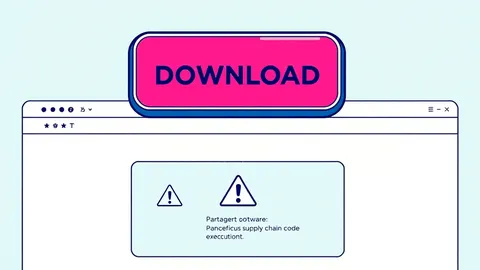
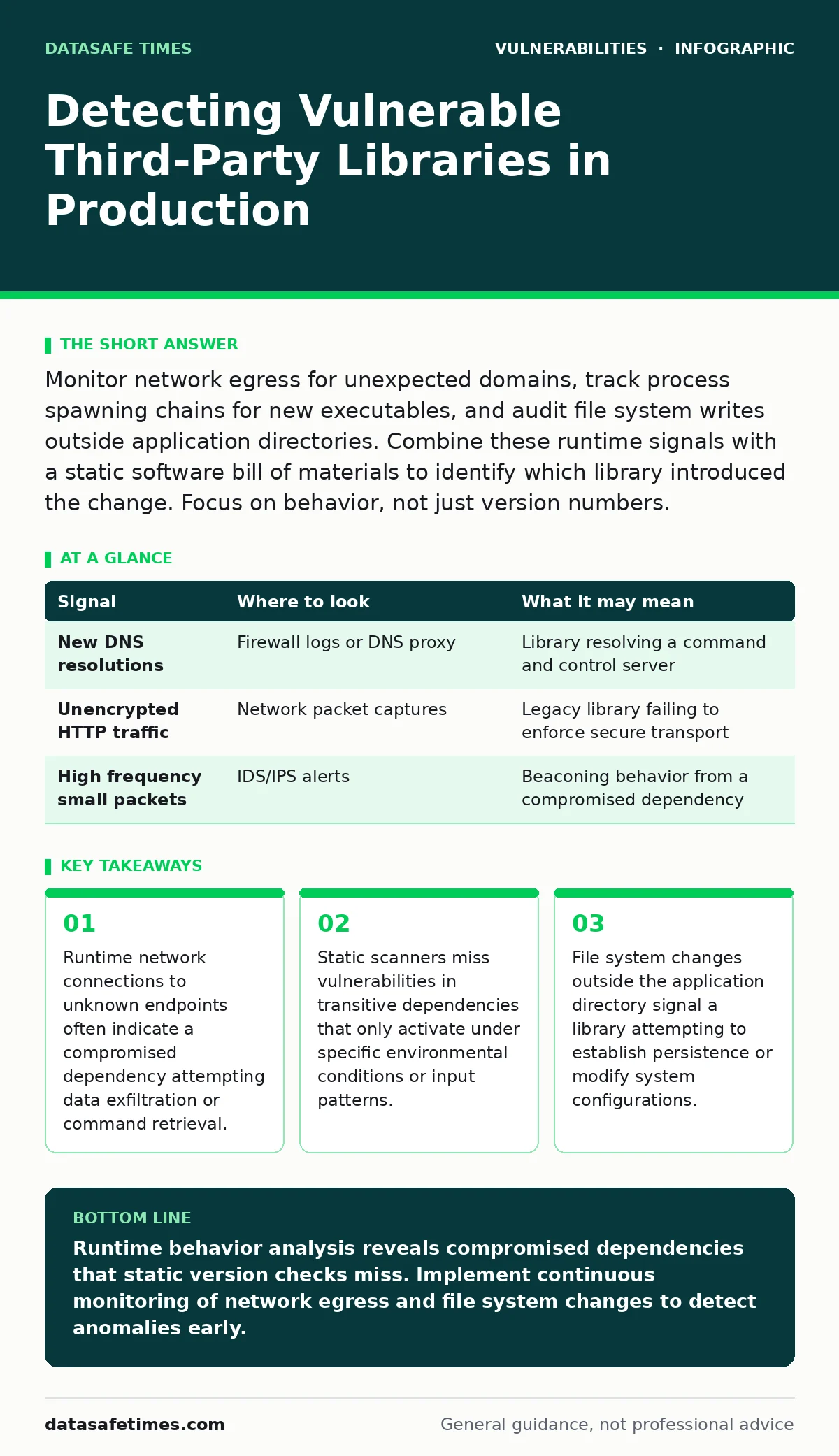
Monitor network egress for unexpected domains, track process spawning chains for new executables, and audit file system writes outside application directories. Combine these runtime signals with a static software bill of materials to identify which library introduced the change. Focus on behavior, not just version numbers.
Network Egress Anomalies
Third-party libraries often include hidden network calls that bypass standard application logic. You observe these as outbound connections to domains that do not match your known service providers. A library might appear dormant until a specific trigger occurs, such as a high volume of requests or a particular header value. This delayed activation allows malicious code to evade initial deployment scans.
Monitor DNS queries for newly resolved hostnames. Legitimate libraries usually connect to well-known update servers or CDN endpoints. Connections to freshly registered domains or IP addresses that do not resolve to public infrastructure warrant immediate investigation. The traffic volume may be low to avoid triggering bandwidth alerts. Focus on the destination rather than the payload size.
| Signal | Where to look | What it may mean |
|---|---|---|
| New DNS resolutions | Firewall logs or DNS proxy | Library resolving a command and control server |
| Unencrypted HTTP traffic | Network packet captures | Legacy library failing to enforce secure transport |
| High frequency small packets | IDS/IPS alerts | Beaconing behavior from a compromised dependency |
Process Spawning Chains
Libraries can execute system commands without explicit developer consent. This often happens through function calls that invoke shell interpreters or process managers. You detect this by monitoring parent-child process relationships. If your application process spawns a shell script or a binary it did not previously use, a dependency is likely executing arbitrary code.
Check for processes that start with elevated privileges. A library running under the application user should not create processes that request root or administrator rights. This privilege escalation is a common tactic for gaining deeper system access. The spawned process might immediately terminate to hide its footprint. Review process creation logs for any executable that was not present during the last known good state.
File System Modifications
Compromised libraries often write files to establish persistence or store stolen data. They may create temporary files in system directories rather than the application’s working folder. You identify this by auditing write operations to sensitive paths. Look for new configuration files, scripts, or binaries appearing in locations like /tmp, /var, or %TEMP%.
The file permissions are often a telltale sign. Malicious libraries may set execute permissions on files that should remain read-only. They might also modify existing system libraries to intercept future calls. This technique, known as DLL hijacking, allows the malicious code to run whenever the system loads the affected module. Regular integrity checks of system directories help detect these unauthorized changes early.
Static Analysis Blind Spots
Static analysis tools compare library versions against known vulnerability databases. This approach fails when the vulnerability is not yet cataloged or when the threat lies in the combination of libraries. You might have every known patch applied, yet still be vulnerable due to how libraries interact. This is known as a polyglot or interaction vulnerability.
Transitive dependencies are the primary blind spot. A library you trust might depend on another library that is vulnerable. Most basic scanners only check direct dependencies. You must generate a full software bill of materials (SBOM) to see the entire dependency tree. This document lists every component, allowing you to trace risk through multiple layers of abstraction.
Runtime Behavior Profiling
Behavioral profiling establishes a baseline for normal application operation. You define what the application should do, including which libraries it loads and which system calls it makes. Any deviation from this baseline indicates a potential compromise. This method catches zero-day vulnerabilities where no patch or signature exists yet.
Focus on resource consumption patterns. A library that suddenly consumes excessive CPU or memory might be performing cryptographic operations, such as mining cryptocurrency or encrypting data for ransomware. These activities leave distinct performance footprints. Correlate these spikes with network activity to confirm whether the resource usage is linked to external communication.
See also: TOCTOU Myths: Why Standard Fixes Fail in Concurrent Code · Exploitability vs Severity: Why High Scores Often Mislead Developers
Supply Chain Integrity Checks
The integrity of the library itself is as important as its version. Attackers may compromise the build pipeline or the package repository to inject malicious code into a legitimate library version. You detect this by verifying cryptographic signatures and hashes. If the hash of the downloaded library does not match the hash published by the maintainer, the file has been altered.
Imagine a scenario where a library maintainer’s account is compromised. The attacker updates the library with malicious code but keeps the version number the same. Standard version checks will pass because the version is correct. You must verify the provenance of the artifact. Use trusted registries that enforce strict identity verification for publishers. This adds a layer of trust beyond simple version matching.
Common Detection Blind Spots
Several areas consistently escape standard monitoring. One is the local development environment. Developers often use local proxies or caches that bypass corporate security controls. Vulnerabilities introduced here may propagate to production if the build process is not isolated. Another blind spot is container images. Once an image is built, it is often treated as immutable, even if a vulnerability is discovered in a base layer.
A third blind spot is dynamic loading. Some applications load libraries at runtime based on user input or configuration. This allows an attacker to inject a malicious library without modifying the application code. You must monitor the directories from which the application loads shared objects or dynamic link libraries. Restrict these paths to known, trusted locations only.
Integration with Existing Frameworks
Integrate library detection into your continuous integration pipeline. This ensures that every build is scanned before deployment. Combine static analysis with runtime monitoring for complete coverage. Static tools catch known issues early, while runtime tools catch behavioral anomalies in production. This layered approach reduces the risk of undetected compromises.
Refer to the guide on software bill of materials (SBOM) for details on generating and managing dependency lists. This provides the foundational data needed for effective scanning. Additionally, consider the principles in memory-safe programming languages to reduce the likelihood of memory corruption vulnerabilities in your own code. While this does not fix third-party libraries, it reduces the attack surface for exploitation.
Key takeaways
- Runtime network connections to unknown endpoints often indicate a compromised dependency attempting data exfiltration or command retrieval.
- Static scanners miss vulnerabilities in transitive dependencies that only activate under specific environmental conditions or input patterns.
- File system changes outside the application directory signal a library attempting to establish persistence or modify system configurations.
Runtime behavior analysis reveals compromised dependencies that static version checks miss. Implement continuous monitoring of network egress and file system changes to detect anomalies early.
Frequently asked questions
How do I distinguish between a legitimate library update and a malicious injection?
Verify the cryptographic signature and hash of the library against the official maintainer’s published values. Check for unexpected network connections or file writes that do not align with the library’s documented purpose.
Can I detect a vulnerable library if it has no network access?
Yes. Monitor for file system modifications, process spawning, and resource consumption anomalies. A library might attempt to exfiltrate data via DNS queries or modify local files to establish persistence without direct internet access.
What is the most common cause of false positives in library monitoring?
Legitimate libraries performing telemetry or update checks. Establish a baseline of expected network destinations and file operations for each library to reduce noise. Whitelist known-good behaviors to focus alerts on anomalies.
How often should I regenerate my software bill of materials?
Regenerate it for every build and deployment. Dependency trees change frequently, even without explicit updates, due to transitive dependencies. A current SBOM ensures your scanning reflects the actual deployed state.
How this guide was produced: written by the DataSafe Times editorial team with AI assistance, checked against the public references listed below, and reviewed when the facts change. See our editorial policy or report an error.