
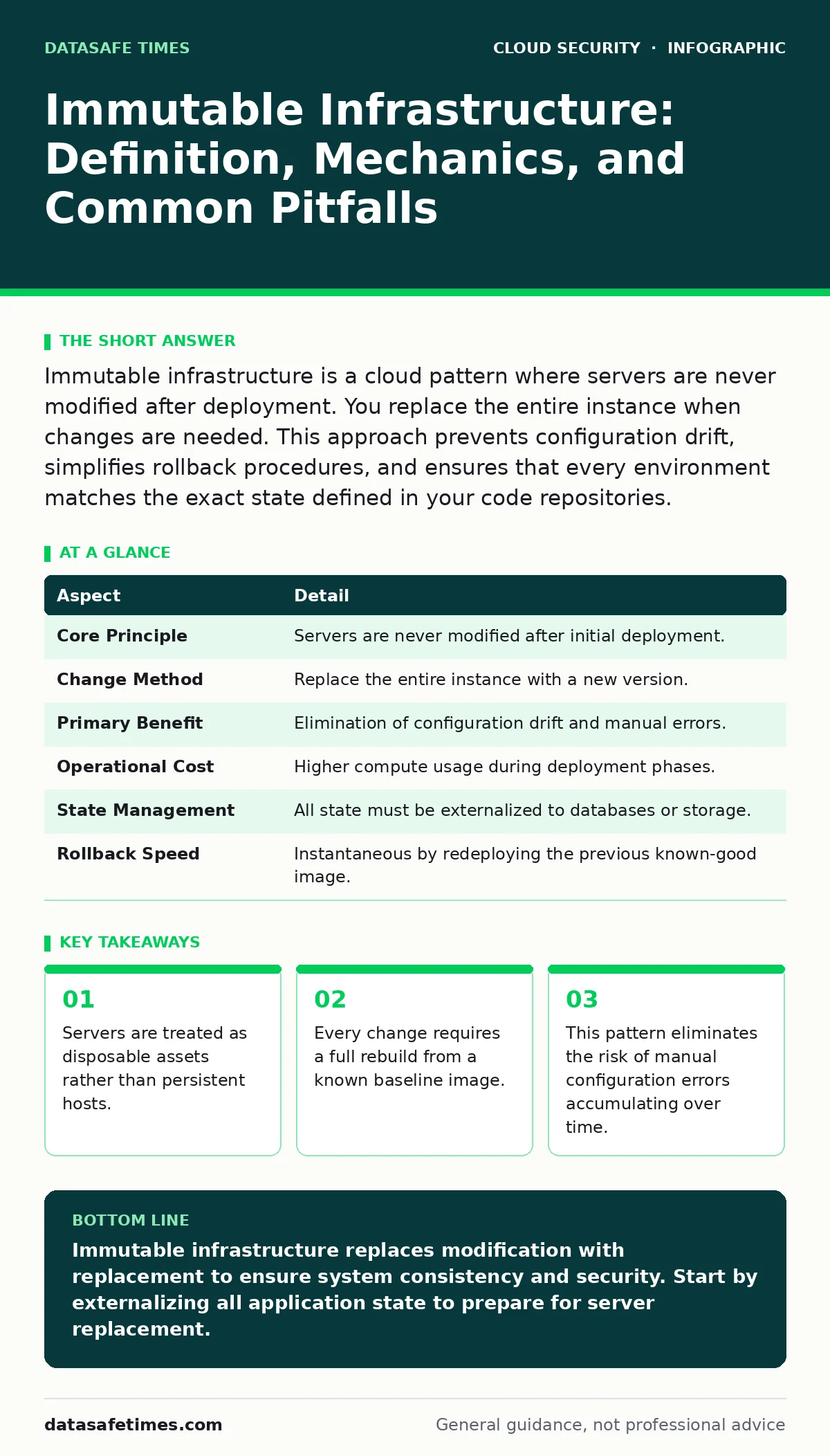
Immutable infrastructure is a cloud pattern where servers are never modified after deployment. You replace the entire instance when changes are needed. This approach prevents configuration drift, simplifies rollback procedures, and ensures that every environment matches the exact state defined in your code repositories.
The Concept of Disposable Servers
Imagine a restaurant kitchen where chefs never clean their stations. Instead, they throw away the entire counter and replace it with a fresh one every time a recipe changes. This analogy captures the core logic of immutable infrastructure. Traditional server management relies on modifying existing systems. You install patches, update libraries, and tweak settings on a running machine. Over time, these changes create a unique state that is difficult to replicate.
Immutable infrastructure rejects this model. You do not modify servers after they are deployed. If you need to update a library, you build a new server image with that library included. You then deploy the new server and terminate the old one. This approach ensures that the system state is always derived from a single source of truth. The server itself holds no persistent configuration data that cannot be reproduced from code.
At a Glance: Immutable Mechanics
| Aspect | Detail |
|---|---|
| Core Principle | Servers are never modified after initial deployment. |
| Change Method | Replace the entire instance with a new version. |
| Primary Benefit | Elimination of configuration drift and manual errors. |
| Operational Cost | Higher compute usage during deployment phases. |
| State Management | All state must be externalized to databases or storage. |
| Rollback Speed | Instantaneous by redeploying the previous known-good image. |
Origins in Cloud Practice
The term emerged from the constraints of early cloud computing. Early adopters found that managing thousands of virtual machines was impossible using traditional sysadmin tools. Manual SSH sessions to fix issues did not scale. Engineers needed a way to ensure that a server in production behaved exactly like the server in development.
This requirement led to the adoption of infrastructure as code. Teams began defining server configurations in declarative files. These files described the desired state of the system. Automated tools would then create servers that matched this description. If the server deviated from the description, it was considered broken. The fix was not to patch the deviation, but to destroy the server and create a new one that matched the code. This shift moved the burden from manual maintenance to automated consistency.
Daily Operations and Workflow
Day-to-day use of immutable infrastructure changes how you handle updates. You no longer schedule maintenance windows to patch running servers. Instead, you update your configuration code and trigger a new deployment pipeline. The pipeline builds a new artifact, such as a container image or a virtual machine disk. It then deploys this artifact to the target environment.
Load balancers route traffic to the new instances. Once health checks confirm the new servers are functioning, the old instances are terminated. This process is atomic from the perspective of the end user. They see no downtime if the deployment is managed correctly. You must ensure that your application logic does not depend on the specific identity of the server. The server is just a vehicle for your application code.
What People Usually Get Wrong
Many teams misunderstand the scope of immutability. They believe it applies only to the operating system. They continue to store session data or temporary files on the local disk of the server. This creates a fragile system. When the server is replaced, that data is lost. Immutable infrastructure requires that all state be externalized. Databases, object storage, and cache layers must exist separately from the compute instances.
Another common error is assuming immutability solves security issues automatically. It does not. If your base image contains vulnerabilities, every new server will contain those vulnerabilities. You must scan your images before deployment. This relates closely to shift-left security practices. You must verify the integrity of the components before they reach the production environment. Immutability ensures consistency, not correctness.
See also: Encrypted Cloud Storage: How Client-Side Encryption Protects You · Shared Responsibility Model: Where Your Security Ends
Hidden Costs and Trade-offs
Immutable infrastructure introduces specific operational costs. The most obvious is compute waste. During a deployment, you run both the old and new versions of your servers. You pay for both. This cost is usually temporary but can add up in high-frequency deployment cycles. You must design your scaling policies to account for this overlap.
There is also a cognitive cost. Developers must learn to think in terms of declarative states. They cannot rely on imperative commands to fix immediate problems. Debugging becomes harder because you cannot inspect the live system to find a one-off error. You must reproduce the error in a test environment. This requires robust cloud logging and monitoring setups. You need detailed logs to understand why a specific instance failed, since you cannot log into it interactively to investigate.
Integration with Cloud Security
Immutable infrastructure strengthens security by reducing the attack surface. Since servers are short-lived, there is less time for attackers to exploit vulnerabilities and maintain persistence. However, this model shifts the security focus to the build process. If an attacker compromises your build pipeline, they can inject malicious code into every new server.
You must protect the credentials used to access cloud resources. This ties into access key rotation protocols. The build system needs permissions to create and destroy resources. These permissions must be scoped tightly. You should also consider cloud network segmentation to isolate the build environment from the production network. If the build system is compromised, the attacker should not have direct network access to running production servers.
Managing State and Data
The biggest challenge in immutable infrastructure is handling state. Applications often generate data that needs to persist. Logs, metrics, and user uploads are examples. You must configure your application to write this data to external services. Object storage buckets are suitable for large files. Relational databases are suitable for structured data.
This separation makes backup and recovery easier. You do not need to snapshot entire servers to recover data. You only need to back up the state stores. However, it adds complexity to the application architecture. You must handle network latency and failure modes when connecting to external state stores. Your application must be resilient to temporary disconnections from the database or storage service. This resilience is a requirement for any cloud-native application, but it becomes critical when the compute layer is ephemeral.
The Role of Configuration Management
Configuration management tools still have a place in immutable infrastructure, but their role changes. They are no longer used to enforce state on running servers. Instead, they are used to build the initial images. Tools like Packer or Terraform are used to create the golden images. These tools ensure that the image is built consistently.
You should verify the integrity of these images. Digital signatures can ensure that the image has not been tampered with. This verification step is part of the deployment pipeline. It provides an additional layer of trust. You can also use cloud audit logs to track who triggered the build and what changes were made. This audit trail is essential for compliance and incident response.
Key takeaways
- Servers are treated as disposable assets rather than persistent hosts.
- Every change requires a full rebuild from a known baseline image.
- This pattern eliminates the risk of manual configuration errors accumulating over time.
Immutable infrastructure replaces modification with replacement to ensure system consistency and security. Start by externalizing all application state to prepare for server replacement.
Frequently asked questions
Does immutable infrastructure mean I never update servers?
You update the definition of the server, not the server itself. You build a new version and deploy it, then discard the old one.
Is immutable infrastructure only for cloud environments?
While it originated in the cloud, the pattern can be applied to on-premise virtualization. However, the speed of provisioning in the cloud makes it more practical there.
How does this help with security compliance?
It provides a reproducible baseline. Auditors can verify that every server matches the approved configuration by checking the build code, rather than inspecting individual machines.
What happens if a server fails mid-deployment?
The deployment pipeline should detect the failure and halt. The old servers remain running. You fix the build issue and retry the deployment. The failed instances are cleaned up automatically.
How this guide was produced: written by the DataSafe Times editorial team with AI assistance, checked against the public references listed below, and reviewed when the facts change. See our editorial policy or report an error.