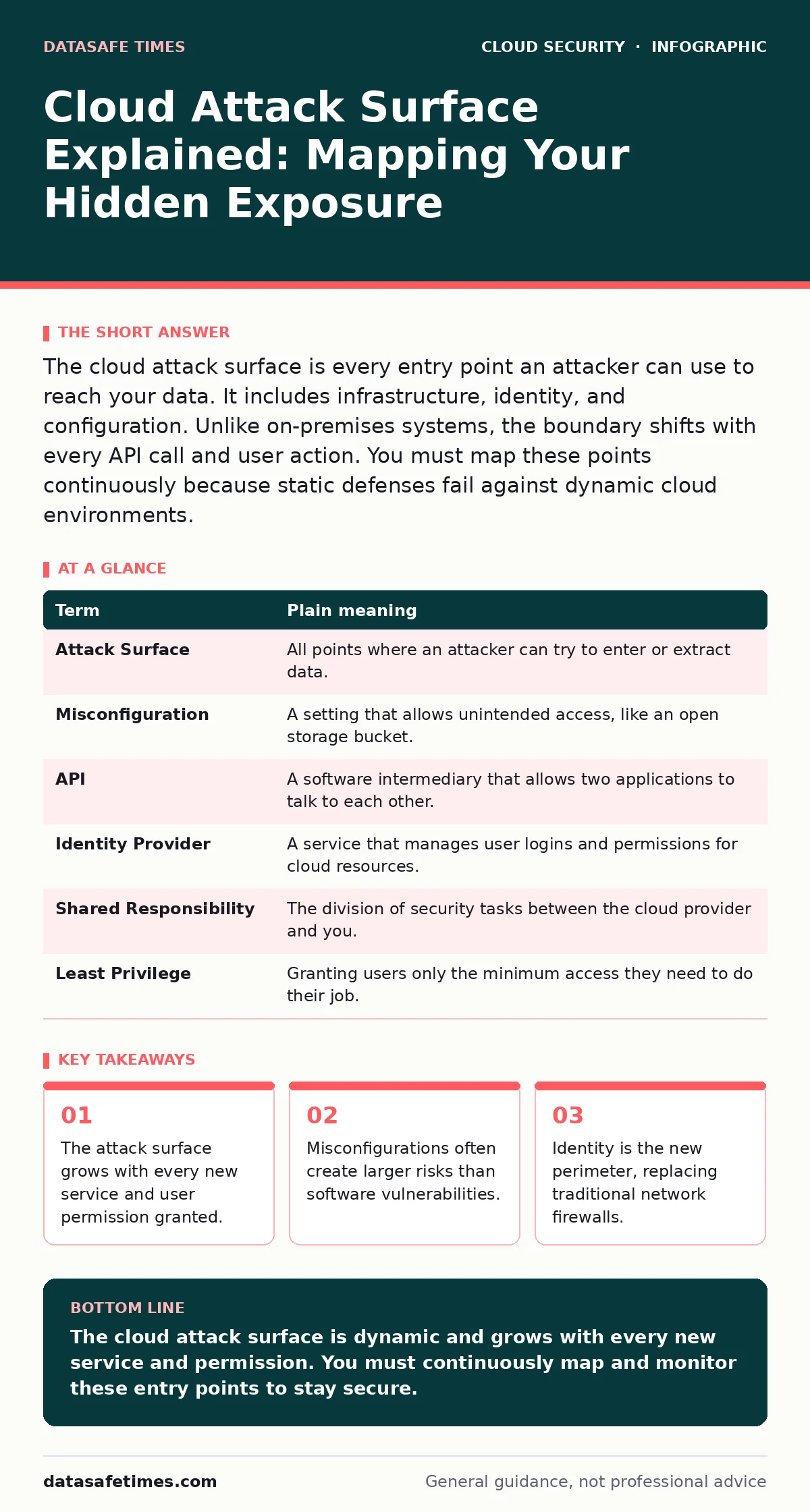
The cloud attack surface is every entry point an attacker can use to reach your data. It includes infrastructure, identity, and configuration. Unlike on-premises systems, the boundary shifts with every API call and user action. You must map these points continuously because static defenses fail against dynamic cloud environments.
The Apartment Complex Analogy
Imagine your cloud environment is a large apartment complex. In the past, you secured the building with a single gate. Today, the gate is open for residents, but every apartment has its own door, window, and balcony. Attackers no longer need to break through the main gate. They look for unlocked windows, keys left under mats, or residents who let strangers in. This shift defines the modern cloud attack surface. It is not just the outer wall. It is every individual entry point across thousands of units.
Defining the Cloud Attack Surface
The cloud attack surface is the sum of all potential entry points into your system. This includes servers, databases, APIs, and user accounts. Each service you enable adds new doors to the apartment complex. A storage bucket is a window. An API endpoint is a side door. A user account is a resident. If any of these are misconfigured or poorly secured, an attacker can enter. The surface grows as you add services. It shrinks only when you remove access or harden configurations.
Key Terms for Cloud Security
Understanding the vocabulary helps you map your exposure. These terms define the components of your attack surface.
| Term | Plain meaning |
|---|---|
| Attack Surface | All points where an attacker can try to enter or extract data. |
| Misconfiguration | A setting that allows unintended access, like an open storage bucket. |
| API | A software intermediary that allows two applications to talk to each other. |
| Identity Provider | A service that manages user logins and permissions for cloud resources. |
| Shared Responsibility | The division of security tasks between the cloud provider and you. |
| Least Privilege | Granting users only the minimum access they need to do their job. |
Common Points of Confusion
Many teams confuse the cloud provider’s security with their own. The provider secures the building structure. You secure the apartments. This distinction is the core of the shared responsibility model. Another confusion is assuming that invisible services are safe. A database not connected to the internet still has an attack surface via internal network paths. You must understand cloud network segmentation to see how data moves inside. An attacker inside the complex can move between apartments if walls are weak.
Identity as the New Perimeter
In traditional networks, firewalls defined the boundary. In the cloud, identity defines it. An API key is like a master key for an apartment. If you lose it, anyone can enter. Many teams treat API keys as static secrets. They are not. They expire, rotate, and leak. Neglecting access key rotation leaves old keys active, expanding your surface. You should also review cloud identity governance to ensure users have only the access they currently need. Stale permissions are unlocked doors you forgot about.
See also: Encrypted Cloud Storage: How Client-Side Encryption Protects You · Shared Responsibility Model: Where Your Security Ends
Configuration Drift and Silent Exposure
Cloud infrastructure changes constantly. Developers deploy new code. Operations teams update settings. This drift creates new entry points. A storage bucket might be public for testing but forgotten in production. This is a common misconfiguration. You need cloud security posture management (CSPM) to detect these drifts. Without continuous monitoring, your map of the attack surface becomes outdated quickly. The apartment complex changes daily. New balconies appear. Old doors break. You cannot rely on a snapshot from last year.
Try This Now
Start mapping your exposure today with these 3 steps.
- List all active API keys and service accounts. Check which ones have not been used in 90 days. Revoke them.
- Review your storage buckets. Ensure none are publicly readable unless required. Use strict access policies.
- Enable cloud logging gaps analysis. Verify that you are capturing access logs for all critical services. If logs are missing, you cannot see the entry.
Immutable Infrastructure Benefits
Traditional servers are patched and updated in place. This creates hidden vulnerabilities. Immutable infrastructure treats servers as disposable. You replace them instead of fixing them. This reduces the attack surface because there are no accumulated changes. Each new instance starts clean. This approach complements your security strategy by removing the risk of configuration drift. It ensures that every apartment is built to the same secure standard.
The Cost of Visibility
You cannot protect what you cannot see. Many teams assume their cloud provider handles all logging. This is false. You must configure and store your own logs. Missing logs create blind spots. An attacker can enter and exit without leaving a trace if you are not watching. This is why understanding cloud logging gaps is critical. You must ensure that every door opening is recorded. Without this data, your security efforts are guesswork.
Key takeaways
- The attack surface grows with every new service and user permission granted.
- Misconfigurations often create larger risks than software vulnerabilities.
- Identity is the new perimeter, replacing traditional network firewalls.
The cloud attack surface is dynamic and grows with every new service and permission. You must continuously map and monitor these entry points to stay secure.
Frequently asked questions
Is the cloud attack surface the same as the network perimeter?
No. The network perimeter is just one part. The cloud attack surface includes identity, storage, APIs, and configuration settings across all services.
How do I reduce my cloud attack surface?
Remove unused services, enforce least privilege access, and automate configuration checks to catch misconfigurations early.
Does using a virtual private cloud reduce the attack surface?
Yes. A virtual private cloud isolates your resources. It limits who can access them, reducing the number of potential entry points.
What is the biggest risk in the cloud?
Human error and misconfiguration are the biggest risks. These create open doors that attackers can find and exploit easily.
How this guide was produced: written by the DataSafe Times editorial team with AI assistance, checked against the public references listed below, and reviewed when the facts change. See our editorial policy or report an error.