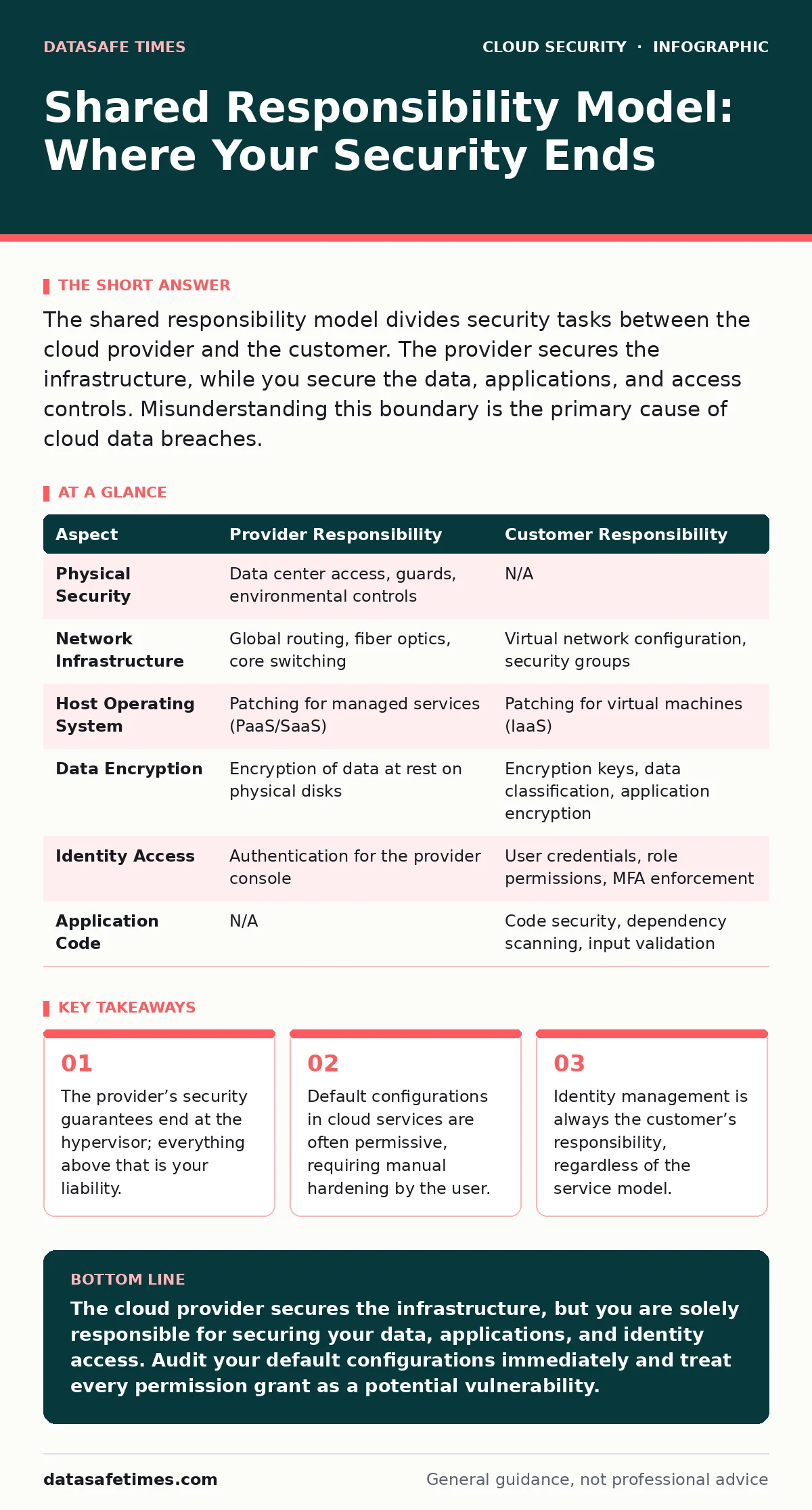
The shared responsibility model divides security tasks between the cloud provider and the customer. The provider secures the infrastructure, while you secure the data, applications, and access controls. Misunderstanding this boundary is the primary cause of cloud data breaches.
The Lease Agreement Analogy
Imagine you rent a secure apartment complex. The management company installs reinforced doors, 24-hour security cameras, and fire suppression systems. They ensure the building stands up and the power stays on. You, the tenant, decide who gets a key to your specific unit. You also decide whether to lock the door when you leave for work. If someone picks your lock, the management company is not liable. They did their job securing the building. You failed to secure your unit.
Cloud computing operates on this exact principle. The infrastructure provider manages the physical security of the data centers and the global network backbone. They patch the operating system that runs the virtual machines. They ensure the storage disks are physically intact. You manage the operating system inside the virtual machine. You manage the firewall rules that dictate what traffic enters your application. You manage the passwords for the users accessing your data.
The boundary shifts depending on the service type, but the liability for your data never shifts away from you.
At a Glance: The Boundary Lines
| Aspect | Provider Responsibility | Customer Responsibility |
|---|---|---|
| Physical Security | Data center access, guards, environmental controls | N/A |
| Network Infrastructure | Global routing, fiber optics, core switching | Virtual network configuration, security groups |
| Host Operating System | Patching for managed services (PaaS/SaaS) | Patching for virtual machines (IaaS) |
| Data Encryption | Encryption of data at rest on physical disks | Encryption keys, data classification, application encryption |
| Identity Access | Authentication for the provider console | User credentials, role permissions, MFA enforcement |
| Application Code | N/A | Code security, dependency scanning, input validation |
The Sliding Scale of Control
The model is not a static wall; it is a sliding scale. When you use Infrastructure as a Service, you rent raw compute power. You install the operating system. You configure the kernel. You manage the web server software. The provider only ensures the bare metal hardware functions. If you leave a port open because you forgot to configure the firewall, that is your error. The provider cannot see inside your virtual machine to fix it.
When you move to Platform as a Service, the provider manages the operating system and the runtime environment. You upload your code. The provider patches the underlying OS. You no longer need to worry about kernel exploits. However, you still own the application logic. If your code has a SQL injection vulnerability, the provider will not fix it. You must secure the data flow within your application.
Serverless computing pushes this further. The provider manages the execution environment, the scaling, and the underlying infrastructure. You only provide the function code. Yet, you still configure the triggers and the permissions. If you grant a function access to read all database tables instead of just the ones it needs, you have created a security risk. The provider executes your code; they do not judge its safety.
Day-to-Day Configuration Reality
In practice, this model manifests in control panels and command line interfaces. You click buttons to grant access. You write scripts to rotate credentials. You define policies that allow or deny network traffic. The provider offers the tools, but you must assemble them correctly.
A common failure point is the assumption that default settings are secure. They are rarely optimized for your specific threat model. A new database instance might be accessible from any IP address by default. A storage bucket might allow public read access until you change the policy. You must audit these defaults immediately upon creation.
Imagine you deploy a new microservice. You configure the identity provider to allow login via a standard email form. You forget to enable multi-factor authentication. An attacker guesses an employee’s password and logs in. The provider’s infrastructure was secure. The network was stable. The breach occurred because you did not implement MFA for cloud accounts. The tool existed, but you did not turn it on.
What People Usually Get Wrong
The most persistent error is assuming the provider protects the data inside the bucket. The provider ensures the disk is not stolen. They ensure the bit-flip rate is within specification. They do not ensure you do not accidentally publish sensitive files to the public internet. This distinction often surprises teams migrating from on-premises servers.
Another misconception is that identity management is a shared task. It is not. The provider secures their own administrative accounts. You secure your user accounts, your service accounts, and your application identities. If you hardcode an API key in your source code, the provider cannot remove it. You must use secrets managers to store and rotate those credentials. The provider offers the vault; you must put the key inside it.
Finally, teams often misunderstand logging. The provider logs their own actions for audit purposes. You must configure your own logging to track who accessed your data and when. Without proper cloud logging and monitoring, you will not know you have been breached until the damage is done. The provider does not alert you to suspicious activity within your tenant by default.
See also: Cloud Security Posture Management: 6 Common Misunderstandings · Encrypted Cloud Storage: How Client-Side Encryption Protects You
The Hidden Cost of Misconfiguration
The financial cost of a breach is obvious, but the operational cost of fixing misconfigurations is higher. When a security incident occurs, the first question is always whether the provider was negligent. In almost every case, the answer is no. The provider follows their documented processes. The customer deviated from best practices.
This leads to a culture of blame. Teams argue over who should have configured the firewall. This friction slows down remediation. Clear documentation of the shared responsibility model within your organization reduces this friction. Define who owns the network policy. Define who owns the application secrets.
You must treat cloud configuration as code. Manual changes are prone to error and drift. When configuration is stored in version control, you can review changes before they apply. You can see who changed a permission and why. This transparency is necessary for maintaining security at scale.
Integrating with Other Security Layers
The shared responsibility model does not exist in a vacuum. It intersects with every other security discipline. For instance, cloud network segmentation relies on your configuration of virtual networks and security groups. The provider gives you the switches; you wire them.
Similarly, Kubernetes network policies are a customer responsibility. The provider manages the cluster control plane. You manage the pod-to-pod traffic rules. If you allow all traffic within the cluster, an attacker who compromises one pod can move laterally to others. You must define strict policies.
Access key rotation is also your duty. The provider provides the mechanism to generate and revoke keys. You must implement the process to rotate them regularly. Stale keys are a primary vector for compromise. You must also perform cloud vulnerability management on your own images and containers. The provider patches the base OS, but you must patch the libraries you install on top of it.
Even in hybrid cloud security scenarios, the boundary remains clear. The provider secures the cloud side. You secure the on-premises side and the connection between them. You must ensure the encryption in transit is properly configured and that the identity federation works as intended.
Taking Ownership
Understanding the shared responsibility model is not about memorizing a chart. It is about recognizing where your control ends and the provider’s begins. You must audit your configurations regularly. You must test your access controls. You must assume that your environment is being targeted.
The provider gives you the keys to the kingdom. They do not hand you the blueprint for how to secure it. That is your job. By accepting this responsibility, you move from a passive consumer of infrastructure to an active architect of security. This shift is the only way to maintain trust in your systems.
Key takeaways
- The provider’s security guarantees end at the hypervisor; everything above that is your liability.
- Default configurations in cloud services are often permissive, requiring manual hardening by the user.
- Identity management is always the customer’s responsibility, regardless of the service model.
The cloud provider secures the infrastructure, but you are solely responsible for securing your data, applications, and identity access. Audit your default configurations immediately and treat every permission grant as a potential vulnerability.
Frequently asked questions
Who is responsible for patching the operating system in a virtual machine?
In Infrastructure as a Service, you are responsible for patching the guest operating system. In Platform as a Service or Serverless environments, the provider manages the underlying OS patches.
Does the cloud provider encrypt my data by default?
The provider typically encrypts data at rest on their physical storage, but you are responsible for managing the encryption keys and ensuring data is encrypted in transit and at the application level.
Can the provider see my application code?
The provider generally cannot see your application code or data due to privacy and technical isolation, but they can see metadata such as network traffic volumes and API calls made to their services.
Who manages the firewall rules for my cloud resources?
You manage the software-defined firewall rules, such as security groups or network ACLs, that control traffic to and from your specific resources. The provider manages the physical network perimeter.
How this guide was produced: written by the DataSafe Times editorial team with AI assistance, checked against the public references listed below, and reviewed when the facts change. See our editorial policy or report an error.