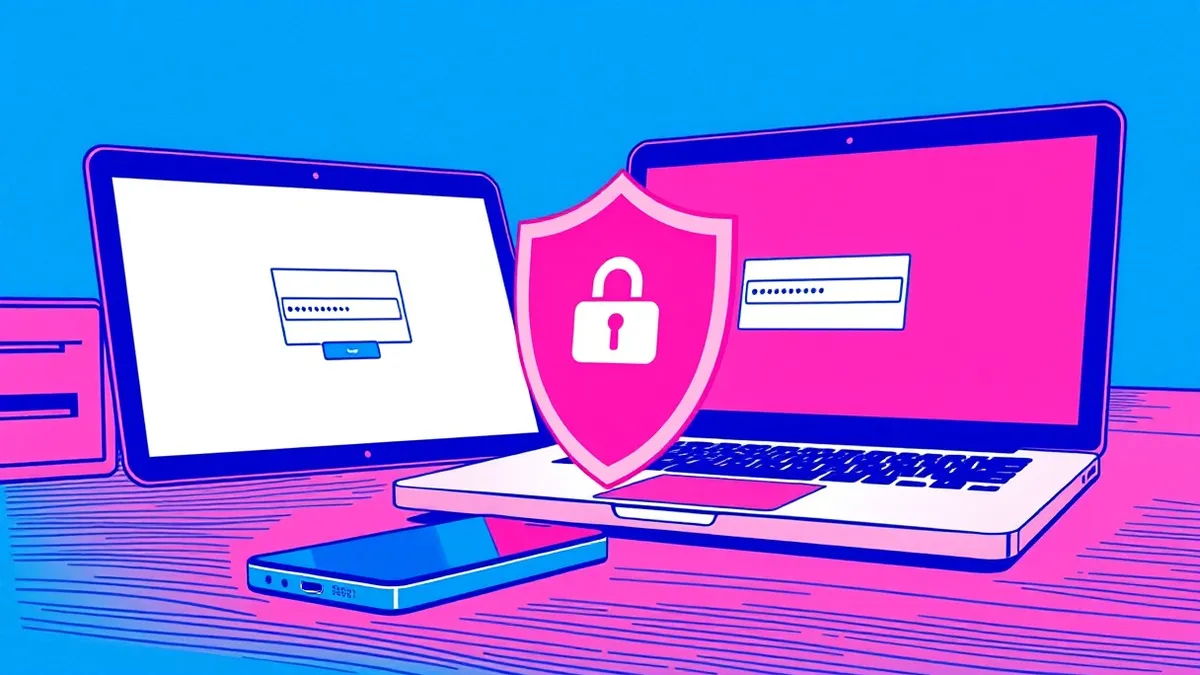
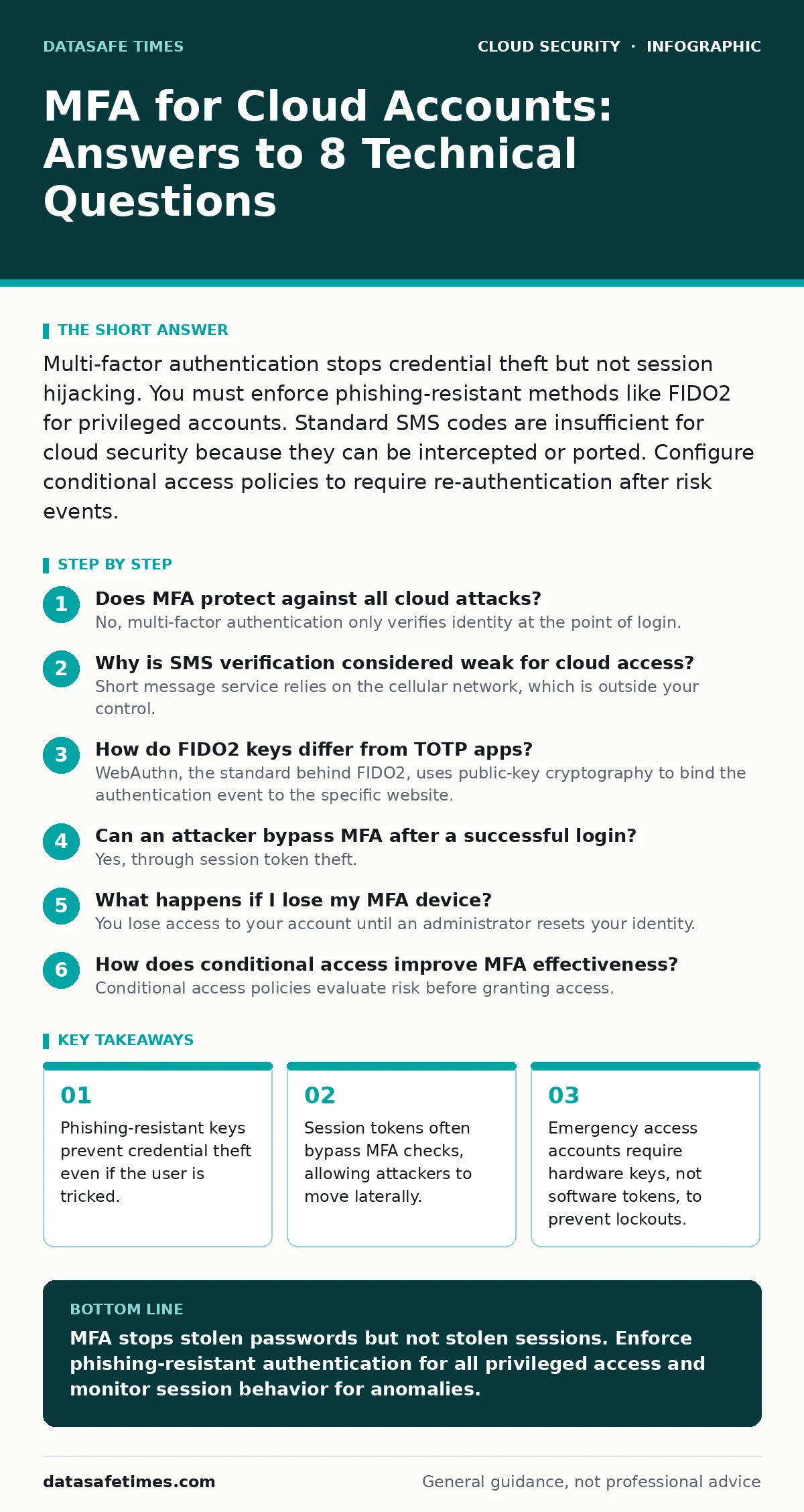
Multi-factor authentication stops credential theft but not session hijacking. You must enforce phishing-resistant methods like FIDO2 for privileged accounts. Standard SMS codes are insufficient for cloud security because they can be intercepted or ported. Configure conditional access policies to require re-authentication after risk events.
Does MFA protect against all cloud attacks?
No, multi-factor authentication only verifies identity at the point of login. It does not secure the session that follows. Once an attacker possesses a valid session token, they can interact with cloud resources without triggering additional authentication challenges. This means MFA is a gatekeeper, not a bodyguard. You must treat the session as a high-value asset that requires its own protection mechanisms.
Why is SMS verification considered weak for cloud access?
Short message service relies on the cellular network, which is outside your control. Attackers can intercept messages through SIM swapping, where they convince a carrier to move your phone number to a new device. They can also use SS7 signaling flaws to redirect SMS traffic. Because the carrier validates the user, not the application, the cloud provider cannot distinguish between a legitimate user and an attacker holding the phone. This makes SMS unsuitable for any account with administrative privileges.
How do FIDO2 keys differ from TOTP apps?
WebAuthn, the standard behind FIDO2, uses public-key cryptography to bind the authentication event to the specific website. Time-based one-time passwords are shared secrets that can be phished. When you use a hardware key, the signature is only valid for the origin of the request. An attacker cannot trick your key into signing a request for a fake login page. TOTP apps generate codes based on time, which a phishing site can accept and forward to the real service in real time.
Can an attacker bypass MFA after a successful login?
Yes, through session token theft. Modern web applications use cookies or bearer tokens to maintain state. If malware on your workstation captures this token, it can impersonate you indefinitely. The cloud provider sees a valid session and grants access. This bypasses MFA entirely because the initial authentication already occurred. You must monitor for impossible travel or unusual API calls to detect these hijacked sessions.
What happens if I lose my MFA device?
You lose access to your account until an administrator resets your identity. In cloud environments, this can halt deployment pipelines or block emergency fixes. This is why emergency access accounts must use hardware security keys stored in physical safes. Software tokens can be lost, stolen, or wiped. Hardware keys provide a durable, offline backup that does not depend on a mobile device or internet connection.
See also: Cloud Security Posture Management: 6 Common Misunderstandings · Encrypted Cloud Storage: How Client-Side Encryption Protects You
How does conditional access improve MFA effectiveness?
Conditional access policies evaluate risk before granting access. They check device health, location, and user behavior. If a login attempt comes from an unfamiliar country or an unmanaged device, the system can require a stronger second factor. This reduces friction for normal users while increasing security for suspicious events. It turns static authentication into dynamic risk management. You should configure these rules to block access from anonymous networks entirely.
| Factor Type | Phishing Resistant? | Usability | Loss Recovery |
|---|---|---|---|
| SMS Code | No | High | Moderate |
| TOTP App | No | High | Moderate |
| FIDO2 Key | Yes | Moderate | Low |
| Biometric | No | High | Low |
Does MFA protect service accounts and APIs?
Standard MFA does not apply to machine-to-machine communication. Service accounts use API keys, certificates, or OAuth tokens. These credentials must be stored securely and rotated regularly. If an attacker steals an API key, they do not need to bypass MFA. They simply use the key to make requests. You should use secrets managers to store and rotate these credentials automatically. This reduces the window of exposure if a key is leaked.
How do I manage MFA for temporary contractors?
You must enforce strict identity lifecycle management. Contractors should receive time-bound access that expires automatically. Their MFA devices should be company-owned and returned upon contract end. Do not allow personal devices for high-privilege access. This ensures you retain control over the second factor. When the contract ends, the access ends, and the device can be wiped. This prevents former employees or contractors from retaining access through cached tokens.
What is the impact of MFA on application performance?
Adding authentication steps introduces latency. Each MFA challenge requires a network round-trip to the identity provider. For high-frequency API calls, this overhead is unacceptable. You should use short-lived access tokens for internal services. These tokens are issued after an initial MFA check but do not require re-authentication for every call. This balances security with performance. You must define appropriate token lifetimes to limit exposure if a token is stolen.
Key takeaways
- Phishing-resistant keys prevent credential theft even if the user is tricked.
- Session tokens often bypass MFA checks, allowing attackers to move laterally.
- Emergency access accounts require hardware keys, not software tokens, to prevent lockouts.
MFA stops stolen passwords but not stolen sessions. Enforce phishing-resistant authentication for all privileged access and monitor session behavior for anomalies.
Frequently asked questions
Can I use MFA for database access?
Databases do not support standard MFA protocols. Use a proxy or bastion host that enforces MFA before granting database connections. This adds a layer of authentication without modifying the database configuration.
How do I prevent MFA fatigue attacks?
MFA fatigue occurs when attackers spam push notifications until the user approves one. Disable push notifications for high-risk accounts. Use hardware keys or TOTP codes instead, which require active input rather than passive approval.
Is biometric authentication secure for cloud accounts?
Biometrics are convenient but not phishing-resistant. A fake website can capture your fingerprint or face data if the device allows it. Use biometrics only as a first factor, combined with a device-bound second factor.
How often should I rotate MFA secrets?
TOTP secrets should not be rotated frequently, as this causes user disruption. Rotate them only if compromise is suspected. For hardware keys, rotation is unnecessary unless the device is lost. Focus on monitoring usage rather than rotating secrets.
How this guide was produced: written by the DataSafe Times editorial team with AI assistance, checked against the public references listed below, and reviewed when the facts change. See our editorial policy or report an error.