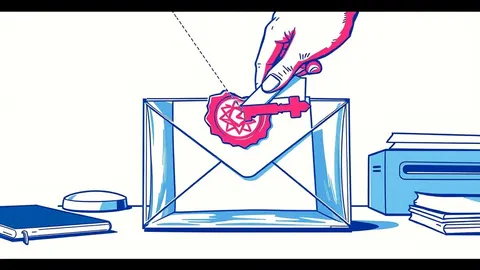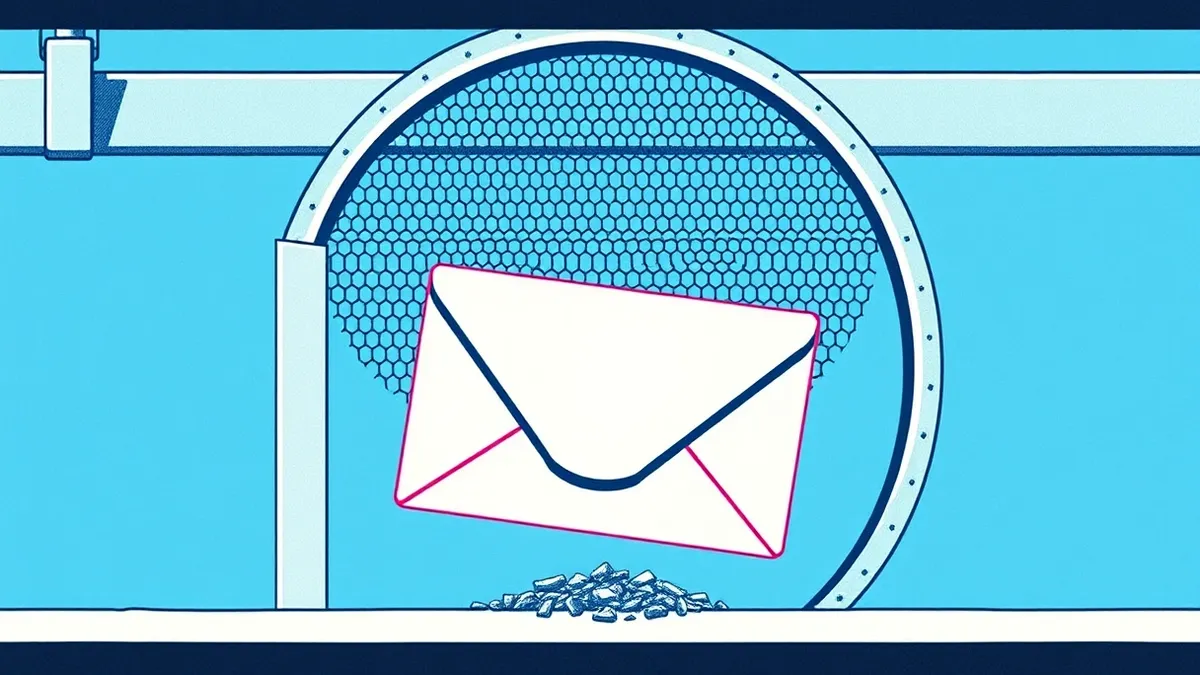
Email filtering is not a firewall. It relies on probabilistic heuristics that generate false positives and negatives. You must treat it as a delay mechanism, not a blocker. Understanding its statistical nature prevents over-reliance and reduces the risk of missing subtle, targeted attacks that evade standard signature detection.
Misreading: The filter stops all malicious email
Correct reading: Email filtering operates on probability, not certainty. The system assigns a score to each message based on sender reputation, content keywords, and structural anomalies. A message crosses a threshold to reach the inbox or the quarantine folder. No threshold exists that catches every threat without also blocking legitimate business communications.
Imagine a marketing campaign that uses slightly misspelled domains but valid SSL certificates. The filter sees a legitimate certificate and a clean header. It allows the message. The payload inside is new and unknown. The filter has no signature for it. The message arrives. You open it. The system failed not because it was broken, but because it was designed to let most traffic through.
This trade-off exists because false positives are costly. Blocking a client invoice stops revenue. Blocking an urgent project update halts work. Security teams tune filters to minimize disruption. This tuning creates a window for attackers who mimic normal traffic patterns. You must assume some malicious email will always reach the inbox.
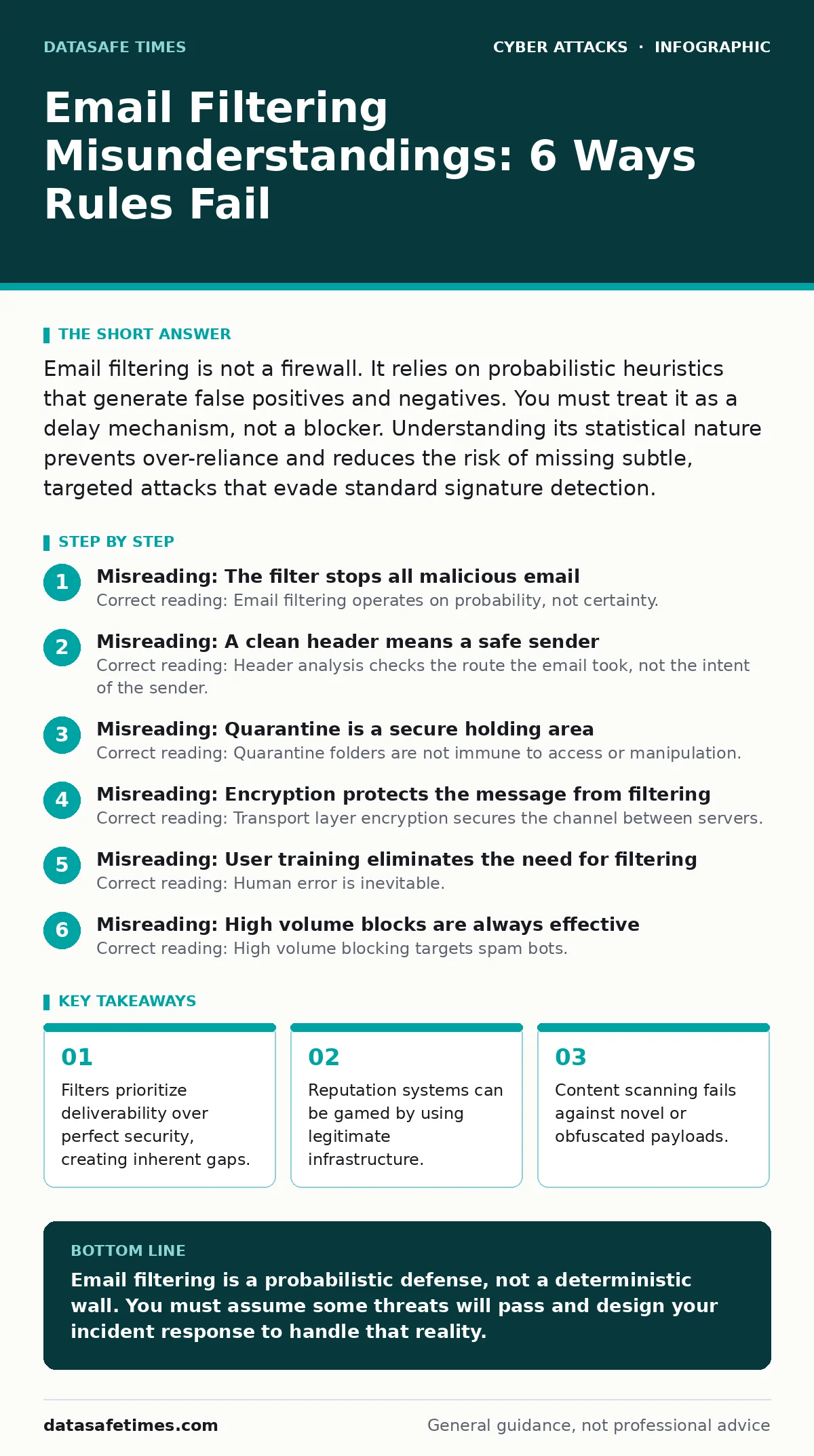
Misreading: A clean header means a safe sender
Correct reading: Header analysis checks the route the email took, not the intent of the sender. Attackers route messages through compromised legitimate servers or use spoofed headers that pass basic validation checks. SPF, DKIM, and DMARC verify that a server is authorized to send mail for a domain. They do not verify that the domain owner authorized the specific content.
Suppose an attacker compromises a small business email account. That account has valid SPF and DKIM records. The attacker sends a phishing message to your organization. Your filter sees valid authentication records. It trusts the sender. The message bypasses reputation filters because the sending IP has a history of clean traffic. The header is clean. The content is malicious.
This is why header validation is necessary but insufficient. It prevents simple spoofing where an attacker forges the "From" address from a different domain. It does not prevent abuse of legitimate accounts. You must inspect the content and the link destinations regardless of header validity. Relying on authentication records alone creates a false sense of security.
Misreading: Quarantine is a secure holding area
Correct reading: Quarantine folders are not immune to access or manipulation. They are often accessible to users with certain permissions. An attacker who gains access to a user account can view the quarantine. They can identify which emails were blocked and why. This reveals your filtering rules. They can then adjust their tactics to avoid those specific triggers.
Imagine a targeted attack where the attacker sends 10 variations of a phishing email. Five are blocked. Five reach the inbox. The user reports the inbox hits. The attacker sees the quarantine logs. They learn that the filter blocks messages with specific subject lines. They remove those lines. The next batch passes. The quarantine becomes a feedback loop for the attacker.
Furthermore, quarantine retention policies vary. Messages may be deleted after 30 days. If you do not review them, evidence disappears. You cannot analyze a threat that no longer exists. You must treat quarantine as a temporary buffer, not a final destination. Regular review is required to spot trends and adjust rules.
Misreading: Encryption protects the message from filtering
Correct reading: Transport layer encryption secures the channel between servers. It does not encrypt the content for the receiver’s filtering system. Most enterprise filters decrypt the traffic at the perimeter to inspect the payload. If the filter cannot decrypt the traffic, it cannot inspect it. It must make a decision based on metadata alone.
Suppose you use end-to-end encryption for all emails. The filtering system sees an encrypted blob. It cannot read the subject line. It cannot scan for malware. It checks the sender’s IP reputation. If the IP is clean, the message passes. The attacker sends malware inside the encrypted envelope. The filter lets it through because it is blind to the content.
This is a common misconception about privacy tools. End-to-end encryption prevents intermediaries from reading your data. It also prevents your security team from scanning for threats. You must choose between privacy and visibility. For most organizations, visibility is the priority. You configure the gateway to decrypt, scan, and re-encrypt. This exposes the content to the gateway operator.
Misreading: User training eliminates the need for filtering
Correct reading: Human error is inevitable. Training improves awareness but does not create perfect detection. Users are tired, rushed, or distracted. A well-crafted phishing email exploits urgency or fear. The user clicks before thinking. The filter provided a layer of defense that the user bypassed. The training failed to override the psychological trigger.
Imagine a CEO sends an urgent request for gift cards. The request comes from a compromised account. The filter allows it because the sender is known. The employee knows better. The employee is pressured by the CEO’s tone. The employee complies. The money is lost. Training did not help. The social engineering was too strong.
Training is a long-term cultural shift. Filtering is an immediate technical control. They serve different purposes. Training reduces the success rate of attacks. Filtering reduces the volume of attacks. You need both. Relying on training alone assumes users act as security professionals. They do not. They act as users.
See also: Misdirected Emails: How to Stop Data Leaks and Recipient Errors · Rate Limiting Implementation Checklist for Secure APIs
Misreading: High volume blocks are always effective
Correct reading: High volume blocking targets spam bots. It misses targeted attacks. Spear phishing campaigns send few messages. They use legitimate accounts. They do not trigger volume thresholds. The filter sees normal traffic patterns. It allows the messages. The attack succeeds because it looks like normal business communication.
Suppose an attacker targets a specific finance team. They send 5 emails. One per day. Each email is unique. The content is tailored. The sender is a known vendor. The filter sees 5 messages from a trusted sender. It does not block them. The volume is low. The reputation is good. The content is clean except for one malicious link. The link is new. The filter has not seen it. The message passes.
Volume-based rules are useful for stopping nuisance spam. They are useless for stopping targeted intrusions. You must use behavioral analysis. You must look for anomalies in user behavior. You must detect when a user clicks a link they never click. You must detect when a user sends data they never send. Volume is a blunt instrument. Precision requires deeper inspection.
Misreading: Filtering replaces endpoint protection
Correct reading: Email is just one entry point. Malware can arrive via web downloads, USB drives, or cloud storage. The email filter only sees email. It does not see what happens after the user clicks a link or opens a document. Endpoint detection and response monitors the device. It sees the execution. It stops the process.
Imagine a user receives a clean email. The email contains a link to a legitimate website. The website is compromised. It serves malware when the user visits. The email filter saw a clean link. It allowed the email. The user clicked. The malware downloaded. The email filter did nothing. The endpoint protection caught the execution. The device was saved.
You must layer defenses. Email filtering reduces the risk. Endpoint protection mitigates the impact. Network monitoring detects lateral movement. Identity management controls access. Each layer addresses a different failure mode. No single tool covers all risks. You must integrate these systems. They must share data. They must act together.
Misreading: Reputation scores are static
Correct reading: Reputation scores change rapidly. An IP address can go from clean to dirty in minutes. Compromised servers are identified and blacklisted. Clean servers are hijacked and used for spam. The filter uses real-time data. If the data is stale, the filter makes wrong decisions.
Suppose a new server is provisioned. It has no history. Its reputation is neutral. An attacker uses it for a short burst of spam. The reputation drops. The filter blocks it. The attacker switches to a new server. The cycle repeats. The filter chases the IP. The attacker stays ahead.
You must use multiple reputation sources. You must combine IP reputation with domain reputation and content analysis. No single source is perfect. Each has blind spots. Combining them reduces the chance of error. You must also monitor your own reputation. If your servers send spam, your legitimate mail will be blocked by others.
Key takeaways
- Filters prioritize deliverability over perfect security, creating inherent gaps.
- Reputation systems can be gamed by using legitimate infrastructure.
- Content scanning fails against novel or obfuscated payloads.
- User behavior often bypasses technical controls entirely.
Email filtering is a probabilistic defense, not a deterministic wall. You must assume some threats will pass and design your incident response to handle that reality.
Frequently asked questions
How do I reduce false positives in email filtering?
Tune your rules to be more specific. Use allowlists for trusted senders. Monitor quarantine logs to identify legitimate traffic that is blocked. Adjust thresholds based on observed errors.
Does email filtering protect against ransomware?
It can block the initial delivery of ransomware via email. It does not protect against ransomware delivered through other channels. You need endpoint protection and backups to mitigate ransomware impact.
How often should I review email filtering rules?
Review them at least monthly. Check for new threat patterns. Update allowlists and blocklists. Ensure rules align with current business needs. Remove outdated rules that no longer serve a purpose.
Can email filtering be bypassed by encryption?
Yes, if the filter cannot decrypt the traffic. You must configure your gateway to decrypt and inspect encrypted email. This requires trusting the gateway operator with your data privacy.
How this guide was produced: written by the DataSafe Times editorial team with AI assistance, checked against the public references listed below, and reviewed when the facts change. See our editorial policy or report an error.