
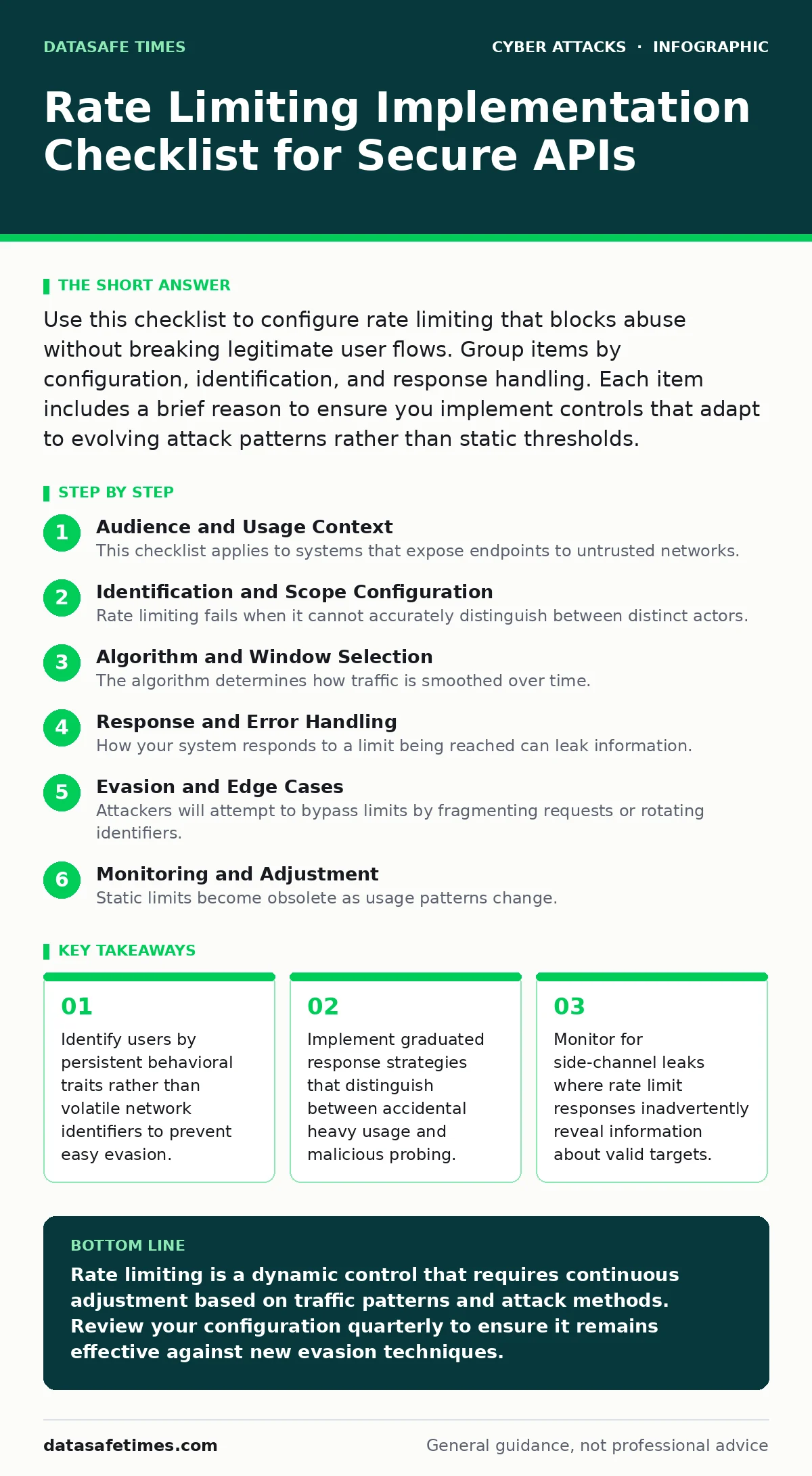
Use this checklist to configure rate limiting that blocks abuse without breaking legitimate user flows. Group items by configuration, identification, and response handling. Each item includes a brief reason to ensure you implement controls that adapt to evolving attack patterns rather than static thresholds.
Audience and Usage Context
This checklist applies to systems that expose endpoints to untrusted networks. You use it to verify that your rate limiting logic resists common evasion techniques. It is not a substitute for application security reviews, but it catches the most frequent configuration errors.
Identification and Scope Configuration
Rate limiting fails when it cannot accurately distinguish between distinct actors. If you rely solely on IP addresses, you create a single point of failure that shared networks can exploit.
- Bind limits to user accounts when authenticated: Prevents abuse of shared credentials and ensures individual accountability for API usage.
- Use cryptographic keys for unauthenticated access: Ensures each integration has a unique identity that cannot be spoofed by changing network parameters.
- Avoid relying on IP addresses alone: Shared residential IPs and NAT gateways cause legitimate users to trigger limits incorrectly.
- Include API keys in the rate limit hash: Separates traffic from different applications even if they share the same origin IP address.
- Define scope per endpoint group: Prevents a heavy operation on one endpoint from starving resources for lightweight operations on another.
Algorithm and Window Selection
The algorithm determines how traffic is smoothed over time. A simple counter resets abruptly, creating a burst window that attackers can exploit.
- Implement a sliding window log: Provides precise tracking of individual requests, reducing the burst capacity available to attackers at window boundaries.
- Use token bucket for smooth traffic: Allows controlled bursts for legitimate users while maintaining a steady average rate that protects backend stability.
- Set different limits for read and write operations: Write operations are more resource-intensive and often targeted in attempts to corrupt data or trigger side effects.
- Configure separate limits for authentication endpoints: Prevents brute force attacks from consuming the general API quota, which could disrupt other services.
- Avoid fixed time windows: Fixed windows allow attackers to synchronize requests just after the reset, creating a high-intensity burst that overwhelms systems.
Response and Error Handling
How your system responds to a limit being reached can leak information. Consistent responses are necessary to prevent attackers from mapping your infrastructure.
- Return standard 429 Too Many Requests status: Clearly signals that the limit has been reached without revealing why or which specific rule triggered.
- Include Retry-After header: Tells clients exactly when they can attempt again, reducing unnecessary polling that wastes bandwidth and server resources.
- Sanitize error messages: Prevents attackers from learning whether a limit was triggered by a valid username or an invalid one, which aids in enumeration.
- Log rate limit events separately: Allows for post-incident analysis of traffic patterns without cluttering application logs with high-volume noise.
- Implement backoff guidance in documentation: Helps legitimate developers build clients that respect limits automatically, reducing accidental abuse.
Evasion and Edge Cases
Attackers will attempt to bypass limits by fragmenting requests or rotating identifiers. Your controls must account for these behaviors.
- Rate limit on combined request parameters: Prevents attackers from creating unique URLs or query strings to bypass per-path limits.
- Monitor for slow-and-low attacks: Detects patterns where requests are spaced out to stay under the limit but accumulate over time to cause damage.
- Limit concurrent connections per identity: Prevents a single user from opening many simultaneous connections to exhaust server thread pools.
- Validate Content-Length before processing: Stops attackers from sending small headers with massive payloads to bypass header-based limits.
- Coordinate with account lockout policies: Ensures that rate limiting on login endpoints complements, rather than conflicts with, existing security measures for preventing credential stuffing.
Monitoring and Adjustment
Static limits become obsolete as usage patterns change. Continuous monitoring is required to adjust thresholds based on real-world data.
- Alert on limit threshold changes: Detects when an administrator modifies limits, which could be a sign of compromised administrative access.
- Track false positive rates: Identifies legitimate users who are frequently blocked, indicating that the current limits are too aggressive for normal usage.
- Analyze traffic distribution: Reveals if traffic is concentrated on specific endpoints, suggesting targeted attacks that require tighter limits.
- Review logs for botnet attacks: Identifies coordinated low-rate attacks from many sources that individually stay under limits but collectively cause harm.
- Update limits based on seasonal trends: Adjusts thresholds to accommodate expected spikes in legitimate traffic, preventing unnecessary blocks during peak times.
Integration and Dependencies
Rate limiting does not exist in isolation. It interacts with other security controls and system components.
- Ensure caching layers respect limits: Prevents cached responses from bypassing rate limits, which could mask the true volume of requests hitting the backend.
- Coordinate with MFA fatigue attacks defenses: Ensures that rate limiting on MFA push notifications prevents attackers from spamming users to gain approval.
- Validate with tabletop exercises: Tests how the system behaves under extreme load and whether rate limiting triggers are appropriate for different attack scenarios.
- Document limit exceptions for internal tools: Ensures that monitoring and administrative tools are not blocked, maintaining operational visibility.
- Review third-party API dependencies: Ensures that your clients respect the rate limits of external services, preventing your application from being blocked by upstream providers.
Key takeaways
- Identify users by persistent behavioral traits rather than volatile network identifiers to prevent easy evasion.
- Implement graduated response strategies that distinguish between accidental heavy usage and malicious probing.
- Monitor for side-channel leaks where rate limit responses inadvertently reveal information about valid targets.
Rate limiting is a dynamic control that requires continuous adjustment based on traffic patterns and attack methods. Review your configuration quarterly to ensure it remains effective against new evasion techniques.
Frequently asked questions
Should I rate limit based on IP address or user ID?
Use user ID or API key for authenticated requests to tie limits to specific identities. Use IP addresses only as a secondary measure for unauthenticated traffic, as they are easily spoofed or shared.
How do I prevent rate limiting from blocking legitimate users?
Implement graduated limits and clear error messages with Retry-After headers. Monitor false positive rates and adjust thresholds to accommodate normal usage spikes without compromising security.
What is the difference between a sliding window and a fixed window?
A fixed window resets at specific intervals, allowing bursts at the boundary. A sliding window tracks requests over a continuous period, providing smoother and more accurate rate enforcement.
Can rate limiting stop DDoS attacks?
Rate limiting mitigates application-layer abuse by limiting request frequency. It does not stop volumetric DDoS attacks that overwhelm network capacity, which require network-level filtering and bandwidth management.
How this guide was produced: written by the DataSafe Times editorial team with AI assistance, checked against the public references listed below, and reviewed when the facts change. See our editorial policy or report an error.