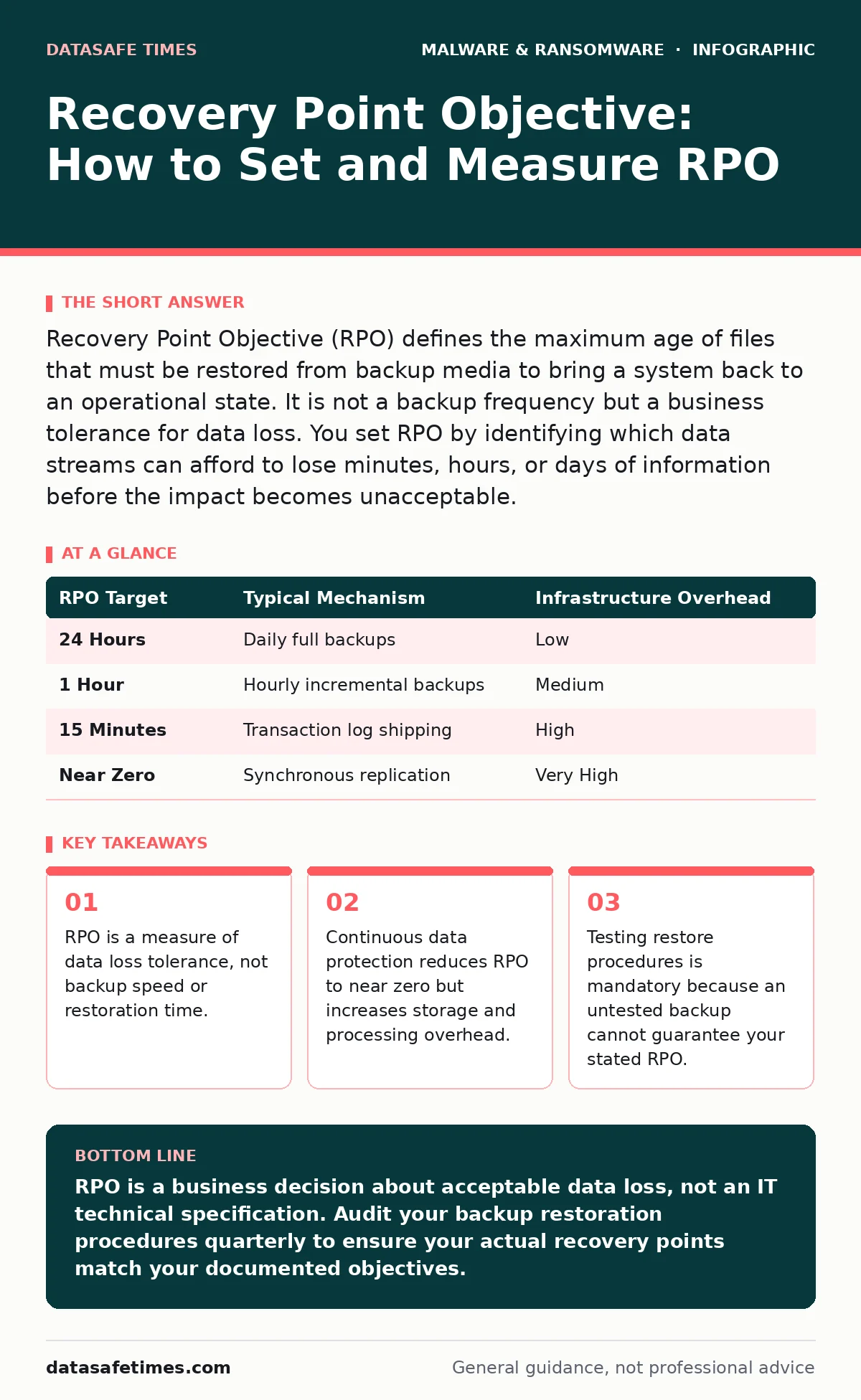
Recovery Point Objective (RPO) defines the maximum age of files that must be restored from backup media to bring a system back to an operational state. It is not a backup frequency but a business tolerance for data loss. You set RPO by identifying which data streams can afford to lose minutes, hours, or days of information before the impact becomes unacceptable.
What exactly is Recovery Point Objective?
Recovery Point Objective (RPO) is the maximum amount of data loss an organization can tolerate, measured in time. It answers the question of how far back in time you can afford to go when restoring systems after a disruption. If your RPO is one hour, you must have backups or logs that allow you to recover data from no more than sixty minutes ago. This metric focuses strictly on data integrity, not on how quickly the system comes back online.
How does RPO differ from Recovery Time Objective?
Recovery Time Objective (RTO) measures how long it takes to restore service, while RPO measures how much data you lose during that downtime. You can have a fast RTO but a poor RPO if you restore quickly from an old backup. Conversely, you might have a tight RPO with frequent snapshots but a slow RTO if the restoration process is complex. Both metrics define different aspects of your business continuity strategy.
Who should determine the RPO for an application?
Business owners and application stakeholders must define the RPO, not IT operations staff. Developers often assume that zero data loss is required for every database, which drives unnecessary infrastructure costs. Business leaders understand the financial and operational impact of losing recent transactions versus losing cached data. They can distinguish between critical state data that must be preserved and ephemeral data that can be regenerated.
How do you calculate the cost of a specific RPO?
The cost of a tighter RPO increases exponentially as you approach zero data loss. Hourly backups require standard storage and scheduling, while second-level replication demands high-throughput networks and continuous logging. You must weigh the cost of the infrastructure needed to capture frequent changes against the potential loss from missing that data. The calculation includes storage volume, network bandwidth for replication, and the engineering time to maintain the pipeline.
| RPO Target | Typical Mechanism | Infrastructure Overhead |
|---|---|---|
| 24 Hours | Daily full backups | Low |
| 1 Hour | Hourly incremental backups | Medium |
| 15 Minutes | Transaction log shipping | High |
| Near Zero | Synchronous replication | Very High |
Can you achieve a zero RPO with standard backups?
Standard backup software cannot achieve a true zero RPO because there is always a gap between the last backup and the moment of failure. To approach zero, you need continuous data protection (CDP) or synchronous replication. CDP records every block change in real time, allowing restoration to any specific point in the past. Synchronous replication writes data to a secondary site before acknowledging the write to the primary, ensuring no loss but adding latency to every transaction.
See also: XDR Best Practices: Aligning Data Sources for Real Threat Visibility · How Sandboxing Works: The Mechanics of Isolated Execution
What happens to RPO when ransomware encrypts backups?
If ransomware encrypts your backups, your effective RPO becomes infinite because you have no valid data to restore. Traditional backup schedules do not protect against encryption if the backup agent retains credentials that the malware can hijack. You must implement immutable storage, where data cannot be modified or deleted for a set period. This ensures that even if credentials are compromised, the attacker cannot alter the recovery points.
Does cloud storage change your RPO requirements?
Cloud storage does not automatically improve your RPO; it only changes where the data resides. If you rely on manual uploads to cloud buckets, your RPO is determined by how often you upload, not by the cloud provider's durability. Automated cloud-native replication can tighten RPO, but it requires configuration. You must verify that the replication stream is active and that the destination is not subject to the same failure modes as the source.
How do you test if your RPO is actually met?
You cannot verify RPO by looking at backup logs; you must perform regular restoration drills. Logs confirm that data was captured, but they do not confirm that the data is usable or complete. You should restore a subset of data to a isolated environment and compare it against the source. This process reveals gaps in the capture window and identifies corruption that automated checks might miss.
Why does application consistency matter for RPO?
A backup taken at the file system level may capture files that are in the middle of being written. This results in a consistent backup that is logically corrupt when restored. Application-consistent backups use hooks or filters to quiesce the application, flush buffers, and capture a stable state. Without this, your RPO is technically met, but the restored data may cause the application to crash or behave unpredictably.
How do you handle RPO for distributed microservices?
In a microservices architecture, each service may have different data retention needs. A user profile service might tolerate hourly loss, while a payment service requires near-zero loss. You must define RPO at the service level rather than the infrastructure level. This allows you to apply expensive continuous replication only where necessary, optimizing costs without compromising critical data integrity.
Key takeaways
- RPO is a measure of data loss tolerance, not backup speed or restoration time.
- Continuous data protection reduces RPO to near zero but increases storage and processing overhead.
- Testing restore procedures is mandatory because an untested backup cannot guarantee your stated RPO.
RPO is a business decision about acceptable data loss, not an IT technical specification. Audit your backup restoration procedures quarterly to ensure your actual recovery points match your documented objectives.
Frequently asked questions
Is RPO the same as backup frequency?
No, backup frequency is the technical method used to meet the RPO. You can have frequent backups that still fail to meet the RPO if the data is inconsistent or corrupted.
Can I change my RPO after a breach?
You can change the target RPO for future incidents, but it does not help with current data loss. You must rely on the recovery points available at the time of the incident.
Does encryption affect RPO?
Encryption adds processing time to backups, which can slightly increase the window of data loss. However, this impact is usually negligible compared to the protection it provides against theft.
What is a realistic RPO for small businesses?
A realistic RPO depends on the business model. For many, four to twelve hours is acceptable. Critical financial transactions may require shorter windows, while static content can tolerate longer periods.
How this guide was produced: written by the DataSafe Times editorial team with AI assistance, checked against the public references listed below, and reviewed when the facts change. See our editorial policy or report an error.