
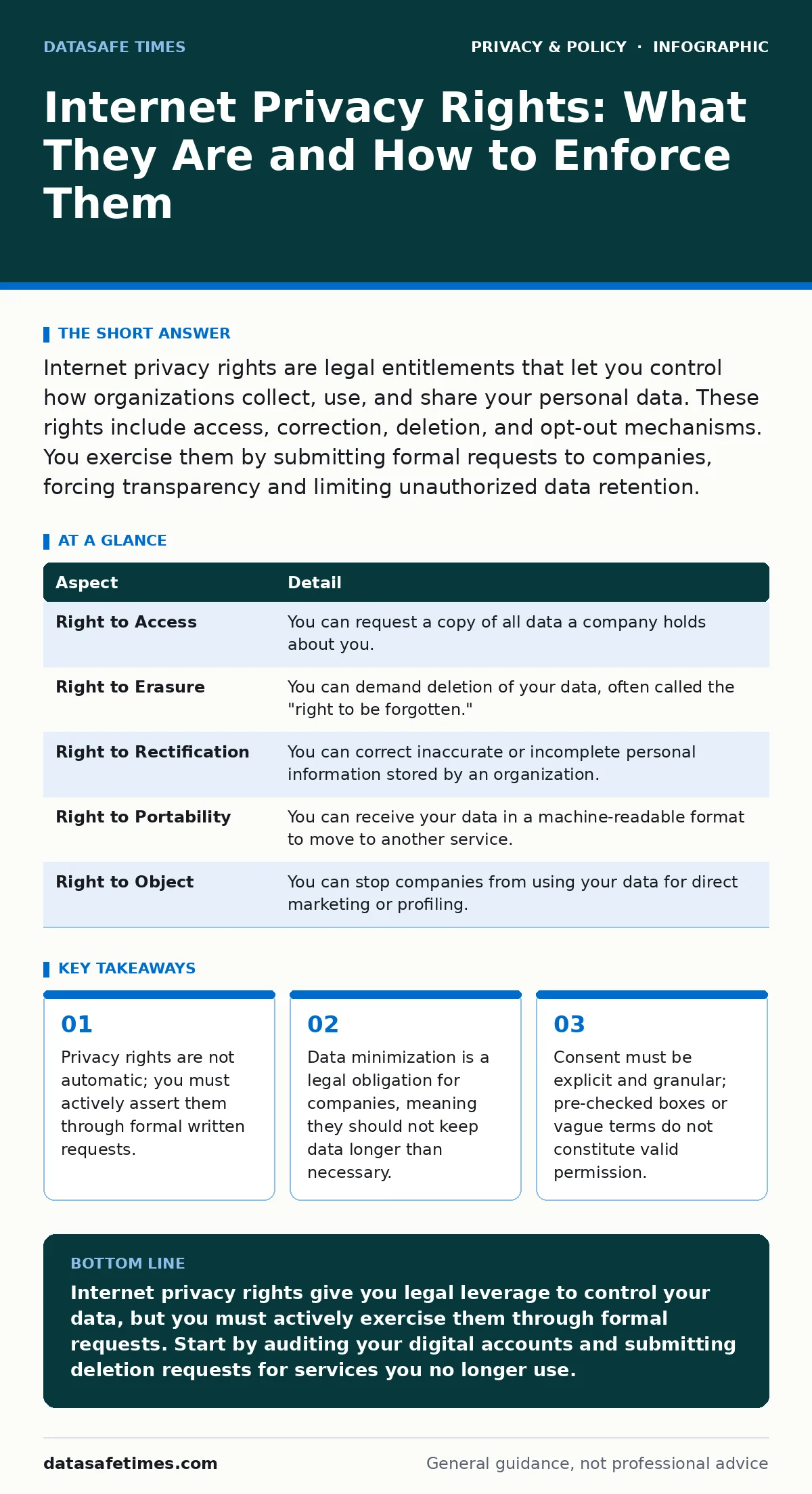
Internet privacy rights are legal entitlements that let you control how organizations collect, use, and share your personal data. These rights include access, correction, deletion, and opt-out mechanisms. You exercise them by submitting formal requests to companies, forcing transparency and limiting unauthorized data retention.
Everyday Analogy: The Digital Library
Imagine a library that copies every book you check out and keeps the copies forever. The librarians sell lists of what you read to advertisers. They never ask if you want them to keep the copies. Now imagine a law that lets you walk in, demand a list of every copy they made, and order them to burn the copies you no longer want. That shift in power is the core of internet privacy rights. It changes data from a permanent asset of the company to a temporary trust held for your benefit.
At a Glance
| Aspect | Detail |
|---|---|
| Right to Access | You can request a copy of all data a company holds about you. |
| Right to Erasure | You can demand deletion of your data, often called the "right to be forgotten." |
| Right to Rectification | You can correct inaccurate or incomplete personal information stored by an organization. |
| Right to Portability | You can receive your data in a machine-readable format to move to another service. |
| Right to Object | You can stop companies from using your data for direct marketing or profiling. |
Internet privacy rights: The Core Mechanism
Internet privacy rights function as a set of legal levers you can pull to interrupt the default data collection cycle. Most digital services are designed to maximize data retention because data fuels advertising and product development. Privacy laws reverse this incentive structure by imposing costs on holding data.
When you exercise these rights, the organization must verify your identity, locate your records across their systems, and process the request within a statutory timeframe. This process is administrative and often manual, which is why companies prefer you not to exercise these rights. The mechanism relies on the principle that data is not property of the collector but a reflection of you.
Who It Affects and Where It Applies
These rights apply to any organization that processes personal data of individuals within a specific jurisdiction. Jurisdiction matters more than where the company is headquartered. If a service targets users in a region with strong privacy laws, it must comply regardless of its physical location. This affects software developers who must build consent management platforms and data deletion pipelines into their applications. It affects consumers who interact with every app and website. It affects businesses that must audit their data flows. The scope includes direct identifiers like names and emails, but also indirect identifiers like device fingerprints and browsing history.
What People Usually Get Wrong
Many users believe that deleting an account automatically erases their data. This is rarely true. Account deletion usually stops future data collection but leaves historical data intact for retention periods. Another common error is assuming that "private browsing mode" protects your data from the websites you visit.
Private browsing only prevents your local device from saving history and cookies. The server still sees your IP address and request headers. You must also distinguish between privacy and security. Security protects data from thieves. Privacy controls who can use your data with permission. A breach is a security failure. Selling your data to a third party is a privacy choice.
Understanding these distinctions prevents false confidence. You cannot rely on browser settings alone. You must engage with the data controller directly. This requires knowing how to navigate the data subject access requests process. Many companies hide these forms deep in their websites. You must look for links labeled "Privacy," "Legal," or "Your Rights" in the footer.
See also: Encrypted Cloud Storage: How Zero-Knowledge Architecture Protects Files
How to Exercise Your Rights
Exercising your rights requires a structured approach. Start by locating the privacy policy of the service. Look for a section on "Your Rights" or "Data Subject Requests." If the policy is vague, search for a dedicated privacy portal. Many large companies have automated forms for this. If no form exists, you must send a written request to their legal or privacy officer.
Include your name, contact information, and a clear statement of your request. Specify whether you want access, deletion, or correction. Attach proof of identity if required. Keep a copy of your request and any responses. If the company ignores you or refuses without valid legal grounds, you can escalate to the relevant data protection authority.
- Identify the data controller and their privacy contact.
- Draft a clear request specifying the right you are invoking.
- Submit the request through the designated channel.
- Verify your identity if requested.
- Follow up if the statutory deadline passes without a response.
The Hidden Cost of Compliance
For developers, implementing privacy rights is not just a legal checkbox. It requires architectural changes. Data must be tagged and linked to user identifiers so it can be found and deleted quickly. This adds complexity to database design. It also creates a tension with data portability. Users want their data in a usable format, but exporting complex relational data is technically difficult. Companies often export raw JSON or CSV files that are hard to import elsewhere. This limits the effectiveness of the right to portability. You should expect friction. The system is designed to make compliance costly, which discourages frequent requests.
Related Privacy Practices
Privacy rights are one part of a broader strategy. To reduce the amount of data you need to request deletion for, you should limit initial collection. Understanding online tracking helps you see how data is gathered before you even sign up. Many services use email tracking pixels to monitor your engagement, creating a detailed profile of your habits. This data is often shared with third parties, making deletion requests more complex.
You should also be aware of social media privacy risks, where your connections and interactions are harvested even if you do not post content. For families, children's online privacy risks are heightened, and specific laws often provide stricter protections. Using encrypted cloud storage ensures that even if data is accessed, it remains unreadable. However, encryption does not prevent the collection of metadata.
Long-Term Strategy for Data Control
You cannot exercise your rights reactively. You must adopt a proactive stance. Regularly audit the services you use. Delete accounts you do not need. Use unique email addresses for different services to limit the data trail. When you must share data, provide only the minimum required. This practice, known as data minimization, reduces your exposure. You should also monitor your digital footprint. Search your name and email addresses to see what public data is available. Request removal from data broker sites that aggregate public records. This work is tedious but necessary. Privacy is not a setting; it is a continuous process of negotiation with the digital economy.
Key takeaways
- Privacy rights are not automatic; you must actively assert them through formal written requests.
- Data minimization is a legal obligation for companies, meaning they should not keep data longer than necessary.
- Consent must be explicit and granular; pre-checked boxes or vague terms do not constitute valid permission.
Internet privacy rights give you legal leverage to control your data, but you must actively exercise them through formal requests. Start by auditing your digital accounts and submitting deletion requests for services you no longer use.
Frequently asked questions
Do I have internet privacy rights if I live outside the US?
Your rights depend on the laws of the region where the company operates or where you are located. Many countries have similar frameworks to the GDPR or CCPA. Check your local data protection laws.
Can a company refuse my deletion request?
Yes, if they have a legal obligation to retain the data, such as for tax records or fraud prevention. They must cite the specific legal reason for the refusal.
How long does a company have to respond?
Most jurisdictions require a response within 30 to 45 days. Some laws allow for extensions if the request is complex. You should receive a notification if an extension is granted.
Is there a fee for exercising these rights?
Generally, no. Companies cannot charge you for standard access or deletion requests. They may charge a reasonable fee if your request is manifestly unfounded or excessive, but this is rare.
How this guide was produced: written by the DataSafe Times editorial team with AI assistance, checked against the public references listed below, and reviewed when the facts change. See our editorial policy or report an error.