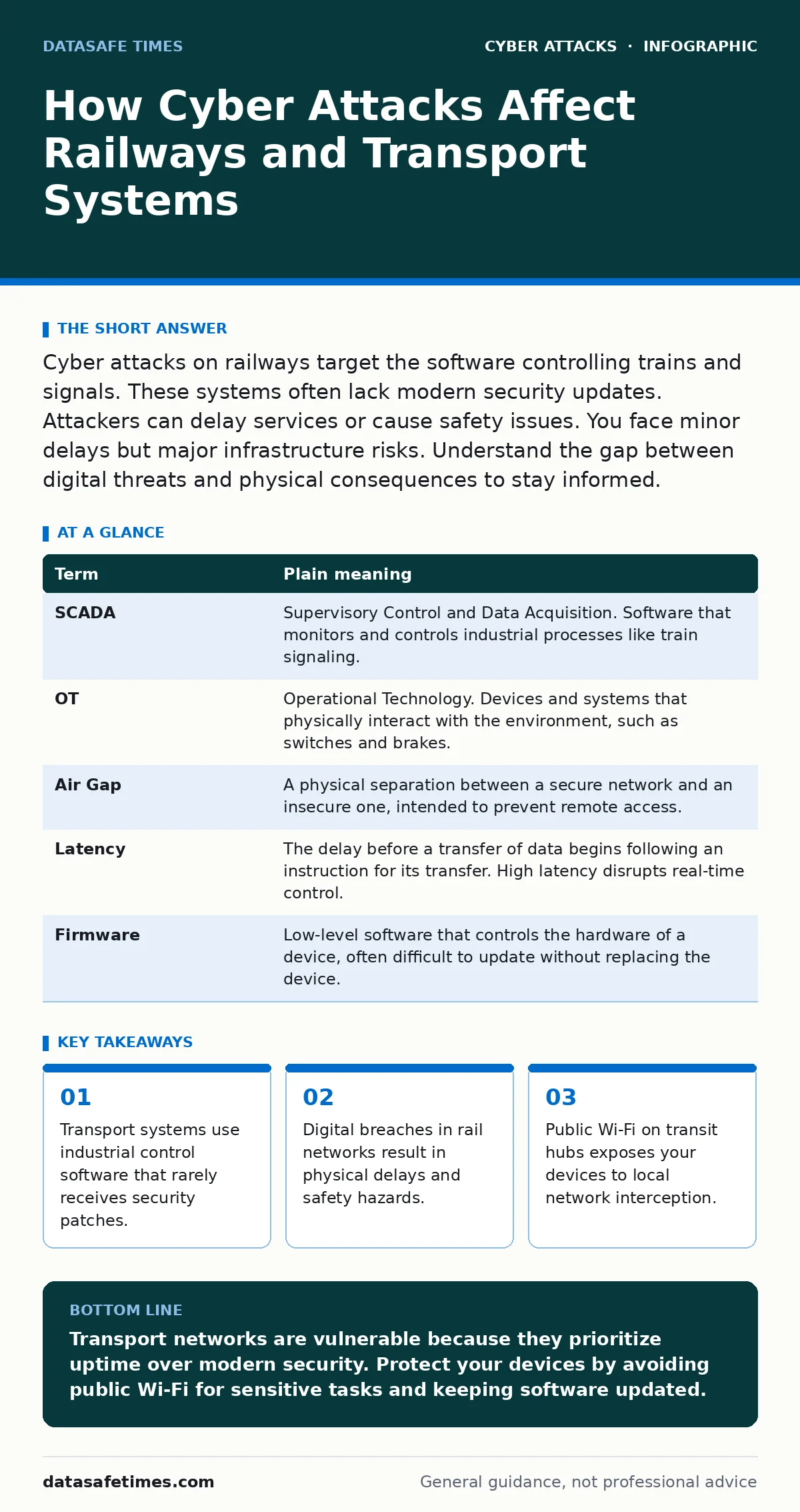
Cyber attacks on railways target the software controlling trains and signals. These systems often lack modern security updates. Attackers can delay services or cause safety issues. You face minor delays but major infrastructure risks. Understand the gap between digital threats and physical consequences to stay informed.
The Train Dispatch Analogy
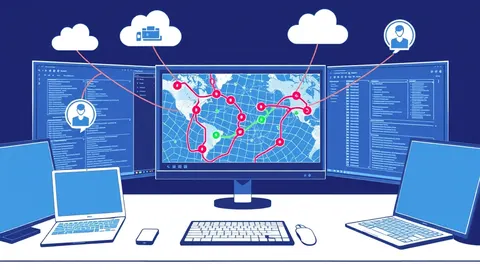
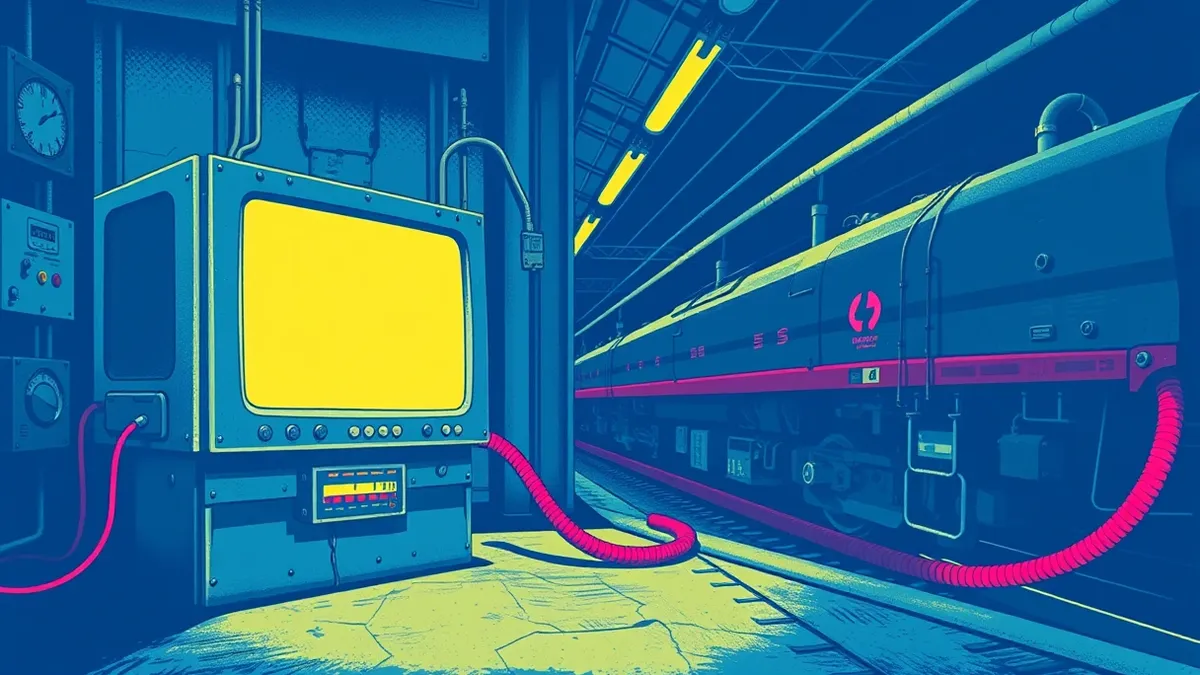
Imagine a railway network as a complex dispatch center. Operators use screens to move trains along tracks. The screens show where each train is located. The physical rails and signals handle the actual movement. A cyber attack targets the screens and the communication between them. It does not touch the steel tracks directly. The disruption happens because the operators cannot trust the information on their displays. They must stop trains to verify positions manually. This creates delays that ripple through the entire network. The physical infrastructure remains intact, but the coordination fails.
Key Terms in Transport Cybersecurity
Transport operators use specific technology that differs from standard office IT. Understanding these terms helps you see why attacks succeed. The systems are often older and designed for reliability, not security.
| Term | Plain meaning |
|---|---|
| SCADA | Supervisory Control and Data Acquisition. Software that monitors and controls industrial processes like train signaling. |
| OT | Operational Technology. Devices and systems that physically interact with the environment, such as switches and brakes. |
| Air Gap | A physical separation between a secure network and an insecure one, intended to prevent remote access. |
| Latency | The delay before a transfer of data begins following an instruction for its transfer. High latency disrupts real-time control. |
| Firmware | Low-level software that controls the hardware of a device, often difficult to update without replacing the device. |
Why Transport Systems Are Vulnerable
Railway systems prioritize uptime and safety over security. Engineers design these networks to run for decades without failure. They often run on operating systems that are no longer supported. These systems cannot be patched easily. A simple update might cause a signal to malfunction. This creates a trade-off. The operator chooses reliability over modern security standards. Attackers exploit this by finding old vulnerabilities that remain open. They do not need to hack the main control room. They can enter through a maintenance laptop or a connected sensor. This is similar to how botnet attacks compromise weak devices to form a larger network.
The Impact on Ordinary Users
You do not control the railway software, but you feel the effects. A successful attack may cause trains to stop unexpectedly. It may delay departures or cancel routes. The disruption is physical, not just digital. Your commute becomes longer and less predictable. You might also see increased security checks at stations. Operators may restrict access to staff areas. This reduces the risk of insider threats. For the average traveler, the main consequence is inconvenience. However, repeated disruptions erode trust in public transport. You may choose private vehicles, which increases traffic and pollution. The digital breach has a tangible environmental cost.
Safety Habits for Transit Users
You can protect your own devices while using transport networks. Public Wi-Fi on trains and in stations is often unsecured. Attackers can intercept data sent over these connections. Avoid logging into sensitive accounts on public networks. Use a mobile data connection instead. This creates a separate path for your traffic. It is harder for attackers to intercept. Also, be cautious when connecting to charging stations. Some ports can transfer data as well as power. Use a power-only cable or a personal battery pack. This prevents formjacking or other malware from installing on your device.
Try This Now
- Disable automatic Wi-Fi joining. Configure your device to ask before connecting to new networks. This stops your phone from joining open transit Wi-Fi without your permission.
- Use a VPN on public networks. A Virtual Private Network encrypts your traffic. This makes it difficult for attackers to read your data even if they intercept it.
- Check for software updates regularly. Keep your operating system and apps current. Many transport-related apps access your location or payment data. Updates fix known security holes.
The Hidden Cost of Security
Securing transport networks is expensive and difficult. Operators must balance safety with security. Adding firewalls to old systems can cause instability. They may need to replace entire control systems. This costs billions and takes years. During the transition, systems remain vulnerable. Attackers know this. They wait for the window of opportunity. This is why account lockout policies are often strict in operational environments. A wrong password could lock out a critical operator. The system prioritizes availability over strict access control. This creates a different risk profile than standard IT.
Understanding the Broader Threat
Transport attacks are not isolated incidents. They are part of a larger trend. Attackers target critical infrastructure to cause maximum disruption. They may use phishing simulations to train staff, but real attacks use sophisticated social engineering. Operators must educate their workforce. A single employee clicking a bad link can open the door. This is why email filtering is critical in these environments. It blocks malicious messages before they reach the user. However, filters are not perfect. Human error remains a significant risk. The combination of old technology and human factors creates a perfect storm.
What You Can Expect Next
Transport operators will continue to upgrade their systems. They will move toward more secure, modern architectures. This process is slow and gradual. You may see more digital signage and contactless payments. These bring new risks. Session cookie theft becomes a concern as you use more web-based ticketing systems. Keep your browser updated. Clear cookies regularly. Be aware that convenience often comes with a security trade-off. The goal is to balance ease of use with protection. You play a role by practicing good digital hygiene. Your habits reduce the overall attack surface.
Key takeaways
- Transport systems use industrial control software that rarely receives security patches.
- Digital breaches in rail networks result in physical delays and safety hazards.
- Public Wi-Fi on transit hubs exposes your devices to local network interception.
Transport networks are vulnerable because they prioritize uptime over modern security. Protect your devices by avoiding public Wi-Fi for sensitive tasks and keeping software updated.
Frequently asked questions
Can hackers stop a train from moving?
Directly stopping a train is difficult due to multiple safety layers. Attackers more commonly disrupt signaling, causing operators to halt trains manually for safety verification.
Are subway systems safer than long-distance rail?
Both face similar risks. Subways may have more localized control, but long-distance rail has more exposed infrastructure. Security depends on the operator's investment in modern systems.
Should I use my phone's hotspot on trains?
Using your mobile data as a hotspot is safer than public Wi-Fi. It keeps your traffic on the carrier's encrypted network. This reduces the risk of local interception.
How do operators detect cyber attacks?
They use intrusion detection systems and monitor network traffic for anomalies. However, detection is often delayed because these systems are not designed for real-time security monitoring.
How this guide was produced: written by the DataSafe Times editorial team with AI assistance, checked against the public references listed below, and reviewed when the facts change. See our editorial policy or report an error.