
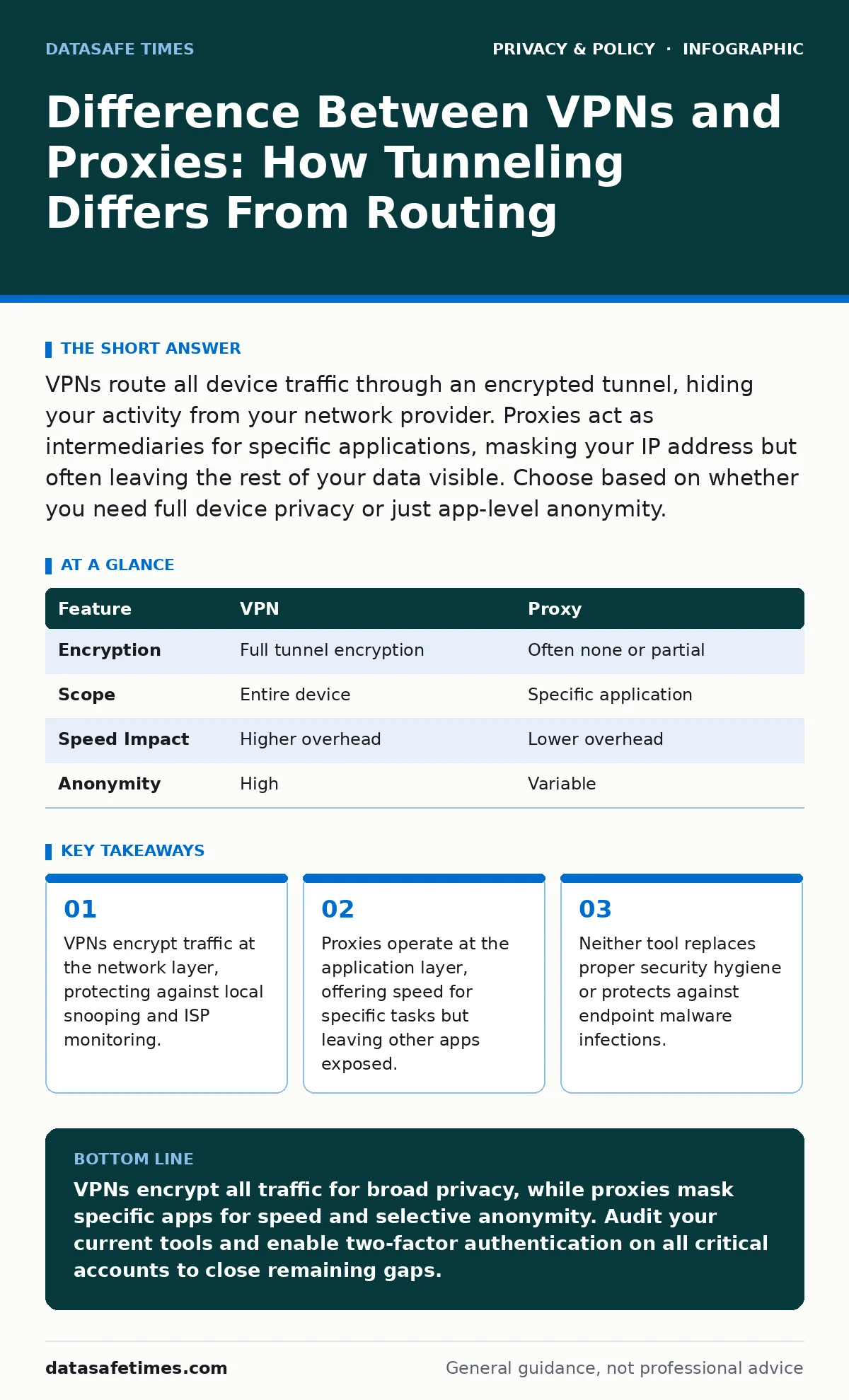
VPNs route all device traffic through an encrypted tunnel, hiding your activity from your network provider. Proxies act as intermediaries for specific applications, masking your IP address but often leaving the rest of your data visible. Choose based on whether you need full device privacy or just app-level anonymity.
What is the difference between vpns and proxies?
VPNs create an encrypted tunnel for all network traffic, while proxies act as a middleman for specific application requests. A Virtual Private Network operates at the network layer, encapsulating your data before it leaves your device. This means every app, browser, and system update sends traffic through the same secure path. A proxy server sits between you and the internet at the application layer. It forwards requests from a specific program, such as a web browser, but ignores traffic from other sources.
How do VPNs encrypt data differently from proxies?
VPNs use tunneling protocols to wrap your data in multiple layers of encryption, whereas proxies typically only mask your IP address. When you connect to a VPN, your device negotiates a secure session using standards like OpenVPN or WireGuard. The provider cannot read your content without the decryption key. Proxies often lack this encryption layer entirely. Standard HTTP proxies transmit data in plain text. Even HTTPS proxies only protect the connection between you and the proxy server, leaving the final leg to the destination potentially vulnerable if the proxy itself is untrusted.
Which tool hides your location more effectively?
VPNs provide consistent location masking across all applications, while proxies only hide the origin of specific requests. If you use a proxy for your browser, your video streaming app or game client still reveals your true IP address to its servers. This inconsistency creates a privacy leak. A VPN assigns a single exit IP to all outgoing traffic. Your ISP sees only encrypted packets destined for the VPN server. They cannot distinguish between a web search, a software update, or a file download. This uniformity prevents correlation attacks that might link different services to your real identity.
| Feature | VPN | Proxy |
|---|---|---|
| Encryption | Full tunnel encryption | Often none or partial |
| Scope | Entire device | Specific application |
| Speed Impact | Higher overhead | Lower overhead |
| Anonymity | High | Variable |
Why might a proxy feel faster than a VPN?
Proxies introduce less latency because they bypass the heavy processing required for full tunnel encryption. VPNs must encrypt and decrypt every packet, which consumes CPU cycles and adds computational delay. This overhead is noticeable when streaming high-bandwidth content or engaging in real-time gaming. Proxies simply forward packets. They do not need to establish complex cryptographic handshakes for every session. This efficiency makes proxies preferable for tasks like bulk data scraping or accessing a single resource quickly. You trade security for raw throughput.
Do VPNs protect you from all online tracking?
VPNs hide your traffic from your local network, but they do not stop end-to-end tracking by websites. When you visit a site, the server sees the IP address of the VPN exit node, not yours. However, the website can still use cookies, browser fingerprints, and account logins to identify you. Your VPN provider can also see your browsing history unless you use end-to-end encryption like Tor. For deeper analysis of how trackers follow you across sites, see our guide on online tracking. A VPN is only the first layer of defense, not a complete shield.
When should you choose a proxy over a VPN?
Use a proxy when you need to route specific application traffic through a different location without encrypting everything. Developers often use proxies to test how their applications perform in different regions. You might use a proxy to bypass geo-restrictions for a single video stream while keeping your financial transactions on your secure home network. This selective routing allows you to maintain direct connections for low-risk activities. It reduces the load on your device and avoids the privacy implications of trusting a VPN provider with all your data.
What are the hidden costs of using free proxy services?
Free proxies often log your activity and sell that data to third parties, creating a significant privacy risk. Unlike reputable VPN providers that may have strict no-logs policies, many free proxy operators monetize by harvesting user data. They can inject ads into your pages or redirect you to malicious sites. Some proxies are merely open proxies set up by attackers to harvest credentials. You gain anonymity from the destination site but lose it to the proxy owner. This trade-off makes free proxies dangerous for any activity involving personal information.
How do these tools interact with legal data requests?
Both VPNs and proxies are subject to legal jurisdiction, meaning authorities can compel them to hand over logs. If a provider stores connection logs, they can link an IP address to a specific user at a specific time. The difference lies in transparency. Proxies rarely provide this level of accountability. Understanding your rights regarding data collection is critical. See our section on legitimate interest under the GDPR for context on how companies justify data retention. Always verify the legal status of the provider before trusting them with sensitive traffic.
Can a VPN replace other security measures like two-factor authentication?
No, a VPN does not protect your accounts from being compromised if your credentials are stolen. A VPN secures the transmission channel, not the endpoints. If you enter your password on a phishing site, the VPN cannot prevent the attacker from receiving it. If malware on your device captures your keystrokes, the encryption tunnel does nothing to stop it. You must combine network security with account security. Implementing two-factor authentication for personal accounts adds a layer that remains effective even if your network traffic is intercepted.
What is the best practice for managing personal data online?
Combine a reputable VPN with strict application permissions and regular audits of your digital footprint. Use the VPN for public Wi-Fi and sensitive transactions. Disable it for trusted home networks to reduce latency. Regularly review which apps have access to your location and network data. Delete accounts you no longer use to minimize your exposure to data brokers. See our guide on personal data management for steps to remove your information from aggregator sites. Privacy is a continuous process, not a one-time setup.
Key takeaways
- VPNs encrypt traffic at the network layer, protecting against local snooping and ISP monitoring.
- Proxies operate at the application layer, offering speed for specific tasks but leaving other apps exposed.
- Neither tool replaces proper security hygiene or protects against endpoint malware infections.
VPNs encrypt all traffic for broad privacy, while proxies mask specific apps for speed and selective anonymity. Audit your current tools and enable two-factor authentication on all critical accounts to close remaining gaps.
Frequently asked questions
Can a VPN hide my activity from my employer?
If you connect to your employer's network before the VPN, they can see that you are using a VPN but not the content. They may block VPN traffic entirely. If you use your own mobile data, they cannot see your activity.
Do proxies bypass geo-blocking better than VPNs?
Proxies can bypass simple IP-based blocks faster, but many services detect and block known proxy IPs. VPNs often have more robust infrastructure to rotate IPs and avoid detection.
Is it legal to use a VPN or proxy?
In most countries, using these tools is legal. However, some nations restrict or ban their use. Always check local laws before connecting, as violating them can result in fines or legal action.
Can I use a proxy for banking?
You should avoid using proxies for banking. They often lack the encryption needed to protect sensitive financial data. Use a secure, direct connection or a reputable VPN with strong encryption standards.
How this guide was produced: written by the DataSafe Times editorial team with AI assistance, checked against the public references listed below, and reviewed when the facts change. See our editorial policy or report an error.