
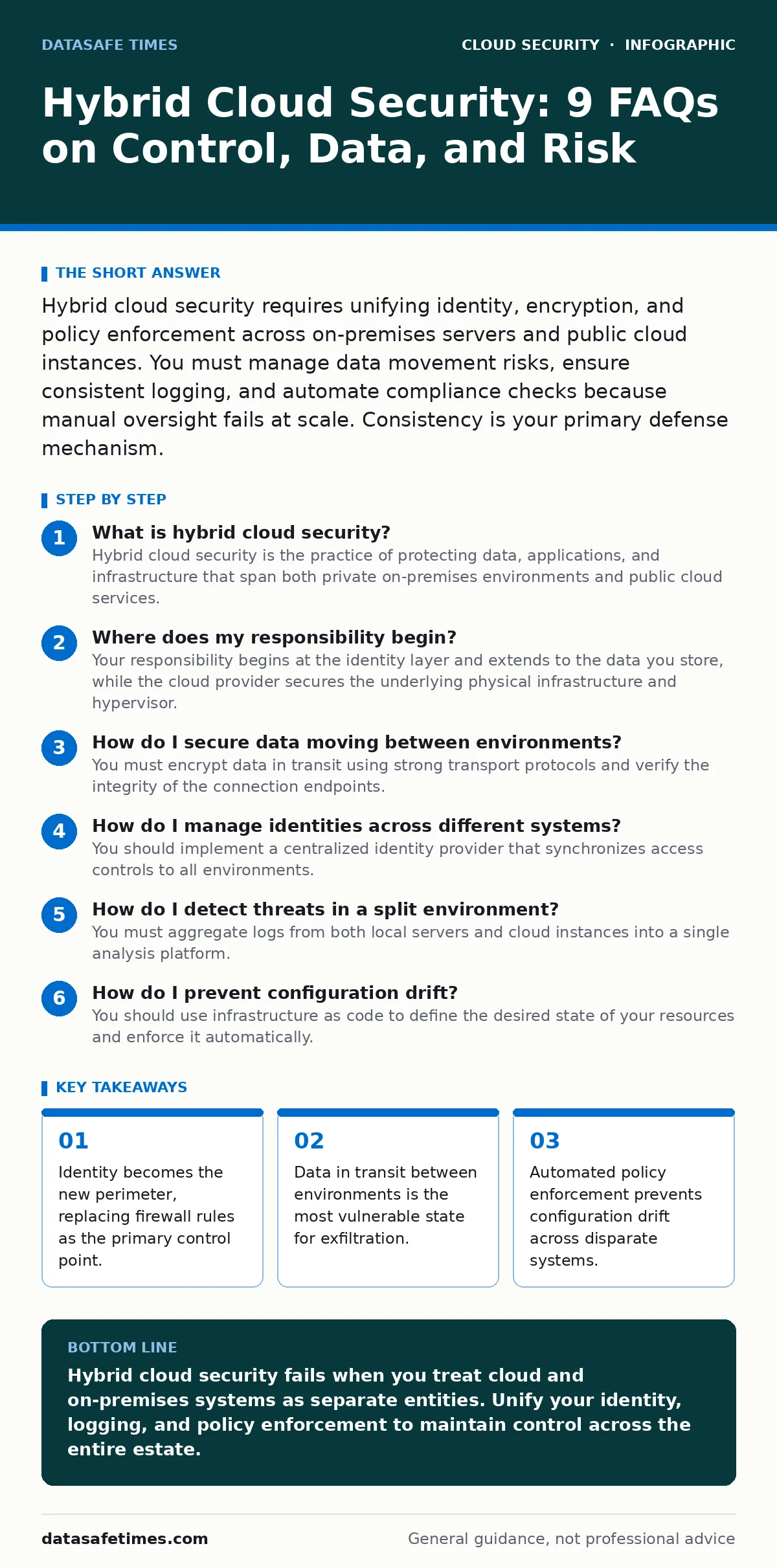
Hybrid cloud security requires unifying identity, encryption, and policy enforcement across on-premises servers and public cloud instances. You must manage data movement risks, ensure consistent logging, and automate compliance checks because manual oversight fails at scale. Consistency is your primary defense mechanism.
What is hybrid cloud security?
Hybrid cloud security is the practice of protecting data, applications, and infrastructure that span both private on-premises environments and public cloud services. It requires a unified strategy because threats do not respect the boundary between your data center and the cloud provider. You must ensure that security policies apply consistently regardless of where a workload resides.
Where does my responsibility begin?
Your responsibility begins at the identity layer and extends to the data you store, while the cloud provider secures the underlying physical infrastructure and hypervisor. This division is defined by the shared responsibility model. You are responsible for securing the guest operating systems, network configurations, and application logic. Misunderstanding this boundary leads to gaps where neither party assumes control.
How do I secure data moving between environments?
You must encrypt data in transit using strong transport protocols and verify the integrity of the connection endpoints. Data moving from an on-premises server to a cloud instance is exposed to interception risks. Use mutual TLS, where both client and server present certificates, to ensure that the receiving end is authenticated. This prevents man-in-the-middle attacks during replication or backup processes.
How do I manage identities across different systems?
You should implement a centralized identity provider that synchronizes access controls to all environments. Users and service accounts need single sign-on capabilities to reduce credential sprawl. This approach ties directly into cloud identity governance, ensuring that access rights are reviewed and revoked consistently. Without a single source of truth, orphaned accounts in one environment become a persistent vulnerability.
How do I detect threats in a split environment?
You must aggregate logs from both local servers and cloud instances into a single analysis platform. Fragmented logging makes it difficult to trace an attack that moves laterally from a compromised workstation to a cloud database. This integration is the foundation of effective cloud logging and monitoring. You need to correlate events across boundaries to identify patterns that single-environment tools miss.
See also: Cloud Attack Surface Explained: Mapping Your Hidden Exposure · Cloud Security Posture Management: 6 Common Misunderstandings
How do I prevent configuration drift?
You should use infrastructure as code to define the desired state of your resources and enforce it automatically. Manual changes to cloud instances or local servers often introduce security misconfigurations that diverge from your baseline. Regular audits compare the current state against the code repository to identify and remediate differences. This process reduces the risk of human error introducing open ports or weak permissions.
How do I protect secrets in hybrid deployments?
You must store credentials, API keys, and certificates in a dedicated secrets manager rather than in code or configuration files. Hardcoded secrets are easily exposed through version control leaks or unauthorized access to build servers. The secrets manager injects credentials at runtime, ensuring they never persist on disk. This practice minimizes the blast radius if a single server is compromised.
How do I enforce network segmentation?
You should treat each environment as untrusted and require explicit allow-lists for traffic flow between them. Default deny rules ensure that only necessary communication paths are open. This strategy complements cloud vulnerability management by limiting the ability of an attacker to move laterally after exploiting a single vulnerability. You must also monitor for unusual traffic patterns that indicate scanning or enumeration attempts.
How do I ensure compliance across boundaries?
You must automate compliance checks that validate configurations against regulatory frameworks in real-time. Manual audits are too slow to catch drift in dynamic cloud environments. Tools like cloud access security brokers (CASB) can monitor data flows and enforce policies such as data loss prevention. These brokers sit between users and cloud services, inspecting traffic for policy violations before data leaves your control.
| Control Area | On-Premises Focus | Cloud Focus | Unified Strategy |
|---|---|---|---|
| Identity | Active Directory | Cloud IAM | Federated Identity |
| Data | Bitlocker/Encryption | KMS/Envelope | Centralized Key Mgmt |
| Network | Firewalls/ACLs | Security Groups | Zero Trust Networking |
| Monitoring | SIEM Agents | Cloud Trail | Unified Log Aggregation |
Key takeaways
- Identity becomes the new perimeter, replacing firewall rules as the primary control point.
- Data in transit between environments is the most vulnerable state for exfiltration.
- Automated policy enforcement prevents configuration drift across disparate systems.
Hybrid cloud security fails when you treat cloud and on-premises systems as separate entities. Unify your identity, logging, and policy enforcement to maintain control across the entire estate.
Frequently asked questions
Is hybrid cloud security harder than pure cloud?
Yes, because you must manage two distinct infrastructure stacks with different tooling and security models while maintaining a consistent security posture.
Can I use the same firewall for hybrid setups?
Traditional firewalls are insufficient. You need a combination of on-premises firewalls and cloud-native security groups, coordinated by a zero-trust architecture.
How often should I rotate access keys?
Access key rotation** should be automated and frequent. Long-lived keys increase the risk of compromise, so rotate them before expiration using automated scripts.
Does encryption replace the need for access controls?
No. Encryption protects data if it is stolen, but access controls prevent unauthorized users from accessing it in the first place. Both are necessary layers of defense.
How this guide was produced: written by the DataSafe Times editorial team with AI assistance, checked against the public references listed below, and reviewed when the facts change. See our editorial policy or report an error.