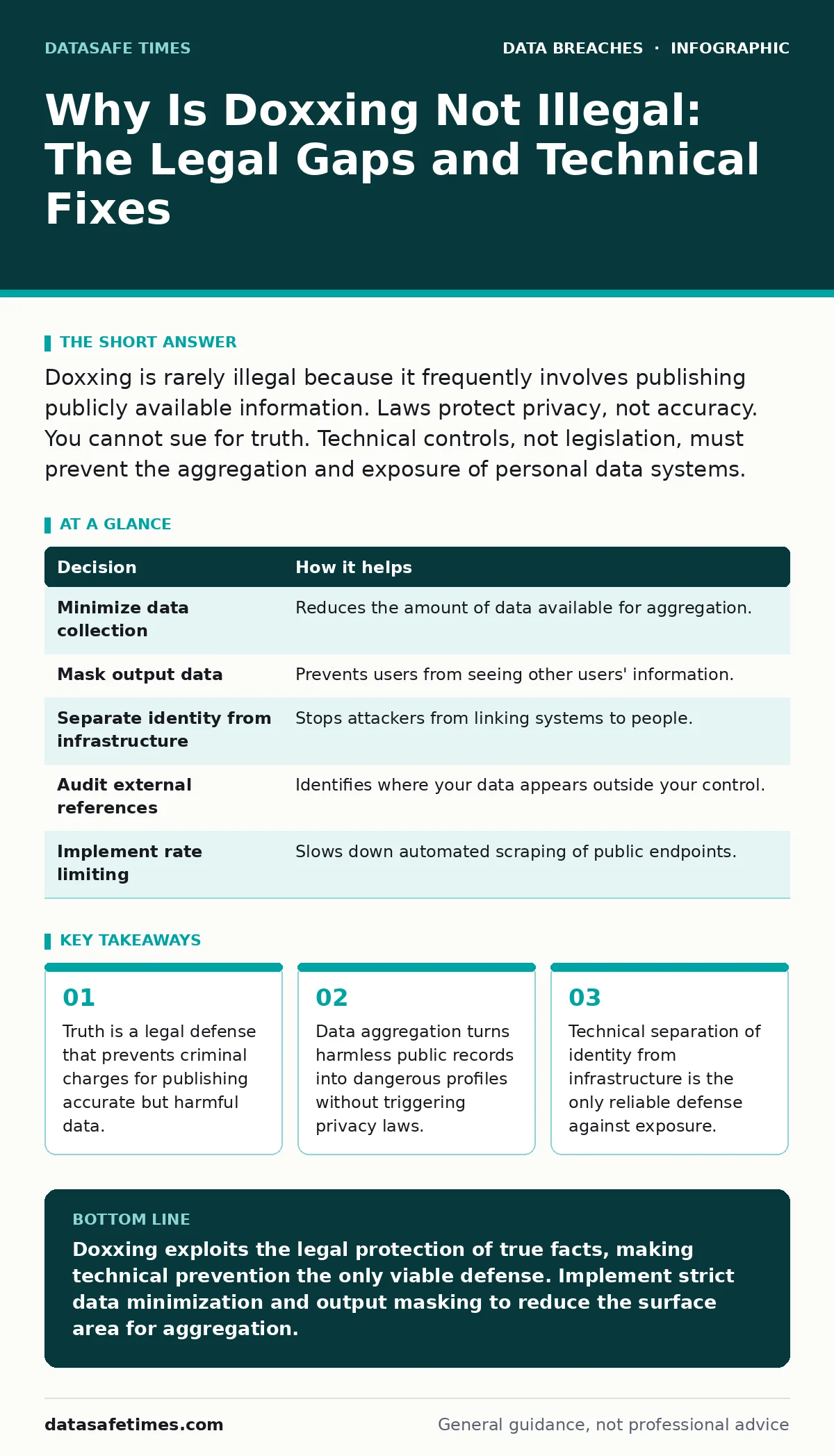
Doxxing is rarely illegal because it frequently involves publishing publicly available information. Laws protect privacy, not accuracy. You cannot sue for truth. Technical controls, not legislation, must prevent the aggregation and exposure of personal data systems.
Why Is Doxxing Not Illegal
Doxxing is not broadly illegal because it often consists of publishing information that is already public. The law distinguishes between stealing data and revealing data. If a person finds your home address in a public voter registry and posts it online, they have committed no crime in most jurisdictions. The act of aggregation is not theft. The act of publication is often protected speech.
This legal gap exists because legislatures struggle to define the boundary between legitimate journalism and harassment. Courts generally refuse to criminalize the publication of true facts. This creates a blind spot for security teams who assume legal recourse exists. It does not. You must design systems that assume your data will be published.
The Aggregation Problem
The real danger lies in data aggregation. Single data points are harmless. A phone number is trivial. An email address is common. When these points combine, they create a complete identity. This process is called doxxing. The attacker does not need to hack a server. They need to scrape multiple public sources. This is why database security is insufficient on its own.
Even if your internal systems are secure, external data exists. You cannot control what others publish. You can only control what you expose. The aggregation happens outside your perimeter. It happens on social media, forums, and data broker sites. This external reality means your defense must be proactive, not reactive.
Legal Definitions and Limits
Privacy laws protect sensitive categories of data. Health records, financial accounts, and government IDs have specific protections. General personal information does not. This distinction is critical. If an attacker publishes your email and username, no privacy law is broken. If they publish your credit card number, federal laws may apply. Most doxxing involves the former.
This is why payment card theft is prosecuted while doxxing is ignored. The legal system prioritizes financial harm over reputational harm. You cannot rely on legal action to stop doxxing. You must rely on architectural decisions. Your system must not leak enough data to allow aggregation. This requires strict output filtering. It requires careful error message design.
Technical Exposure Vectors
Attackers find data through several technical vectors. One common vector is misconfigured cloud storage. Buckets left public allow anyone to list files. Another vector is verbose error messages. These messages often reveal internal paths, user IDs, or email formats. A third vector is source code repositories. Developers accidentally commit configuration files containing credentials.
These files are indexed by search engines. Attackers use these indexes to find targets. This is a form of data exfiltration that happens without active exploitation. It happens through negligence. Your code must never contain personal data. Your error messages must never reveal internal structure. Your storage must never be public by default.
The Cost of Exposure
Exposure carries hidden costs. The immediate cost is harassment. The long-term cost is identity erosion. Once data is public, it persists. Search engines cache it. Archives copy it. Removal requests are slow and often denied. This persistence means the damage is permanent. For organizations, this leads to reputational decay. Users lose trust when their data is visible.
This loss of trust is harder to recover than a financial loss. It affects customer retention. It affects brand value. This is why third-party data breaches are so damaging. The breach is not the leak. The breach is the loss of control over narrative. You cannot control what is published. You can only control what is available to be published.
See also: Digital Privacy Laws: How Rules Shape Data Collection
Contrast: Two Approaches
Imagine two teams handling user data. Team A stores full names and emails in public-facing APIs. They assume users will not abuse this. Team B stores only hashes and IDs. They map identities internally. Team A suffers when an attacker scrapes their API. Team B suffers no exposure because the data is not there. Team A tries to sue the attacker. The lawsuit fails because the data was public. Team B has no lawsuit to file. They have no problem. This difference is architectural. It is not about luck. It is about design. Team B understands that public data is public. They do not rely on trust. They rely on separation.
Decision Framework
You must make specific decisions about data exposure. Each decision has a trade-off. Convenience often conflicts with security. You must choose security. The table below outlines common decisions and their impact.
| Decision | How it helps |
|---|---|
| Minimize data collection | Reduces the amount of data available for aggregation. |
| Mask output data | Prevents users from seeing other users' information. |
| Separate identity from infrastructure | Stops attackers from linking systems to people. |
| Audit external references | Identifies where your data appears outside your control. |
| Implement rate limiting | Slows down automated scraping of public endpoints. |
Operationalizing Privacy
You must operationalize privacy through code. Use secure data disposal practices for logs. Logs often contain personal data. If logs are accessible, data is exposed. Rotate keys regularly. Use short-lived tokens. These measures reduce the window of exposure. Monitor for insider data theft as well. Insiders can export data intentionally. Technical controls must apply to all users. This includes administrators. No user should have unnecessary access. This principle is called least privilege. It applies to data access. It applies to system access. It applies to everything.
The Role of Verification
Verification adds a layer of protection. Two-factor authentication prevents account takeover. Account takeover is a common first step in doxxing. If an attacker controls your account, they can access your data. Verification stops this. It does not stop publication. It stops the initial access. This is a critical distinction. Verification protects the asset. It does not protect the reputation. You need both. You need technical controls to protect the asset. You need legal and PR strategies to manage reputation. But the technical control is the first line. It is the only line that works consistently.
Digital Forensics and Response
When exposure occurs, you need digital forensics to understand the scope. Did the data come from your systems? Or from external sources? This distinction matters. If it came from your systems, you have a technical failure. If it came from external sources, you have a public relations challenge. Forensics helps you determine the source. It helps you identify the vector. It helps you fix the root cause. Without forensics, you are guessing. Guessing leads to incomplete fixes. Incomplete fixes lead to repeat exposure. You must investigate every incident thoroughly. You must document every finding. You must update your controls based on findings.
Misdirected Information
Sometimes exposure happens through misdirected emails. An employee sends data to the wrong recipient. This is human error. It is not a technical failure. But it is still exposure. You must train employees on data handling. You must implement email scanning tools. These tools catch errors before they leave the organization. This is a basic control. It is often ignored. It is easy to implement. It prevents many incidents. Do not ignore it. Human error is inevitable. Technical controls can mitigate it. You must use them.
Final Considerations
Doxxing is not illegal because it uses true information. The law protects truth. It does not protect privacy in the public sphere. You cannot change the law. You can change your systems. You must design for exposure. You must assume your data will be published. You must minimize what is available. You must separate identity from infrastructure. You must verify access. You must monitor for leaks. You must respond quickly. This is the only path. It is not easy. It is necessary. The alternative is exposure. Exposure is permanent. Prevention is the only option.
Key takeaways
- Truth is a legal defense that prevents criminal charges for publishing accurate but harmful data.
- Data aggregation turns harmless public records into dangerous profiles without triggering privacy laws.
- Technical separation of identity from infrastructure is the only reliable defense against exposure.
Doxxing exploits the legal protection of true facts, making technical prevention the only viable defense. Implement strict data minimization and output masking to reduce the surface area for aggregation.
Frequently asked questions
Can I sue someone for doxxing me?
Only if they stole data or published false information. Publishing true, public facts is generally legal and protected speech.
Does GDPR stop doxxing?
GDPR regulates data processing, not publication. It helps you request removal, but it does not criminalize the act of posting public data.
How do I remove doxxed data?
Contact the hosting platform for takedown. Contact search engines for de-indexing. Legal removal is difficult and often unsuccessful.
Is doxxing a crime in the US?
No federal law criminalizes doxxing. Some states have harassment laws, but they require proof of threat or intent, not just publication.
How this guide was produced: written by the DataSafe Times editorial team with AI assistance, checked against the public references listed below, and reviewed when the facts change. See our editorial policy or report an error.