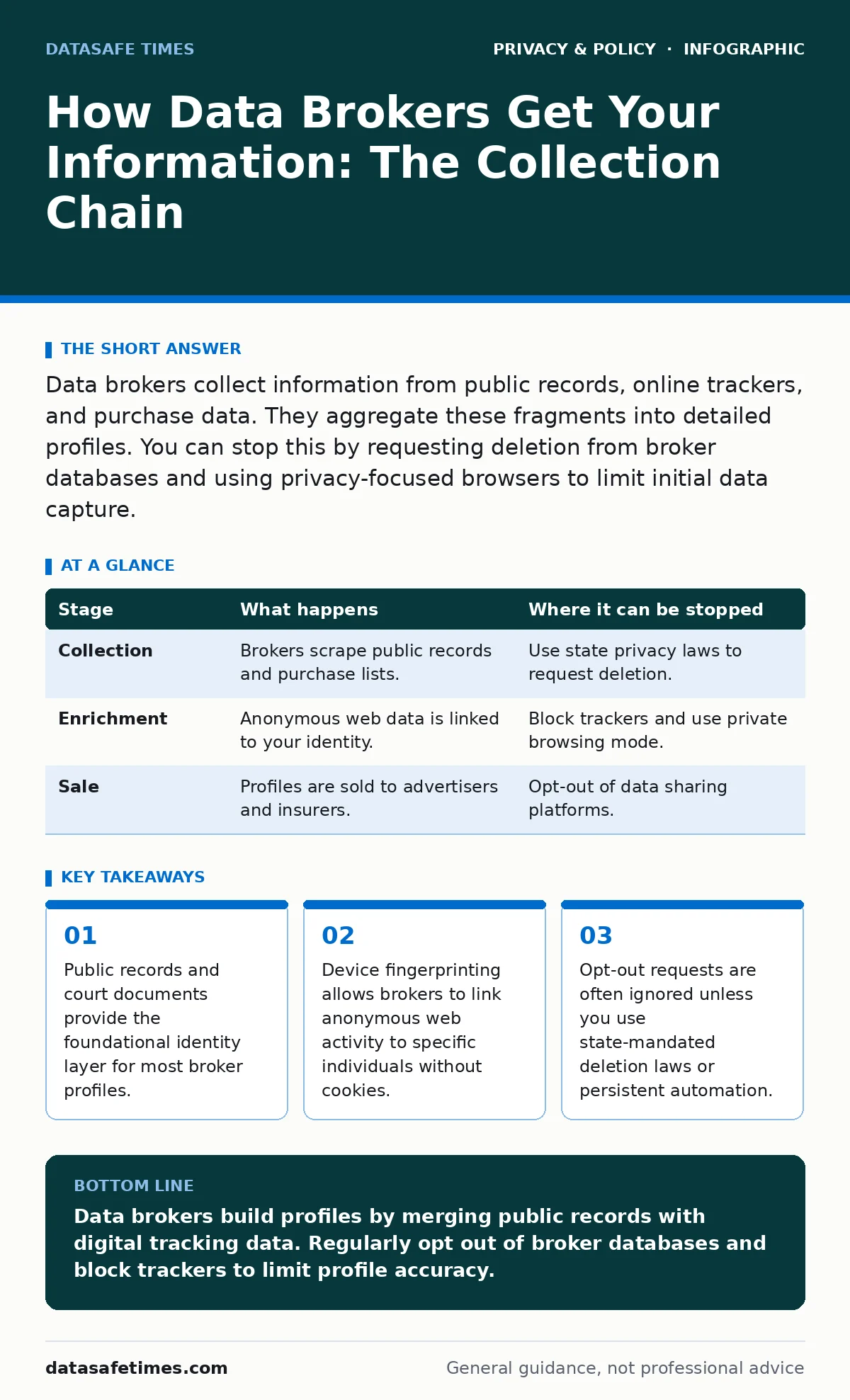
Data brokers collect information from public records, online trackers, and purchase data. They aggregate these fragments into detailed profiles. You can stop this by requesting deletion from broker databases and using privacy-focused browsers to limit initial data capture.
How Data Brokers Get Your Information
Data brokers acquire personal information through three primary channels: public records, digital footprints, and third-party data sharing. They do not typically steal data. Instead, they purchase or scrape information that is legally available. The process begins with identifying you. Once identified, they map your habits, location, and financial status. This aggregation creates a sellable product.
The initial identification relies on stable identifiers. Your name, address, and birth date are static. Brokers use these to anchor transient data points. A search for "how do data brokers get your information" reveals that the source is rarely a single hack. It is usually a combination of open sources.
Stage 1: Public Record Aggregation
Brokers start with government data. Vital records, property deeds, and court filings are public. These documents contain your full name, date of birth, and residential history. Brokers scrape these websites daily. They cross-reference names to eliminate duplicates.
This stage creates a baseline identity. It confirms where you live and own assets. You cannot delete these records from government servers. However, you can prevent brokers from republishing them. Many states require brokers to delete consumer data upon request.
| Stage | What happens | Where it can be stopped |
|---|---|---|
| Collection | Brokers scrape public records and purchase lists. | Use state privacy laws to request deletion. |
| Enrichment | Anonymous web data is linked to your identity. | Block trackers and use private browsing mode. |
| Sale | Profiles are sold to advertisers and insurers. | Opt-out of data sharing platforms. |
Stage 2: Digital Footprint Mapping
Once your identity is anchored, brokers map your behavior. They use tracking scripts on websites and apps. These scripts record your clicks, scroll depth, and time spent on pages. This data is sold to ad networks.
Device fingerprinting is the hidden mechanism here. Even if you clear cookies, your browser configuration, screen resolution, and installed fonts create a unique signature. This signature links your anonymous browsing to your known identity.
Stage 3: Data Enrichment and Profiling
Brokers merge disparate data sources. They might combine your public record with your purchase history. If you buy baby products, the profile updates to reflect parenthood. If you visit travel sites, your travel intent score rises.
This enrichment happens in bulk. Algorithms guess your income, political leaning, and health conditions. The accuracy varies. Errors propagate when one wrong data point corrupts the whole profile. You rarely see these errors until they affect credit or insurance decisions.
Stage 4: Distribution and Monetization
The final stage is sale. Brokers sell access to their databases. They do not usually sell raw files. They provide an API for real-time lookups. An advertiser queries your profile to decide if you should see a specific ad.
This distribution is continuous. Your profile updates in near-real-time. If you delete data from one broker, another may refill it from a different source. This creates a whack-a-mole dynamic for privacy protection.
The Mechanics of Identity Resolution
Identity resolution is the core technical challenge for brokers. A device ID is not a name. Brokers must bridge this gap. They use probabilistic matching. If a device with a specific fingerprint logs into a bank account, the broker assumes that device belongs to that account holder.
This assumption is fragile. Shared Wi-Fi networks cause false positives. If you connect to public Wi-Fi risks, your device may inherit the identity of previous users. Brokers may attribute another person’s shopping habits to you.
Where the Pipeline Breaks
The broker pipeline fails at points of friction. Opt-out processes are designed to be difficult. They require navigating multiple websites, filling out forms, and waiting for verification. This friction causes most people to abandon the process.
Technical controls help. Blocking third-party cookies reduces the data available for enrichment. Using encrypted cloud storage for personal files prevents accidental leaks. However, these measures only limit new data. They do not remove existing profiles.
Legal and Technical Countermeasures
State laws like the California Consumer Privacy Act give you the right to delete your data. You can request that brokers stop selling your information. This is not a ban on collection. Brokers can still collect data for their own use.
Technical tools provide additional layers. A VPN masks your IP address. This makes IP-based profiling harder. However, device fingerprinting remains effective. You must combine network-level privacy with application-level blocking.
Consider the legitimate interest under the GDPR if you are in Europe. Brokers may claim they have a legitimate interest in processing your data. You can contest this interest. The burden of proof shifts to the broker.
The Hidden Cost of Data Sharing
Many apps share data as a condition of use. The privacy policy often hides this in dense text. You trade data for free services. The broker receives this data via SDKs (software development kits) embedded in apps.
This sharing is often irreversible. Once data leaves the app, the developer loses control. The broker aggregates it with other sources. You cannot retract data that has been merged into a larger dataset.
Long-Term Privacy Management
Privacy is not a one-time fix. It requires ongoing maintenance. Brokers refresh their databases frequently. Your opt-out status may expire. You must periodically verify your deletion requests.
Automated tools can help manage this. Some services scan broker databases and submit deletion requests on your behalf. This reduces the manual labor. It does not guarantee complete removal.
For financial data, consider two-factor authentication for personal accounts. This prevents unauthorized access to your sensitive information. It does not stop brokers from scraping public financial records.
Smart home privacy risks add another layer. Voice assistants and connected devices collect ambient data. This data can be sold to brokers. Check the privacy settings of your smart devices. Disable data sharing where possible.
Final Considerations
You cannot stop all data collection. The internet is built on data exchange. You can reduce the surface area. Use privacy-focused browsers. Block trackers. Request deletion regularly.
The goal is not invisibility. It is control. By understanding the mechanism, you can make informed choices. You decide which data points are worth sharing. You limit the rest.
Key takeaways
- Public records and court documents provide the foundational identity layer for most broker profiles.
- Device fingerprinting allows brokers to link anonymous web activity to specific individuals without cookies.
- Opt-out requests are often ignored unless you use state-mandated deletion laws or persistent automation.
Data brokers build profiles by merging public records with digital tracking data. Regularly opt out of broker databases and block trackers to limit profile accuracy.
Frequently asked questions
Can I completely remove my data from all data brokers?
No. While you can request deletion from many brokers, some may retain data for legal compliance or refuse to delete it. New data will also be collected over time.
Do data brokers sell my data to criminals?
Brokers sell data to legitimate businesses. Criminals may hack these databases, but brokers do not intentionally sell to illicit actors. The risk is from breaches, not direct sales.
Is it legal for data brokers to collect my data?
In many jurisdictions, it is legal. Laws vary by region. Some states and countries require consent or offer opt-out rights. Check your local privacy laws.
How often should I check my data broker profiles?
Check annually or after major life events. Life events like moving or marriage generate new public records. These updates trigger new data collection.
How this guide was produced: written by the DataSafe Times editorial team with AI assistance, checked against the public references listed below, and reviewed when the facts change. See our editorial policy or report an error.