
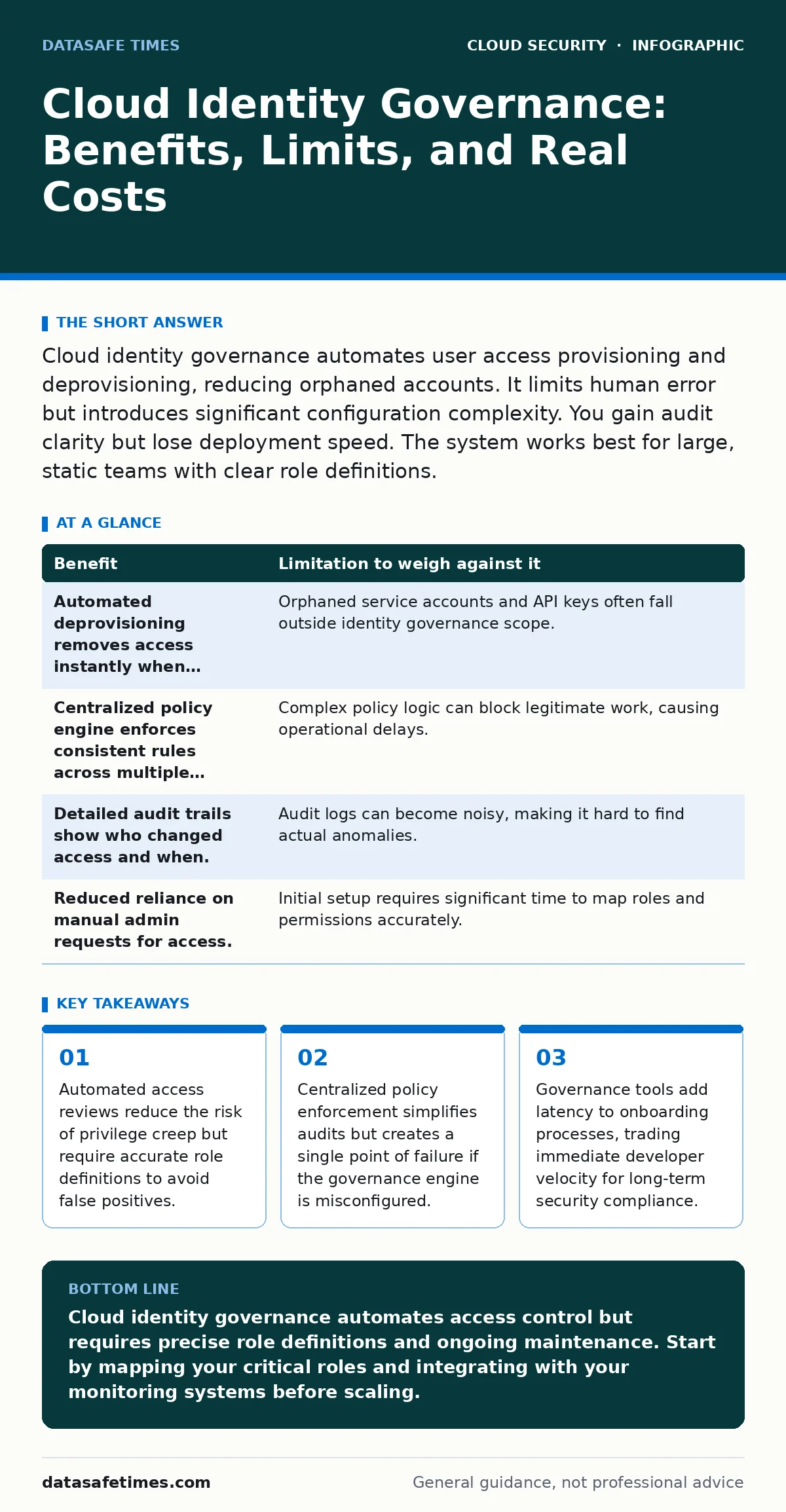
Cloud identity governance automates user access provisioning and deprovisioning, reducing orphaned accounts. It limits human error but introduces significant configuration complexity. You gain audit clarity but lose deployment speed. The system works best for large, static teams with clear role definitions.
The Mechanism of Access Control
Cloud identity governance manages the lifecycle of digital identities across cloud services. It ensures that users have the correct permissions at the correct time. The system relies on a central directory that syncs with cloud providers. When a user joins or leaves, the governance engine updates access rights automatically.
This process removes manual steps from provisioning. You define roles, and the system assigns permissions based on those roles. If a role changes, the permissions update instantly. This reduces the window where a user retains access they no longer need.
The core value lies in consistency. Manual processes vary by administrator. Automated governance applies the same rules every time. This consistency is what auditors look for.
The Hidden Cost of Complexity
Implementing governance requires defining roles with precision. You must map every job function to a specific set of permissions. This mapping is difficult in dynamic environments. Cloud services add new features constantly. Each new feature may introduce new permissions.
If your role definitions are too broad, you violate the principle of least privilege. If they are too narrow, users cannot do their jobs. You end up creating "super roles" that contain excessive permissions. This defeats the purpose of governance.
You also face the problem of transitive permissions. In many cloud platforms, permissions can be inherited through groups or service accounts. A governance tool might not see these indirect paths. You may think a user has no access, but they inherit it through a group membership you missed.
Benefits and Limitations Table
| Benefit | Limitation to weigh against it |
|---|---|
| Automated deprovisioning removes access instantly when employees leave. | Orphaned service accounts and API keys often fall outside identity governance scope. |
| Centralized policy engine enforces consistent rules across multiple clouds. | Complex policy logic can block legitimate work, causing operational delays. |
| Detailed audit trails show who changed access and when. | Audit logs can become noisy, making it hard to find actual anomalies. |
| Reduced reliance on manual admin requests for access. | Initial setup requires significant time to map roles and permissions accurately. |
The Gap Between Identity and Secrets
Identity governance focuses on human users and their accounts. It does not manage secrets. Secrets are passwords, tokens, and keys used by applications. These secrets often reside in secrets managers.
A governance tool can ensure a developer has access to the secrets manager. It cannot ensure the secrets themselves are rotated or valid. You need a separate process for access key rotation. If you rely only on identity governance, your application secrets may remain static for years.
This gap is critical. An attacker who compromises a long-lived secret can bypass identity controls. The identity was valid, but the secret was stolen. You must treat secrets management as a distinct layer.
When It Is Worth It
Governance is worth it when your organization has high turnover. If people leave frequently, manual reclamation of access is risky. Automation ensures that access is removed immediately. This reduces the risk of former employees accessing data.
It is also worth it for regulated industries. Auditors require proof of access reviews. Manual reviews are hard to document. Automated systems generate the necessary reports. This saves hours of manual effort during audit seasons.
If you use multiple cloud providers, governance becomes more valuable. Each provider has its own access model. A central governance layer normalizes these differences. You manage one set of policies instead of many. This simplifies your security posture.
See also: Insider Threat Mistakes That Expose Your Data and How to Fix Them · Role Based Access Control vs ACL: The Structural Difference
When It Is Not Worth It
Governance is not worth it for small teams with stable membership. If you have ten developers who rarely change roles, the overhead is unjustified. The time spent configuring roles exceeds the time saved by automation.
It is also not worth it if your cloud environment is ephemeral. If you spin up and destroy resources daily, static role definitions become obsolete. Your governance rules may block legitimate temporary access. You end up fighting your own system.
In these cases, simpler measures work better. Focus on MFA for cloud accounts and basic group management. Do not build a complex governance engine for a simple problem.
Integration with Monitoring
Governance sets the rules. Monitoring checks if the rules are followed. You need cloud logging and monitoring to detect violations. If a user accesses a resource they should not, the logs will show it.
Governance tools can trigger alerts based on these logs. If an access review fails, the system can disable the account. This creates a feedback loop. Governance enforces policy, and monitoring verifies enforcement.
This integration requires careful setup. You must ensure that logs are complete and accurate. Missing logs lead to blind spots. You cannot govern what you cannot see.
The Shared Responsibility Reality
Cloud providers secure the infrastructure. You secure the identity. This is part of the shared responsibility model. Governance is your responsibility. The provider cannot fix your permission errors.
You must also consider hybrid cloud security. If you have on-premises systems, your governance tool must sync with them. Identity fragmentation is a major risk. A user may be disabled in the cloud but still active on-premises.
You need a unified identity strategy. Governance tools help bridge this gap. They ensure that identity changes propagate everywhere. This prevents shadow access.
Key takeaways
- Automated access reviews reduce the risk of privilege creep but require accurate role definitions to avoid false positives.
- Centralized policy enforcement simplifies audits but creates a single point of failure if the governance engine is misconfigured.
- Governance tools add latency to onboarding processes, trading immediate developer velocity for long-term security compliance.
Cloud identity governance automates access control but requires precise role definitions and ongoing maintenance. Start by mapping your critical roles and integrating with your monitoring systems before scaling.
Frequently asked questions
Does identity governance replace MFA?
No. Identity governance manages access rights. MFA verifies user identity. You need both to secure accounts. Governance cannot prevent password theft.
Can governance tools manage service accounts?
Some can, but often poorly. Service accounts have different lifecycle needs. Treat them separately with automated key rotation.
How long does implementation take?
It depends on your complexity. Simple setups take weeks. Complex multi-cloud environments take months. Start small to validate your approach.
What happens if the governance tool fails?
Access may not update automatically. You need manual fallback procedures. Ensure your admins know how to revoke access manually during outages.
How this guide was produced: written by the DataSafe Times editorial team with AI assistance, checked against the public references listed below, and reviewed when the facts change. See our editorial policy or report an error.